Tag: film festival

  • Harold Ramis Shares Some Words of Wisdom About Film’s Future

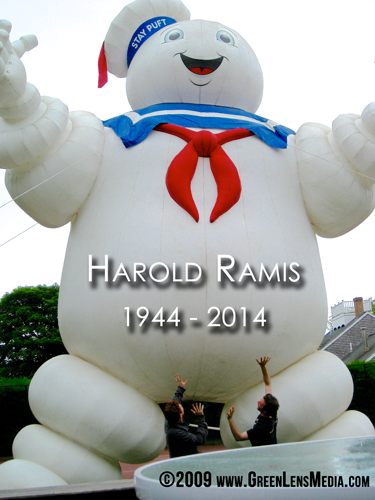
    Mr. Stay Puft lives again during the 25th Anniversary screening of Ghostbusters at the 2009 Nantucket Film Festival
    Mr. Stay Puft lives again during the 25th Anniversary screening of Ghostbusters at the 2009 Nantucket Film Festival
    What a blow. By now you’ve probably heard Harold Ramis, the force behind such movies as Caddyshack, Ghostbusters, Groundhog Day, and Analyze This, has passed at the age of 69. In honor of his legacy, I thought I would skip the circumstances of his death and the array of films he gave us, which you undoubtedly already know by now, and instead tell you an inspirational story of my brief interaction with him at the Nantucket Film Festival in 2009.

    The highlight of the festival that year had to have been Ramis himself, who was in attendance for three main reasons: to receive the Screenwriter’s Tribute, to premiere his new film Year One, and to celebrate the 25th anniversary of Ghostbusters. As someone who grew up with Ghostbusters, was completely transfixed by the multilayered themes and messages of one of my all time favorites Groundhog Day, and depended on Analyze This for more than one DVD date night, it was a particularly meaningful few days for me.

    First of all, I was tasked to be on the team blowing up the actual 25 foot Stay Puft Marshmallow Man that was used to market Ghostbusters when it premiered in 1984. Come on—does it get any cooler than that? This float dominated the skies, and stared out at the Atlantic from Siasconset’s Casino theater on the south side of the island. Getting Mr. Stay Puft to cooperate was a challenge, but somehow the group was able to cross the streams and get him into his new 2009 role as Mr. Stay Put. As guests arrived for a special screening of a brand new 35mm print of the film, he greeted them to their awe and delight.

    I met Ramis during the screening of Year One, while I was in the front entryway waiting for the film to end. With everyone seated in the theater watching the movie, Ramis stepped out some point near the middle to have some time to himself. Year One turned out to be not one his better movies (4.9 on IMDB, a 14% on Rotten Tomatoes), so perhaps the typical “director in the back gauging the audience reaction” wasn’t necessary in his mind. Factor in how many times he must have seen the film while editing, and perhaps it’s easy to understand why he would be stepping out. Whatever the reason, Ramis chose a wooden bench by the ticket booth, and got involved with some game or texting activity on his phone—I can’t recall which, though if I had to guess I’d say some kind of game.

    After a few minutes of this he took a brief nap, but must have had some internal clock wake him about 10 minutes before the end of the film. As he looked around, no phone in hand, I thought “if I’m ever going to talk to him this would be the chance,” so I did.

    It’s amazing how cool and collected you can head into a conversation with someone of his stature, and then completely out of character get all tongue twisted once you started speaking. That was me, but fortunately I found my steady voice before we got to a level of embarrassment. He smiled as I sputtered, knowing we both knew he was being very gracious to let me occupy some of his time, something no doubt countless fans and filmmakers had done before. I think he was amused not by the fact that I was trying to tell him how much I respected his work, but more by the direction I took our talk, which he seemed surprisingly engaged by.

    After the pleasantries and unnecessary gushing, I finally got to what I thought would be the most relevant and purposeful discussion I could come up with on the spot. I asked him if he thought film as we knew it would survive. Did he feel the access digital video gave filmmakers, with its ease, price, and increasing quality, would implode the professional market, and ultimately for those reasons overcome “Hollywood” looking content? Would the storytelling suffer? Would the good stuff be able to compete with quality gear getting so cheap, and the potential noisy flood of bad content springing up online more every day? And more so, would there even be a career in film by the time I “made it,” if that time ever came?

    He thought for a moment, and after reflecting on this told me that while the technology had changed in the past few decades, the core of filmmaking, the very root of motion pictures, was in capturing and telling a good story. “We can’t stop the way society is changing this profession,” he said, “so while it may become harder to get your work in front of large audiences, or into traditional theaters, or to get your film backed by a big studio so you can make the big bucks, in the end whoever can adapt and embrace the circumstances best will come out okay. If you love making films, just keep making films.”

    He asked me what I had done to advance my career, so I told him about starting Green Lens Media, and about making my first feature in high school years ago under a SAG student contract. He reiterated that while film as a format and industry would change, there would always be room for new stories and new filmmakers, who yes, could make careers of it if they worked hard enough for it. It was a sobering thing to hear that the industry I’d been pursuing for nearly a decade at the time was, according to this Hollywood insider, bound to be different, but also refreshing that he was so optimistic about its future considering.

    I was fortunate to get to hear this insight from Ramis, and it stuck with me despite the many other speaking events I saw him at throughout the festival. Most people wanted answers to things like “what was it like working with Bill Murray,” and “what’s the funniest thing that happened behind the scenes on such-and-such movie?” It’s sometimes easy to forget while starstruck that these are just people after all; people who, of course, are talented, but are also hard-working and even a little lucky. They might be able to point to a particular instance where they were in the right place at the right time to catch some opportune “break,” but isn’t that just something that would have happened eventually another way anyway, if not that way? In other words, if you work hard enough, if you “just keep making films,” eventually that lucky break will find you.

    Thanks, Harold, for all of your comedic genius for the time you were here. Thank you for your reassurances about the film business, and for believing in film’s future, as murky as it seems sometimes. I’d like to think that when we see an Egon hard at work inventing something, or a Dr. Sobel trying to figure out how to not die this time, or a Phil Connors making humor when there was none despite a desperate situation, there is in each instance an inevitable and eventual hope that evolves at some moment into something we have been looking forward to. It’s a great message, one that I and other filmmakers are inspired to see and be reminded of. You will be greatly missed, and I wish you all the best on your journey as I continue down mine, and continue making films.

    On a side note, if you ever care to haunt GLM (especially our scriptwriting software), that would be just fine; I promise you would be given Slimer status (the endeared, free-to-roam friend Slimer, not streamed-into-the-Trap Slimer).

    All the best,
    Adam

    Leave a comment! What are some of your favorite Harold Ramis movie moments, and what is your opinion on the future of the film industry?
  • The No-Brainer Business Venture and/or Education Decision

    This past weekend, on September 1st, 2013, Green Lens Media finally announced its newest service, The Filmmersive™ Workshop Series. This workshop series has been a year and a half in the making, and was much more demanding in its planning than was originally projected for multiple reasons. But we kept at it, because we knew as soon as we conceived of it, no matter how difficult it was to set up, we HAD to do it. It was just too perfect to not do it, as it fulfills multiple needs to multiple parties in a cost effective way. Through hard work and the will to succeed, we finally have it ready, and I am proud to officially proclaim our workshops are launched, public, and open for business – let the filming begin!

    Why is this such a big deal?

    Today, if you are a business, you want your product and service out there, circulating, known, because that leads to clients and customers. If you are a filmmaker or involved in video or marketing, you are looking for experience, for contacts, for resources, but really more than anything those are means to the end—you are looking for JOBS. If you are a writer, you want people to see your work, make connections, improve your storytelling skills, but more than anything, you want more and better JOBS. If you are an actor, you may want people to watch you onscreen, get your name out there, and meet people who can hook you up, but all of those things are to feed your ultimate goal, landing killer JOBS.

    I know this. Everyone knows this.

    But what is anyone DOING about it?

    As a filmmaker, I believe in video. I love making it, and I love telling a good story. As a business owner, I believe video can help a business in ways that almost all other forms of marketing fall short. Video presence is important, and will continue to increase as the years go on. And once everyone finally catches up and realizes video is important to attract attention, how will your video become more attractive than someone else’s?

    Film school is expensive, and a big decision. A fully customized video production is expensive, and also a big decision. Getting attention as a writer or actor is hard, because there are so many others out there, and so few really great jobs. I wanted GLM to solve these 3 problems faced by our community: 1) Attention, 2) Cost, and 3) Return On Investment (ROI). I believe our Filmmersive™ Workshops address these issues in a unique, smart way.

    I’m not advocating our workshops as a replacement for college degrees, program certificates, less expensive or free online training, or high-end custom productions, but as a supplement and booster for your career or business there is truly nothing like it. For some it may be just enough, while for others it will prove that only the surface has been scratched. From my perspective, it’s the kind of thing I wish had been available to me, both as a filmmaker AND a business, back when I was first starting out in the professional workplace.

    All the details can be found on the Training page of our website, so I won’t explain how it works in great detail other than this synopsis: the workshops are 5 days of intense filmmaking training for small 4-8 person groups given by experienced instructors. Workshop Attendees pay to learn filmmaking but also take part in actually executing a short video by the end of the week, start to finish, giving them a portfolio piece to showcase. In Narrative workshops we pay a modest fee to use a local writer’s 3-6 page fictitious script, which gives this writer heightened exposure. In Corporate workshops the Attendees do a 1-day shoot at a real company, each editing their own version of the video; the business gets to review all versions and decide at no obligation if they would like to purchase it for their website for a fraction of the normal cost.

    Basically, we structured our workshops to focus on the collaboration and the ROI for all involved. For Attendees, it’s a cost-effective, fun, and rewarding way to learn, and you wind up with a unique portfolio piece. For writers, actors, and sponsors, it’s a great opportunity for exposure with a limited commitment and with a quick turnaround final result. For businesses, it’s a risk free way to preview multiple videos about their business, since purchase costs are more affordable than highly customized projects and always no obligation to buy. For GLM, it’s a way to share our knowledge through training while continuing to operate in the field making productions. And for everybody, it is a great networking opportunity and an all around enjoyable and worthwhile experience.

    So what’s the catch?

    Honestly, I can’t think of one. This is the NO-BRAINER part of the whole concept – everyone benefits. Really, the only hesitation was in the idea of actually structuring the setup of the program, and then executing it. With all the variables involved it is a complex undertaking. As the host of the workshop, this responsibility falls on GLM’s shoulders, but I felt so strongly this model would strengthen the business and film community in Boston that it was worth every effort to see through. I would like to see new startups, particularly green / environmental ones (though we won’t be exclusive to them), benefit from this program, and begin to flourish and enhance our city. I would like to see Boston, which has already grown as a film town in the past decade, take this to a new, even higher level.

    The Filmmersive™ Workshops are not where your film education or video productions end, though it will be a good jumpstart. Every ingredient like this helps, and GLM will make its workshops one such ingredient of the overall recipe that promotes companies, individuals, and the film community. I hope you will check out what our program offers to see if it is right for you, but whatever you choose to do I hope you will continue to investigate how to get video on your site and / or learn the practices of filmmaking by whatever means make the most sense in your situation. 21st century communication is already headed in video’s direction, and riding the wave of the future should be one hell of a thrill, so let’s make it thrilling and catch the perfect wave.

  • Coalition of the Willing: Inspired Work, Inspiring Work

    I have a complicated relationship with film.

    For the most part, I love it. I love that it can inspire, empower and liberate people. As a medium, it is limitless – it can tell stories previously untold, tap emotions previously untapped and explore parts of the world previously unexplored.

    But here’s my problem: commercial film rarely ever does.

    Yes, Ryan Gosling is stunning. And so is Emma Stone. Alright, I get it.

    But why are we making a movie about it? That part, I don’t get.

    With all the fandoms, poster boys, Jennifer, and plotless excuses for movies popping up everywhere, I can’t help but feel disillusioned by film. But every once in a while, a movie comes along to remind me that Ryan Gosling and Emma Stone haven’t completely taken over. On one of my many afternoons spent idly browsing Vimeo for inspiration, I stumbled upon a film by Knife Party that reinstated my faith in the wonders of the medium.

    Coalition of the Willing, is, as the title suggests, the collective brainchild of a brilliant coalition. The film addresses an issue burning with actuality (pun intended!) – the issue of global warming. And yet…there are no pie charts, bar graphs or visuals of receding ice caps viewed from outer space.

    That’s the beautiful thing about this film. It succeeds not despite but because of the lack of statistics and infographics in its storytelling. Because when you really think about it, global warming isn’t an issue that’s as far away and distant as the statistics and satellite images often used to represent it.

    It’s personal. It’s a choice.

    Throughout the film, the visuals follow man and mankind. Our evolution, our changing times, our history, our politics, our sociology. Visually, it is absolutely stunning. I felt myself being increasingly drawn into the world of the film – our world – and it wasn’t difficult to understand why the movie walked away with the Best Short Award at the 2012 San Francisco Green Film Festival.

    The stunning animation and smooth flow of the film transports the viewer back in time, employing the memorable image of a ’50s businessman turning into a hippie to chronicle the radical individualism of the ’60s. As the colours get brighter and the backdrops increasingly complex, the individualism fades into consumerism and the whole movement eventually culminates in a lack of regard for the world around us. The status quo.

    Although humanity took a turn for the worse, the film isn’t pessimistic about it. Not in the least. There is a palpable vibrance in its visuals, a quirky hopefulness in its scoring and an awareness of the power of individual efforts. It connects the past with the present, muses about the many changes that humanity has undergone, and, above all, provides hope for the future. Its look, feel and message work together to do what film fundamentally ought to do: awaken and stimulate the minds absorbing it. The film brings the concept of coalition to life and itself stands a testament to the wonders achievable through creative minds coming together.