Category: Filmmaking

  • 8 Movies That Prove Digital Can Look (Practically) as Good as Film

    Digital-vs-Film_v1.0Oh, this here, folks, is a fun one. Film vs. Digital is one of those debates that movie fans just cannot seem to stop having. If you’re not familiar with the difference, basically it boils down to this. Film means literally shooting footage on rolls of film (traditionally 35mm), and it’s the way movies have been shot for decades. It provides a beautiful, warm image that many consider to be cinema. But it also has its drawbacks.

    Digital, on the other hand, is usually more cost effective, allows you to shoot to your heart’s content, and, unlike film, isn’t vulnerable to physical damage. Unless you smash your camera with a hammer, I guess.

    For many, film’s inconveniences are plenty worth putting up with for the finished product. They swear that digital can never look as beautiful as film, or (if they’re of the more radical nature) that it’s ruining cinema all together. Personally, I happen to lean more on the film side of the argument. I think well shot film is stunning and I love the alive feeling it gives an image, with its grain and little imperfections.

    BUT. There are also plenty of movies shot on digital that I think look miles better than the majority of “film films” out there. In the hands of a talented cinematographer, digital filmmaking can look absolutely glorious—and achieve effects that film can’t.

    So, in the spirit of playing devil’s advocate, I decided to create a list (in no particular order) of movies shot on digital that do just that. If you’re a die hard fanatic of “film films” and think anything else is just a rip-off, hopefully this can make you see the enemy in a kinder light.

    Hugo – This really could be the start and end of the argument. If digital is good enough for Martin Scorsese, then it’s damn well good enough for you. Hugo looks like a storybook brought to life. Crisp, vivid and breathtaking. I haven’t gotten a chance to see it in 3D, and though I don’t usually like 3D, I have a feeling in this case, it might really add to the experience.

    Sin City – With Sin City, Robert Rodriguez managed to bring a comic book world to life like no one ever had, or has since. A perfect example of using digital filmmaking together with stellar visual effects to create a unique style that is unlike anything else out there.

    Gravity – If you didn’t get to experience this movie in theaters, then I’m sorry. As pretty much any review will tell you, Gravity is a visceral experience that ties the audience into the seat of a roller coaster and refuses to slow down. The beautiful imagery, combined with basically flawless CGI, creates a thrill ride that is one of the quickest 90 minutes I’ve ever had in a movie theater.

    Red State – Okay, so I know you’re thinking that all of the previous movies were special effects driven pictures which would of course work better with digital. Well, calm down, cowboy. Cause here’s Red State. Kevin Smith’s $4 million horror flick creeps up on you and forces your eyes wide open. The sharp, almost clinical look of the digital photography gives the movie an unsettling feel that resonates in the audience’s mind from first frame to last. To put it simply: film would have been too pretty for Red State.

    Collateral – Michael Mann can do amazing things with very little. It’d be hard to find a better example of that then Collateral . What’s essentially a basic, almost clichéd, noir story is made into a thrilling, personal narrative about people and the city of Los Angeles. Mann’s digital filmmaking gives the movie an extremely realistic, almost documentary-like look; a major reason why it works so well.

    The Girl With the Dragon Tattoo – I could have just easily put The Social Network or Zodiac here, but there’s something magical about The Girl With the Dragon Tattoo’s bleakness. From the pitch black apartments to the paper white Swedish snow, there’s intensity and suspense almost every frame. It’s hard to describe, but it’s immediately sensed while watching the movie. It’s an effect digital filmmaking helps achieve.

    Drive – Drive feels like a dream. A strange, violent dream with pulsating dance beats and lush, absorbing colors. It’s a testament to the power of visual storytelling, and the beautiful cinematography has a lot to do with that. When I found out that Drive was shot digitally, I was shocked. I couldn’t believe colors that deep, that rich, could be achieved with anything short of the highest quality film camera. Drive is proof that they can.

    Skyfall – Roger Deakins is one of the most talented people to ever hold a camera. That’s about all that needs to be said. Legendary filmmakers from the Coen brothers to Sam Mendes have called on him time and time again to give their movies that exquisite visual touch. Deakins’s work on Skyfall doesn’t reestablish, it only confirms his well deserved reputation as the master of the camera. Every single shot in the movie is a gorgeous painting, worthy of hanging in a museum. And you need look no further to find as compelling an argument for digital filmmaking.

  • The Top 13 Films of 2013

    movietheater01Movie lovers, rejoice. Great storytelling is still alive, well, and kicking like an over-caffeinated donkey. 2013 seemed like it was going to be a year film buffs would remember almost from the start. By the time it was over, there was no doubt about it.

    Before we start the list (arranged in descending order for the most dramatic umfh), I feel obligated to say that this is all only my opinion. Film is subjective, and what I found amazing, riveting and engaging, someone else might find boring, predictable and just plain stupid.

    That said: one of the best things about movies is the discussions they open up. So, if you strongly disagree about some of my choices (or would just like to share your opinion, whatever it may be), I urge you to leave a reply below and start a dialogue.

    Finally, I did not get a chance to see some of this year’s most acclaimed movies — namely 12 Years a Slave and Nebraska — so it’s very possible I missed out on some real gold.

    With all that out of the way, let’s get on to my picks for 2013’s best films.

    13. SPRING BREAKERS

    This was one of the first movies I saw this year, and boy, did it make an impression. Unrelenting, hypnotizing and unforgettable. Like many great works of art, Spring Breakers takes a decisive moral stand. It presents the world of spring break for everything that it is – a nightmare flimsily disguised as a fantasy.

    Also, say what you will about James Franco, but his performance here is one that absolutely glues your eyes to the screen and dares you to look away. It’s a peculiar role, and one many actors would be too afraid to tackle. But he does so with a fierceness that is incredible to watch.

    12. THE WAY, WAY BACK

    Movies about angsty teenagers are a dime a dozen, so it’s always a real treat when one comes along that manages to defy expectations. This certainly does that. Just as much about the adults as it is about the teens, The Way, Way Back is funny, heartbreaking and ultimately uplifting. It’s a feel-good movie the way feel-good movies should be done.

    Special props to Sam Rockwell (who is always a joy to watch) and Steve Carell, who branches off and plays someone unlike anyone else he’s ever played — a genuine jerk.

    11. MUD

    The fact that a movie this good didn’t even crack the top 10 tells you a whole lot about film in 2013. Like writer/director Jeff Nichols’ previous work Take Shelter, this is a deliberately paced character study with a unique down-on-the-bayou feel.

    As fantastic as Matthew McConaughey is (and boy, did he have a run of quality performances this year), the real star of the show is Tye Sheridan, the young actor who basically carries the movie on his shoulders. I can’t wait to see what he does next.

    10. AMERICAN HUSTLE

    Let me get this out of the way: This is a flawed film. HOWEVER — and this is a big however — if you gave me Blu-ray copies of every movie on this list, I’d probably pop in American Hustle more often than any of them.

    It’s a blast from start to finish, a treat for both your eyes and ears, and one of the most enjoyable movie going experiences I’ve had all year (twice). In particular, I want to point out the opening scene which is simply Christian Bale (who in my opinion gives the performance of the year here) putting on a hair piece. It’s so simple, yet so effective in telling you everything you need to know about the character. Brilliant storytelling, and a whole heap of fun, even if the entire package is slightly uneven.

    9. BLUE JASMINE

    Man, Cate Blanchett really killed it here. We all know she’s going to win the Oscar, and damn right, if you ask me. She’s impossible to take your eyes off of. I’ve heard a lot of people say this is a return to form for Woody Allen. I can’t speak to that, as I’ve only seen half a handful of his movies, but for a movie that is essentially people in rooms talking for an hour and a half, this is a blast.

    You’ll laugh, you’ll cry, you’ll thank your lucky stars your life isn’t as dysfunctional.

    8. THE HUNGER GAMES: CATCHING FIRE

    As great as so many movies were in 2013, one genre seemed to disappoint: the blockbuster. I’m sure many of you will disagree, but personally, I found practically every big-budget extravaganza disappointing. In particular, Thor: The Dark World, The Great Gatsby and especially Star Trek Into Darkness.

    So by the time The Hunger Games: Catching Fire rolled around, I had lost a lot of faith in big-budget/special effect pictures. And then I watched it. Holy crap.

    This is top-tier filmmaking from first frame to last. I won’t say much more about it, in case you haven’t seen it yet, except SEE IT. The first Hunger Games was a really solid teen action-drama, but this transcends the genre. It’s The Dark Knight of teen sci-fi/action movies. If you still can, definitely try to see it on the big screen.

    7. KILL YOUR DARLINGS

    This was yet another surprise. I saw this for one reason: Dane DeHaan. He is someone I consider to be amongst the finest actors working today, especially for his age. And while I certainly got a great DeHaan performance, I also got a whole lot more.

    This is a dark, engrossing film that pulls no punches and makes no apologies. If you enjoy films that deal with the darker side of youth, and explore interesting subcultures, this is for you. Check it out. Really great editing in this, too.

    6. DALLAS BUYERS CLUB

    Now we’re really talking. This is one of the finest character arcs I’ve seen in a very long time. Most great actors give an award worthy performance once every few years – this year alone, Matthew McConaughey gave three (we’ll get to the third). He’s unbelievable in this, as is Jared Leto, who transforms himself in the role of a pre-op transgender woman.

    Those two performance are worth the price of admission alone, but Dallas Buyers Club also has an incredibly tight, smart script that’s only made better by Jean-Marc Vallée’s confident direction.

    5. HER

    Romantic movies aren’t usually my thing. Sure, there’s plenty I do like, but for the most part, I find them to be very typical and not particularly interesting. Spike Jonez’s Her almost seems like a response to that complaint.

    The film follows genre tropes more closely than you might expect, but it does something utterly fresh and unique with them. Perhaps what I enjoyed most was the subtle sci-fi setting, which while a major part of the film, never overbears the characters, as it does in so many other sci-fi movies.

    Though a few moments might not land as well as intended, this film is really something special.

    4. MONSTERS UNIVERSITY

    Prequels are hard to get right. Actually, I take that back. Prequels are almost impossible to get right. After all, movies are all about change — characters going through arcs — and by definition, a prequel means we will be seeing characters that have yet to go through the change that drew us to them in the first place.

    The result is usually sloppy, unnecessary and most of all not nearly as interesting as the previous movies. But somehow, Pixar pulled it off.

    Monsters University has no right to be as good as it is. Yet, it is. It really, really is. It stands shoulder to shoulder with almost any of Pixar’s best, and like them, it is a spectacular achievement – made all the more so when you think about how much of a train wreck it could have been.

    3. INSIDE LLEWYN DAVIS

    Like Monsters University, Inside Llewyn Davis is a movie that shouldn’t work. It has no real plot, its protagonist doesn’t really change at all by the end, and yet… it is never once dull, never once pointless, and never for a moment not compelling. Indeed, it is the exact opposite.

    If Coen brothers’ humor is your thing, you’ll probably find this a melancholy, but hilarious movie. If it’s not, you’ll probably be depressed for days. Either way, you’ll likely find yourself sucked into the cold world of the early 60s New York folk scene.

    And if you wanna talk about Oscar snubs, few things fit the bill better than Oscar Isaac not getting nominated for his performance here.

    2. THE WOLF OF WALL STREET

    Once again, Martin Scorsese shows all the kids how it’s done. The legendary filmmaker may be 71 years old, but here he has crafted a film more full of unrelenting life and energy than anything even remotely comparable by his much younger peers. This is Goodfellas for the 21st century.

    The fast pace, almost constant voice over and subject matter certainly makes this a spiritual successor to both Goodfellas and Casino, but thanks to an entirely different cast, scriptwriter and cinematographer, it manages to stand on its own.

    Like in those films, Scorsese takes a strong moral stand while also presenting these characters with absolute honesty. The Wolf of Wall Street is not for the faint of heart, but if you can handle it, this is a movie that will entertain you like crazy, then make you hate yourself for being so entertained in the first place. It’s riveting stuff that will stay with you long after the credit rolls.

    PS: Though he’s only in the film for the first 20 or so minutes, Matthew McConaughey hits his third home run of the year here. Well done, Matthew. Now leave some work for the rest of Hollywood.

    1. THE PLACE BEYOND THE PINES

    I went to the theatre to see this movie early in 2013, knowing next to nothing about it. By the time the lights came up, I knew I had witnessed something really special. This isn’t just the best film of the year. This is the best film of the last several years. Walking out of the theatre, I knew there was hardly any chance I would see a movie this good by the time 2013 ended. While The Wolf of Wall Street made me doubt that, in the end, I had to give it up to Pines.

    To me, this is nothing short of a modern American masterpiece. It features career defining performances from all the leads — especially Eva Mendes and Bradley Cooper – and is the quickest 2 hours and 20 minutes you’ll have at the movies this side of The Dark Knight.

    It’s the kind of movie that won’t do the math for you. It forces you to think, to put the dots together in your head, and it refuses to succumb to your expectations. A lot of people will be turned off by some of the directions this movie goes in, but all that means is that this is a movie that takes real risks. And oh lord, is it refreshing to see that.

    From the acting, to the gorgeous cinematography, haunting score, and razor sharp editing, The Place Beyond the Pines is indeed a cinematic masterpiece.

    Also, although this is predominately an actor’s movie, I don’t consider it an overstatement to say it features the finest chase scene I have ever seen.

    If you haven’t checked this movie out yet… do it.

    The chances we’ll get a year so full to the brim with great movies is rare, but let’s just be grateful we got this one, eh?

    What were some of your favorites from 2013?
  • Rewriting: If You’re Going Through Hell, Keep Going

    Rewriting is a sobering experience. All too quickly that story you’ve been convinced is better than anything Hollywood’s churned out in the last twelve years isn’t so great anymore. Suddenly the holes seem a lot more apparent. The little sections you knew needed to be rethought grow much larger. You realize you’ve got a lot of work left to do. You realize it’s time to rewrite.
    To be clear, I’m not talking about revising here. Revising is fun. When you get to that stage, you already know that the story works. The structure is tight, the character arcs solid. Revising is tightening things up, getting them to be the best they can be. That last bit of polish before your baby is ready to be seen by the world.

    Unlike revising, rewriting is scary because there’s always that fear—as small and as in the back of your mind as it may be—that the story might completely collapse. I’m currently in the rewriting process, so I thought this would be a good opportunity to share a few of the things that help me when the going gets tough.

    As it often does.

    Treat your writing like it’s your worst enemy’s.

    This is basically another way of saying “be honest”. If you read my post on the writing of Breaking Bad, you’ll recognize that we’re treading familiar ground here. Take a step back. If you can stomach it, a week or two away from your story is often extremely helpful. It helps clear the mind, obviously, and if you like bouncing back from projects, I recommend starting to work on something else.

    Then, when you’re ready, come back to your story and prepare to be brutal. When I say treat it like it’s your worst enemy’s I mean go into it expecting to hate it. Call yourself out on everything. The small stuff, like dialogue that’s too on the nose or blatant exposition. And the big stuff, like a protagonist that’s rarely proactive, or a weak (and often criminally short) third act.

    This is the stuff that’ll make or break your film, so be honest about whether or not it works.

    Find people you respect and ask them to critique your work.

    I can’t stress this enough. As honest as we can be about our own writing, ultimately, we are way too close to it. Our stories live and breathe in our heads, and they’re much more expansive than what an audience will ever see. Often we might take elements in them for granted and leave out important information, or worse, not realize what our movie is really about.

    To avoid this, it’s vital for any serious writer to find someone they can count on to provide honest feedback. Preferably, multiple people with different qualifications. A fellow writer who understands the art of structure and pacing can be an invaluable resource; but an average-Joe who doesn’t know anything about movies other than that they like them will often catch things a pro might miss.

    If you can, get both perspectives. I’d say in general, avoid best friends or family members unless you know they’re not going to pull any punches. Also, if your critic is a writer, it’s only natural that you offer to give them feedback on their work as well—plus, this will most certainly benefit your own writing as well.

    Know that it takes time, but it will be worth it when it’s done.

    This might be the most important bit. Rewriting can be a long and painful process. First off, if you’ve even finished that first draft, give yourself a well deserved pat on the back. You’ve gotten farther than a lot of aspiring writers ever do.

    Just know that it’s not over.

    You’ll have to throw away some of your favorite scenes and replace them with brand new ones. You’ll probably delete entire characters you thought were vital to the plot. And almost every small change you make will ripple through the story in some way (or at least it should), and you’ll have to play clean up and make sure everything gels together. It’s a lot of work. But when you’ve got a second draft sitting in front of you, I guarantee you’ll very plainly see the difference in quality from the first. All the hard work will finally seem worth it. Then, it’s time to go through the process again.

    When it gets hard, remind yourself that most movies go through four, five, or even more drafts. A story that always inspires me comes from Rian Johnson, writer/director of the film Looper. While working on the script, Johnson came upon the realization that the second half wasn’t working. So he threw it out, and wrote an entirely new one.

    That’s the kind of honesty and (this one’s important, folks) willingness to do the work it takes to be a professional writer.

    Finally, to end on an amusing anecdote. For the life of me, I can’t remember where I came across it, so apologies to whoever thought it up. It puts a smile on my face and fills me with just that bit of inspiration required to keep going. Hope it hits you likewise.

    In the first draft, the characters are strangers. In the second draft, they are friends. In the third draft, they are family.

  • Why the Writing of Breaking Bad is So Good

    Before we start, I have one word for you: SPOILERS.

    There. Let’s begin.

    Every screenwriter, aspiring or otherwise, knows the immense surge of inspiration that can come after watching a great film. It’s jet fuel. It propels us to keep working, to keep striving to make our own storytelling measure up. A great piece of filmmaking can be a better lesson than the most acclaimed college course on the planet. Which leads me to Breaking Bad.

    Breaking Bad isn’t just television. It’s filmmaking of the highest possible caliber. For screenwriters, it’s a goldmine (or money-stuffed barrel) of lessons on great storytelling. Though, if you’re only paying attention to the finished product, you might get a whole set of lessons that are, well, frankly… wrong.

    I’m not gonna lie, I’m a little worried that right now, somewhere, screenwriters and Hollywood execs are shouting “Make it darker!” Or perhaps, “Give it more ‘holy crap’ moments!”

    Yes, Breaking Bad is a very successful series (though it’s important to remember that it wasn’t for the majority of its life on the air). Yes, Breaking Bad is dark. Yes, Breaking Bad is chalk full of “holy crap” moments. But that’s not why it’s good.

    What makes it good, at least in this humble writer’s opinion, is the absolute honesty with which Vince Gilligan and his writing staff treat their characters and the world they inhabit.

    The Breaking Bad writers don’t shove those “holy crap” moments into the middle of the story just to get a rise out of the audience. They carefully earn every one. A guy opening his door and getting shot is dramatic, absolutely. But when the character who opens his door is Gale — perhaps as innocent as a meth-cook can be — and the character who shoots him is Jesse — someone totally aversive to murder – the drama is a hundred fold.

    Drama that good only lies at the end of a long road. One covered with too much coffee, tears and heads banged against keyboard. But there’s really good drama at the end!

    The first step on said road is to ask: “Where is the character’s head at?” It’s something the Breaking Bad writers refer to constantly as the starting point for their discussions. What does each character want at that very moment? What do they fear? What are they willing to do to get what they want? Just as importantly, what are they NOT willing to do?

    When these questions are answered, a character is formed. Then, telling the story becomes a matter of asking: “What would this character do in this situation?” If you’re honest, you get good drama. Breaking Bad writers often talk about having great ideas for scenes or story beats that would fall by the wayside, simply because that’s not where the characters wanted to go.

    A favorite example of mine is Drew Sharp, the boy on the motorbike whom Todd shoots dead. About halfway through “breaking” (meaning, plotting out the story beat by beat) the first eight episodes of Season 5, the writers had a general idea for where the series was going. The plan was for Walt to retire and Jesse to take over as Albuquerque’s new kingpin. Then Todd shot Drew Sharp.

    From that moment on, everything changed. The writers knew there was just no way Jesse would let that slide. There was just no way he would stay in the meth business. So he quit. The writers didn’t lock themselves into their original plan, they let the characters lead the way.

    I was curious if Todd was a character created out of necessity – aka, someone to shoot Drew Sharp – so I asked Breaking Bad writer and producer Thomas Schnauz. The answer was no: Todd came first, and Drew Sharp was a pretty last minute addition. Who knows what the writers’ original plan for Todd was, but it just goes to show their willingness to throw away their plans and let the story come naturally.

    Breaking Episodes – How Breaking Bad writers organize rock solid scenes.

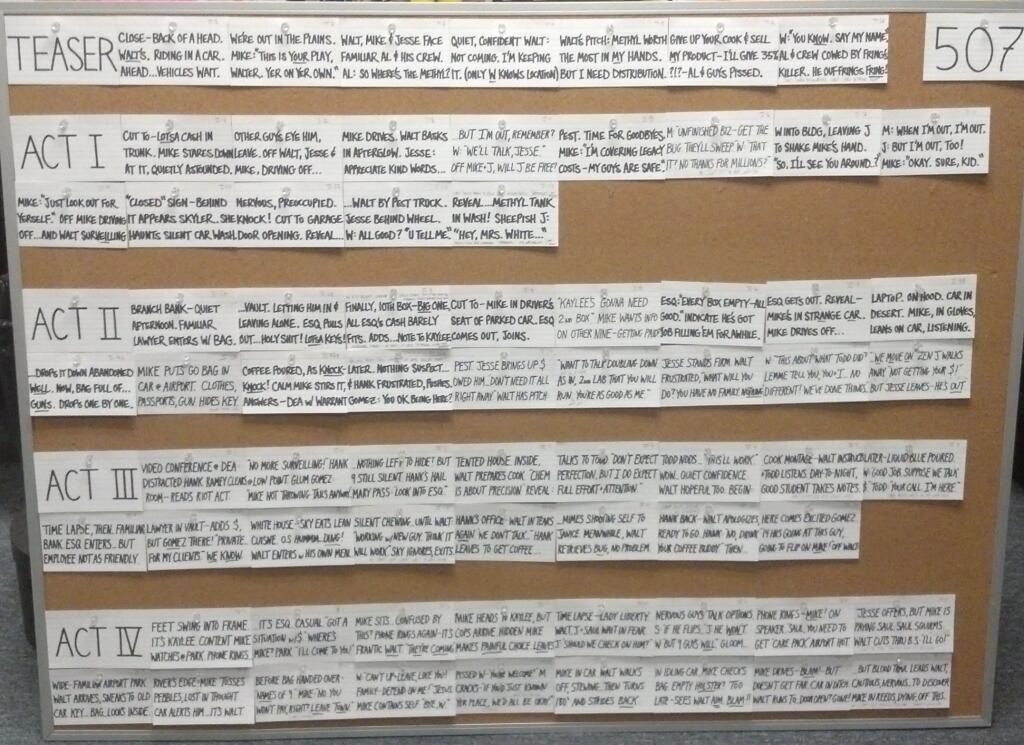
    Famous amongst fans of the Breaking Bad writers are the index card filled cork boards. When breaking each episode, the writers would work together to plan out every single beat of the story in extensive detail. They would write out beats on 3×5 index cards and pin them to a cork board. All together, an episode would average somewhere around 60-65 cards. That’s a lot of plot, and a lot of detail. But it ensures that every episode has a rock solid structure, then, when an individual writer goes off to work on an episode’s script, they get to “do a little jazz”, as writer Peter Gould puts it.

    Each writer creates the dialogue, embellishes the scenes and puts their unique stamp on their individual episodes. They get to do this with confidence, because they know most of the heavy lifting has already been done by the group. But the work and time put into that heavy lifting cannot be ignored. Especially when the writers write themselves into a corner, something which, let’s be honest, they tend to do with frequency.

    Midway through Season 3, Walt and Jesse are trapped in the RV with Hank looming outside like a hungry shark. It’s a moment that pins the audience to the edge of their couches and makes them wonder “Just how are Walt and Jesse going to get out of this?”

    Well, believe it or not, the writers had to ask themselves the same thing.

    They often reference this moment as an example of just how painful the writing process can be. It took hours upon hours of thinking, of talking and coming up with plenty of bad ideas until a Breaking Bad worthy solution was thought up: A fake phone call to Hank telling him something horrible had happened to Marie.

    Made for some damn good drama, didn’t it?

    I came upon a similar roadblock recently while working on a screenplay. Well into the climactic scene, my protagonist was ready to unleash her master plan and defeat the bad guy. Ta-da! The sun shines high and everyone cheers. Feel good film of the year. Then something dawned on me (I like to call it logic), and I realized that there was no way the bad guy wouldn’t anticipate the protagonist’s plan. So he did, and he turned it on its head.

    And I had no idea what she was going to do.

    At that point, I wanted to shut my laptop off, go get lunch and convince myself the solution would come easier after some heavy procrastination. Then I remembered Hank outside the RV, and I realized that if I didn’t have any clue how the protagonist was going to get out of her plight, chances are the audience wouldn’t either.

    So I kept working. There was a lot of staring at the screen, a lot of start and stop writing, and so much thinking I ought to have paid tuition. The bad ideas came first. And man, oh, man, was there a lot of them. But finally, after what felt like three days in the desert, I came up with a solution. The scene – and as a result, the screenplay – is ten times better because of it.

    What allowed me to make it better is the inspiration I’ve derived from the Breaking Bad writers. The lessons countless hours of watching the show and closely analyzing it have taught me. Chief amongst which is: HONESTY.

    There’s an index card with “Where’s Walt’s head at?” taped on the wall next to my desk. It’s a constant reminder to always stay true to my characters. I must look at the thing a thousand times a day, and every time, it fills me with inspiration and an immediate self awareness if what I’m currently working on isn’t treating the characters with honesty.

    So, next time you’re writing a script and you feel the biting urge to make it darker, just because Breaking Bad is dark AND good, stop. Take your hands off the keyboard, put the pencil down (yes, I know there’s at least one of you still left) and remind yourself that Breaking Bad isn’t good because it’s dark. It’s good because it’s honest.

    —–

    PS: For anyone interested in studying the craft behind Breaking Bad further, I cannot recommend the “Breaking Bad Insider Podcast” more highly. Hosted by Kelley Dixon, one of the show’s editors, and Vince Gilligan himself, the podcast discusses every episode from Season 2 till the finale in glorious, extensive detail. Guests such as other writers, directors, cast and crew members are always present, and the amount of insight one can get about the making of the show is simply unmatched. Do yourself a favor and start listening.

    Also, most of the Breaking Bad writers are on Twitter. In particular, Thomas Schnauz and Moira Walley-Beckett are quite active and will often take the time to answer questions. As is the writers’ assistant, Gordon Smith, who provides a different view of the process.

  • The No-Brainer Business Venture and/or Education Decision

    This past weekend, on September 1st, 2013, Green Lens Media finally announced its newest service, The Filmmersive™ Workshop Series. This workshop series has been a year and a half in the making, and was much more demanding in its planning than was originally projected for multiple reasons. But we kept at it, because we knew as soon as we conceived of it, no matter how difficult it was to set up, we HAD to do it. It was just too perfect to not do it, as it fulfills multiple needs to multiple parties in a cost effective way. Through hard work and the will to succeed, we finally have it ready, and I am proud to officially proclaim our workshops are launched, public, and open for business – let the filming begin!

    Why is this such a big deal?

    Today, if you are a business, you want your product and service out there, circulating, known, because that leads to clients and customers. If you are a filmmaker or involved in video or marketing, you are looking for experience, for contacts, for resources, but really more than anything those are means to the end—you are looking for JOBS. If you are a writer, you want people to see your work, make connections, improve your storytelling skills, but more than anything, you want more and better JOBS. If you are an actor, you may want people to watch you onscreen, get your name out there, and meet people who can hook you up, but all of those things are to feed your ultimate goal, landing killer JOBS.

    I know this. Everyone knows this.

    But what is anyone DOING about it?

    As a filmmaker, I believe in video. I love making it, and I love telling a good story. As a business owner, I believe video can help a business in ways that almost all other forms of marketing fall short. Video presence is important, and will continue to increase as the years go on. And once everyone finally catches up and realizes video is important to attract attention, how will your video become more attractive than someone else’s?

    Film school is expensive, and a big decision. A fully customized video production is expensive, and also a big decision. Getting attention as a writer or actor is hard, because there are so many others out there, and so few really great jobs. I wanted GLM to solve these 3 problems faced by our community: 1) Attention, 2) Cost, and 3) Return On Investment (ROI). I believe our Filmmersive™ Workshops address these issues in a unique, smart way.

    I’m not advocating our workshops as a replacement for college degrees, program certificates, less expensive or free online training, or high-end custom productions, but as a supplement and booster for your career or business there is truly nothing like it. For some it may be just enough, while for others it will prove that only the surface has been scratched. From my perspective, it’s the kind of thing I wish had been available to me, both as a filmmaker AND a business, back when I was first starting out in the professional workplace.

    All the details can be found on the Training page of our website, so I won’t explain how it works in great detail other than this synopsis: the workshops are 5 days of intense filmmaking training for small 4-8 person groups given by experienced instructors. Workshop Attendees pay to learn filmmaking but also take part in actually executing a short video by the end of the week, start to finish, giving them a portfolio piece to showcase. In Narrative workshops we pay a modest fee to use a local writer’s 3-6 page fictitious script, which gives this writer heightened exposure. In Corporate workshops the Attendees do a 1-day shoot at a real company, each editing their own version of the video; the business gets to review all versions and decide at no obligation if they would like to purchase it for their website for a fraction of the normal cost.

    Basically, we structured our workshops to focus on the collaboration and the ROI for all involved. For Attendees, it’s a cost-effective, fun, and rewarding way to learn, and you wind up with a unique portfolio piece. For writers, actors, and sponsors, it’s a great opportunity for exposure with a limited commitment and with a quick turnaround final result. For businesses, it’s a risk free way to preview multiple videos about their business, since purchase costs are more affordable than highly customized projects and always no obligation to buy. For GLM, it’s a way to share our knowledge through training while continuing to operate in the field making productions. And for everybody, it is a great networking opportunity and an all around enjoyable and worthwhile experience.

    So what’s the catch?

    Honestly, I can’t think of one. This is the NO-BRAINER part of the whole concept – everyone benefits. Really, the only hesitation was in the idea of actually structuring the setup of the program, and then executing it. With all the variables involved it is a complex undertaking. As the host of the workshop, this responsibility falls on GLM’s shoulders, but I felt so strongly this model would strengthen the business and film community in Boston that it was worth every effort to see through. I would like to see new startups, particularly green / environmental ones (though we won’t be exclusive to them), benefit from this program, and begin to flourish and enhance our city. I would like to see Boston, which has already grown as a film town in the past decade, take this to a new, even higher level.

    The Filmmersive™ Workshops are not where your film education or video productions end, though it will be a good jumpstart. Every ingredient like this helps, and GLM will make its workshops one such ingredient of the overall recipe that promotes companies, individuals, and the film community. I hope you will check out what our program offers to see if it is right for you, but whatever you choose to do I hope you will continue to investigate how to get video on your site and / or learn the practices of filmmaking by whatever means make the most sense in your situation. 21st century communication is already headed in video’s direction, and riding the wave of the future should be one hell of a thrill, so let’s make it thrilling and catch the perfect wave.

  • To Film or Not to Film? That Is The Question

    Being in film school makes you feel like you’ve aged 50 years in the span of two. Don’t get me wrong. It’s not a bad thing.

    I grew up in India, a country with brilliant minds and bold hearts. A country where your average young person is capable – and driven – enough to be exactly what they want to be, and be successful at it. But for the young Indian, being successful isn’t even the difficult part. The difficult part is self-knowledge. Knowing what you want to do. Finding the power to know, in a country where your future is determined as soon as you’re born: doctor, lawyer, engineer, business executive.

    When I applied to college, I applied as a journalism major. Far enough from the Indian career mold to be creative, but not so far that I can’t bank on the degree to get me a job when I graduate. The perfect balance.

    But coming to college changed everything.

    The idea of getting involved with filmmaking emerged from the experience of moving to the United States. I was in a new city, a new country, a new world. I was given a chance to rewrite my story, make new memories and, most importantly, get to know the person I would become. Suddenly, I was exposed to people from all over the world – my roommate was Korean, my best friend was Mexican, my study partner was half-Polish. Being surrounded by interesting people and interesting stories makes you fall into storytelling, even if you didn’t set out to do it.

    I’d always been interested in film, but it had never occurred to me that it was something I could do forever. There was something so exhilarating about the concept of creating something from nothing: of engaging in a craft founded in emotion and unpredictability; an outlier in the textbook-and-problem-set world of conventional knowledge.

    Think about the great directors of the world, for example. Alfred Hitchcock, Quentin Tarantino, Stanley Kubrick, Martin Scorsese (to name a few.)

    Now try separating film from filmmaker. You can’t.

    Every storyteller is unique. They vary in so many ways, but are great storytellers nonetheless. There are no formulas and numbers involved in storytelling. No right answers. No wrong answers. Just instinct and imagination.

    Terrifying, isn’t it? Having no rules? I can’t say it isn’t.

    But I wouldn’t be able to call my life a full life without stories. My life has been characterized by change. I’ve lived in Mumbai, Boston, Paris and London – I’ve been challenged, pushed out of my comfort zone and made to build up from scratch. By being exposed to stories and the storytellers that tell them, I’ve grown beyond the 20 years I’ve spent on this planet, because none of the places I lived in ever came with rules. But they came with faces, places and stories that are such an important part of my life. And that’s why I could never be a doctor, lawyer, engineer or business person.

    It might be human nature to fear the unknown, but it’s a filmmaker’s instinct to embrace it.

    Is it terrifying? Yes. Is it worth it? Absolutely.

  • Back to the Basics: Failure to Film

    Whenever people ask me what I do at work, I tell them I help out with making films. And whenever I say that, they’re intrigued: films? how glamorous!

    Except…not really.

    The reason the word film is so frequently associated with glamour is because most people are exposed exclusively to the final product. What they don’t see is all the mishaps, errors and edits that went into creating that glamourous product. What they don’t see is that everything that can possibly go wrong usually does.

    And the sad part is, I’m not even being dramatic.

    Take today, for example. I had the tripod set up. I had the camera mounted, the battery in, the SD card in. I even managed to plug the furry little mic into the correct jack (hey, when you’re a student, it’s the small victories that count…) I had a beautiful frame set up, my subject looked great and the light was co-operating. For once, everything was falling into place.

    So I went ahead and pressed the record button.

    One stimulating interview and exactly sixty minutes later, I felt great. The shoot went extremely well, we finished on schedule and I had some great sound bytes. I couldn’t wait to get started on the edit.

    And so the pack-up process began. I ejected the battery and the CF card, took the camera off the tripod. Folded it up. Unplugged the mic, opened it up to take out the – oh, wait. There was no battery.

    I stared wordlessly at the space where the battery should have been. Putting in a battery is probably the most elementary part of this whole process. There was no reason not to do it. I now have an hour of footage of my subject awkwardly moving his lips as no sound comes out and gesturing excitedly with no context.

    I’ve been on the Dean’s List at BU for three straight years, but I don’t know that I have to put in a battery.

    Now if you were in my place at this point in time, you would have two logical options:
    a) Cry.
    b) Cry.

    But both of those options render themselves useless when you ask yourself the dreaded question: now what?

    And then face the dreaded answer: Nothing.The footage is absolutely useless.

    While my complete lack of grey matter may make it seem like the moral of the story is don’t be an idiot, it really is simpler than that – be prepared. Make sure all your equipment is ready to work, and don’t rush the setup. Go in with a checklist and include even the most basic steps, down to the pack-up.

    It’s when you mess up the basics that you mess with the final product. It’s when you compromise on things like batteries and cards that you taint the perfection that people associate with your craft. I, for one, am not ready for my friends and family to think that my job is anything but clappers, bright lights and Matt Damon. And if all it takes to maintain that perception is being attentive and being prepared…then failure is not an option.

  • Books are Books, Movies are Movies, and Now the Twain Shall Meet

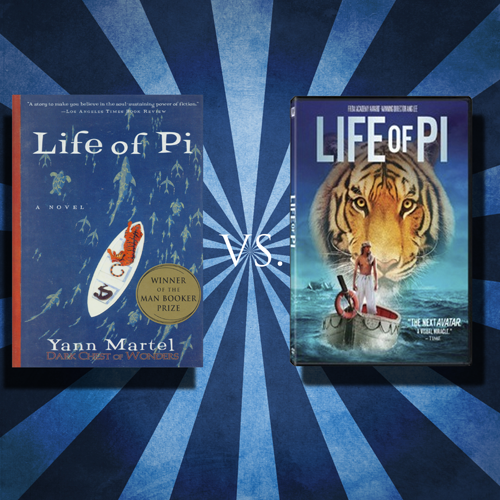
    Life of Pi vs. Life of Pi
    Life of Pi Book vs. Film Adaptation

    I know what you’re thinking. Ho-hum, another books vs. movies debate. But don’t stop reading yet! This is not a debate. I love books. And I live movies (no, that’s not a typo.) And I’m tired of people pitting the two against each other.

    Think about it. Both books and movies demand a significant amount of effort in bringing them to life. Both are mentally stimulating and emotionally engaging. I was only ten years old when I read Life of Pi. In case you haven’t heard of Life of Pi yet, it’s a story about a teenage boy who loses his family, loses his home and finds himself stranded at sea with only a ravenous tiger for company. But when I tried explaining the story with my best friend at the time, she scoffed and said “I can’t even imagine that.”

    But that’s exactly the point.

    So many of the world’s stories are about worlds and times that most people consider to be beyond the realm of human imagination. Books deemed “unfilmable” by book and movie lovers alike. The Hobbit. Harry Potter. Game of Thrones. The magic realism that characterizes Pi’s story – and Harry’s, and Frodo’s, and Tony Stark’s – sets them apart from stories closer to home. But it is the “unfilmable” and “unimaginable” nature of these stories that make them the stories most worthy of being imagined. Brought to life.

    And what better way to do that than through film?

    Book lovers insist that the movie can never be the same as the book, but does it have to be the same? If the movie was meant to be the same as the book, it wouldn’t be a movie. For me, the point of a movie adaptation is to re-imagine the story of the book without overwhelming it. I grew up with Harry Potter, and reading Life of Pi changed my life forever. And the film versions of those books didn’t match up with the little movies I’d already made in my had while reading them.

    But this little film I already made in my head while reading the book Life of Pi is one of those rare examples of a movie whose 3D visuals don’t overwhelm its storytelling but enhance it. It’s about that flawless balance between world and visual, capturing the complexities of a character’s world and the the viewer’s mental world.

    That said, even if the screenplay is amazing and the visuals are flawless, much of the audience’s decision about whether or not they like the film relies on their own emotions. Their own story. Having read the books for all the adaptations I’ve watched, I never walked into a movie thinking it would make me feel anything new. But each and every time, it did. And that’s what makes me believe in film as the book’s friend rather than its enemy. It’s the only medium that has the power to take an existing experience, reshape it and make it visceral in the way no other medium can.

  • Coalition of the Willing: Inspired Work, Inspiring Work

    I have a complicated relationship with film.

    For the most part, I love it. I love that it can inspire, empower and liberate people. As a medium, it is limitless – it can tell stories previously untold, tap emotions previously untapped and explore parts of the world previously unexplored.

    But here’s my problem: commercial film rarely ever does.

    Yes, Ryan Gosling is stunning. And so is Emma Stone. Alright, I get it.

    But why are we making a movie about it? That part, I don’t get.

    With all the fandoms, poster boys, Jennifer, and plotless excuses for movies popping up everywhere, I can’t help but feel disillusioned by film. But every once in a while, a movie comes along to remind me that Ryan Gosling and Emma Stone haven’t completely taken over. On one of my many afternoons spent idly browsing Vimeo for inspiration, I stumbled upon a film by Knife Party that reinstated my faith in the wonders of the medium.

    Coalition of the Willing, is, as the title suggests, the collective brainchild of a brilliant coalition. The film addresses an issue burning with actuality (pun intended!) – the issue of global warming. And yet…there are no pie charts, bar graphs or visuals of receding ice caps viewed from outer space.

    That’s the beautiful thing about this film. It succeeds not despite but because of the lack of statistics and infographics in its storytelling. Because when you really think about it, global warming isn’t an issue that’s as far away and distant as the statistics and satellite images often used to represent it.

    It’s personal. It’s a choice.

    Throughout the film, the visuals follow man and mankind. Our evolution, our changing times, our history, our politics, our sociology. Visually, it is absolutely stunning. I felt myself being increasingly drawn into the world of the film – our world – and it wasn’t difficult to understand why the movie walked away with the Best Short Award at the 2012 San Francisco Green Film Festival.

    The stunning animation and smooth flow of the film transports the viewer back in time, employing the memorable image of a ’50s businessman turning into a hippie to chronicle the radical individualism of the ’60s. As the colours get brighter and the backdrops increasingly complex, the individualism fades into consumerism and the whole movement eventually culminates in a lack of regard for the world around us. The status quo.

    Although humanity took a turn for the worse, the film isn’t pessimistic about it. Not in the least. There is a palpable vibrance in its visuals, a quirky hopefulness in its scoring and an awareness of the power of individual efforts. It connects the past with the present, muses about the many changes that humanity has undergone, and, above all, provides hope for the future. Its look, feel and message work together to do what film fundamentally ought to do: awaken and stimulate the minds absorbing it. The film brings the concept of coalition to life and itself stands a testament to the wonders achievable through creative minds coming together.

  • 4 Quick Fixes: The DIY Filmmaker’s Cheat Sheet for a Quality Film on the Cheap

    Whoever said “time flies when you’re having fun” was absolutely right. And if you’re a filmmaker, you already know by now that having fun is part of your job.

    The best thing about creative work is that the sky’s the limit. If I wanted to, I could think up a world of gremlins and goblins and bring it to life. I could also make a hard-hitting documentary about world hunger. Or, if all of that doesn’t work out, I could set up a camera outside my lovely perch in Porter Square, leave it there all day, import my footage and still tell a story. (Hey, Andy Warhol did it…)

    All I need is my trusty DSLR, my lights, my sound kit, my tripod, my slate, my dolly…oh, wait, this is a problem.

    Or is it?

    It doesn’t have to be. Gone are the days of bombshell budgets and tedious technics. Times-are-a-changing and so is technology. Where once you had to worry about thousands of dollars and tons of extra baggage, you now only have to worry about the bare necessities. With a range of tools and technologies to our disposal, it’s becoming easier and easier to roll up your sleeves and start from scratch. Here’s how:

    Quick Fix #1: The Handheld Camcorder

    OK, OK. Before you scroll past this section altogether, let me remind you of a great moment from the pilot of Breaking Bad. You know, the one where Walter White leaves a video message for his wife and kid when he thought he was about to get caught. What’s interesting about that video message is that, even compared to the rest of the show’s already gritty visual style, the camcorder version was shockingly real. So if you’re on the run and you’re looking to capture the washed out realism of life pre-DSLR, this quick fix is for you.

    But if you’re going for a fancier feel, try…

    Quick Fix #2: The DIY Viewfinder

    Beautiful filmmaking is all about composition. And perfect composition is all about the little elements – aperture, ISO, white balance. But when you’re out and about, the sun can make it hard for you to get those elements just right, and a professional viewfinder will cost you a cool $100-$200 at the very least. But why shell out the cash when you have edit-room coffee runs and shiny new equipment to save up for? Believe it or not, you can make your own LCD viewfinder for under $20. And if you’ve got 5 minutes and an appreciation for dinosaurs, check out this video that shows you exactly how to do it:

    Make your own LCD viewfinder for your DSLR

    Now that you’ve got that viewfinder, you can focus on framing that perfect shot by getting all those little elements just right. But if you’re anything like me, that’s not enough. Getting everything right behind the camera is only a step towards making the magic happen in front of it. Which leads us to…

    Quick Fix #3: Get Creative With Lighting

    As a 5 foot nothing filmmaker without a bodybuilding certification, I was definitely not designed to haul around a light kit on long shoots. Paper lanterns and clamp lights are just two of the many options you have when it comes to quick, clean, low-maintenance light sources. Not only are these options totally affordable, they do just the trick if you’re lighting your subject outside or in a cramped space where you don’t have access to a lot of space or outlets. But if you do have some space and you’re looking for a conventional three-point lighting setup, here’s a video that will show you a low-cost way to achieve it:

    Make your own lights on less than $100

    A good lighting setup is really the cherry on top of the beautiful composition cake. But now that everything looks perfect, it has to feel perfect. And what better way to make it feel perfect than…

    Quick Fix #4: Create Movement with a DIY Dolly

    Think about it. What kind of world would this be if nothing never moved? A boring one. And what kind of film would you create if nothing ever moved? That’s right…a boring one. Camera movement is a foolproof way to inject your movie with feeling and dynamism, especially when used on what would normally be a static image. That said, the laborious task of carting around a full-size dolly is not something a small crew can afford to put up with. But that doesn’t mean your film can’t benefit from the wonders of movement. In fact, the solution for your static-shot problems can be easily found in none other than your local Home Depot. I’ll let YouTuber MediaUnlocked explain the details:

    Make your own DSLR slider dolly track

    And there you have it! With these four completely doable (and cheap!) fixes, you no longer have to let money or logistics stand in the way of telling your story. If you’re already imaginative with your storytelling, all you need to do is apply that great imagination to your technique.