Category: Environmental

  • Green Lens Media Produces Videos for ELM’s 2020 Commonwealth Environmental Leadership Awards

    Green Lens Media Produces Videos for ELM’s 2020 Commonwealth Environmental Leadership Awards

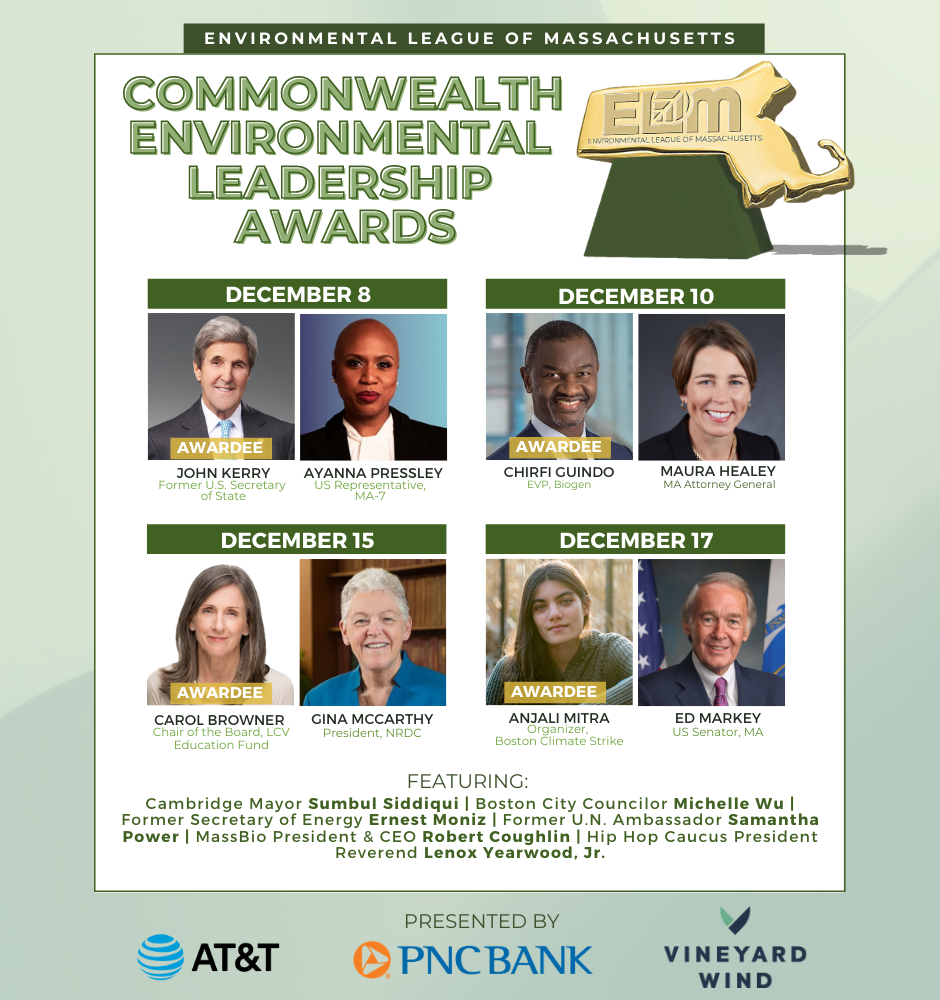
    The Environmental League of Massachusetts (ELM) signed Green Lens Media onboard to create videos for their 2020 Commonwealth Environmental Leadership Awards. This year’s awards go to Secretary John Kerry (Dec. 8), Biogen (Dec. 10), the League of Conservation Voters (Dec. 15), and the organizers of the Boston Climate Strike (Dec. 17).

    You can read more about the upcoming CELA event below, and register for all four presentations (free) here: http://bit.ly/CELAS2020
    But first, some history about our projects with this terrific organization…

    Our history with ELM…

    GLM was proud to first begin working with ELM in 2017 during their efforts to increase public awareness and support for funding state park projects. As a company founded on the mission of providing top shelf video production services to green and eco-conscious organizations, businesses, institutions and advocates, ELM is exactly the type of client for which we aspire to fill our production schedules.
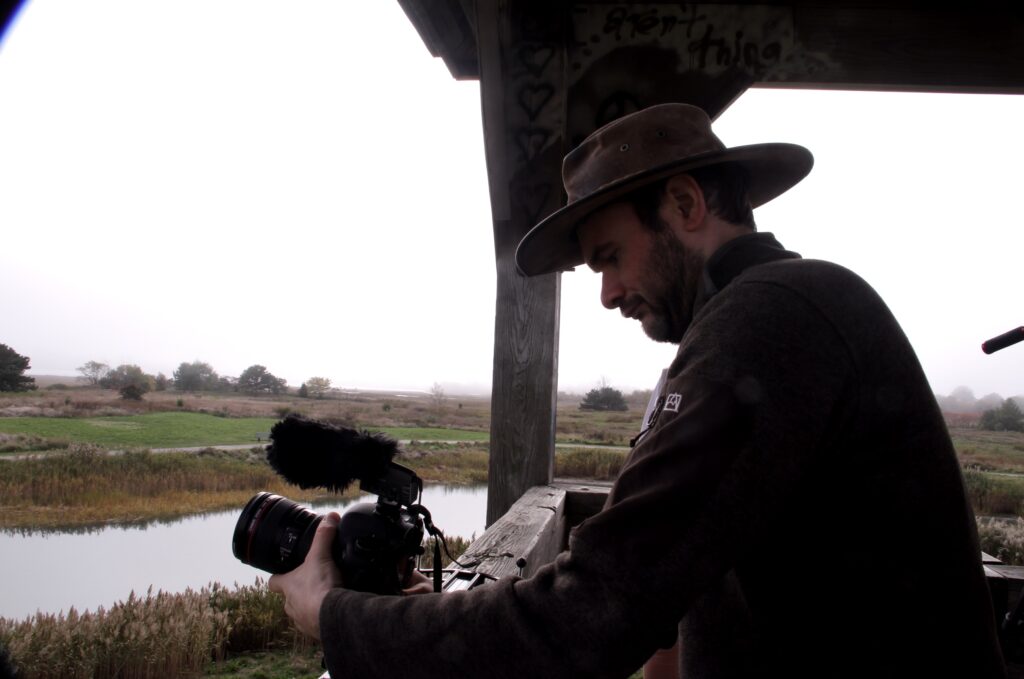
    Green Lens Media founder Adam Greene captures a foggy scene at Belle Isle Marsh Reservation in Boston, MA.
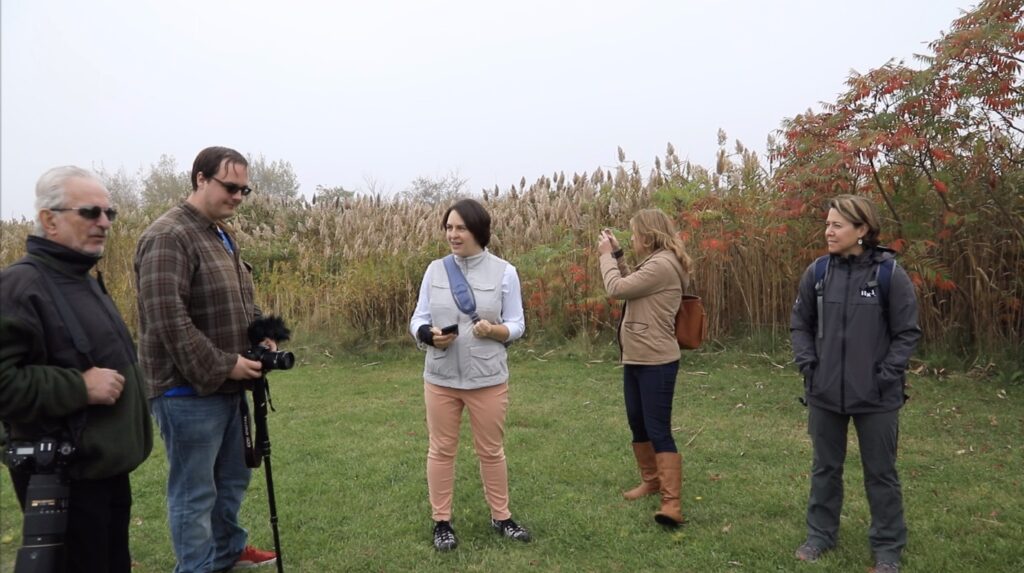
    GLM Script Supervisor and Camera Assistant Viktor Herrmann discusses shoot agenda with ELM’s Legislative Director Erica Mattison and the rest of the on-camera talent.

    Our film shoots for that first project took us to the hidden gem of Belle Isle Marsh right near Logan Airport, which the Executive Office of Energy and Environmental Affairs refers to as a Reservation that “includes the last remnant within Boston of the salt marshes that were once prevalent along the Massachusetts Bay shoreline.” If you haven’t been, put it on your list–it’s an incredible to have in the backyard of Boston. You can check out that production here: 

    ELM also had GLM produce in that campaign a video drawing awareness to the importance of Lobby Day(s), since potential environmental policies are more likely to get attention and become law and real projects the more the public is in favor of those measures. Our Lobby Day video can be viewed here:

    Events: From In-Person to Online

    Since this year’s CELA event is occurring during the pandemic we’ve all been dealing with, ELM was faced with the same predicament many organizations and businesses have been challenged with: how do you create a completely online experience for a normally in-person event? 

    The process of creating such a presentation began with ELM sending GLM photos, zoom interviews they conducted, some graphic layers they’d been using in their marketing and wanted either animated or replicated for brand consistency, and a foundational outline for suggested spoken content that would help drive the narrative. After using that as a guide and putting our own filmmaker-touch on the editing, we then supplemented this with video media of several variations.

    First and foremost, we turned to the archival media from our previous project with ELM 3 years prior. By working with us again, ELM was able to tap the benefits of all the production work done with GLM before, using previously unseen footage, recycling a project with no new cost implication, allowing us to move faster in editing due to our prior organization and familiarity with the footage, and the added benefit of it being customized content for ELM in the first place.

    Next, we turned to select other environmental clientele we felt may have footage in their archives befitting of the project, and after gaining their blessing we were able to showcase some of those clips as well throughout the storytelling.

    We then turned to the GLM archive. We’ve accumulated hundreds of hours of original and personal projects over the years. We combed through our library, picking out moments that could work well for the CELA videos, with the added benefit of not needing to obtain any further releases. Lastly, we looked to round out some of the more global and “climate change in-the-flesh” moments from world events and the news by sourcing from licensable clip vendors. We always turn to this last in order to keep videos as fresh and original as possible. 

    We are greatly looking forward to the Commonwealth Environmental Leadership Awards being shown over the next 2 weeks on Tuesdays and Thursdays, and do hope you can check out the event, whether your looking for information on who’s doing what on climate change in our communities, the state of environmental goals and policy in MA and America, or you’d simply like to see what does one approach to adapting an in-person event to a virtual experience look like. These local leaders are inspiring, and we hope it contributes to even more attention to the most important issue of our time. When it comes to the video work, our philosophy on this is the same regarding any video content shown online—it should be as engaging and entertaining as possible, should feel authentic and memorable, should be designed as much as possible for a specific audience, and should touch viewers on an emotional level.

    Keep up the great work ELM!

    ELM’s Original Post

    ELM has written on their site the following about Tuesday’s Awardee, Secretary John Kerry:
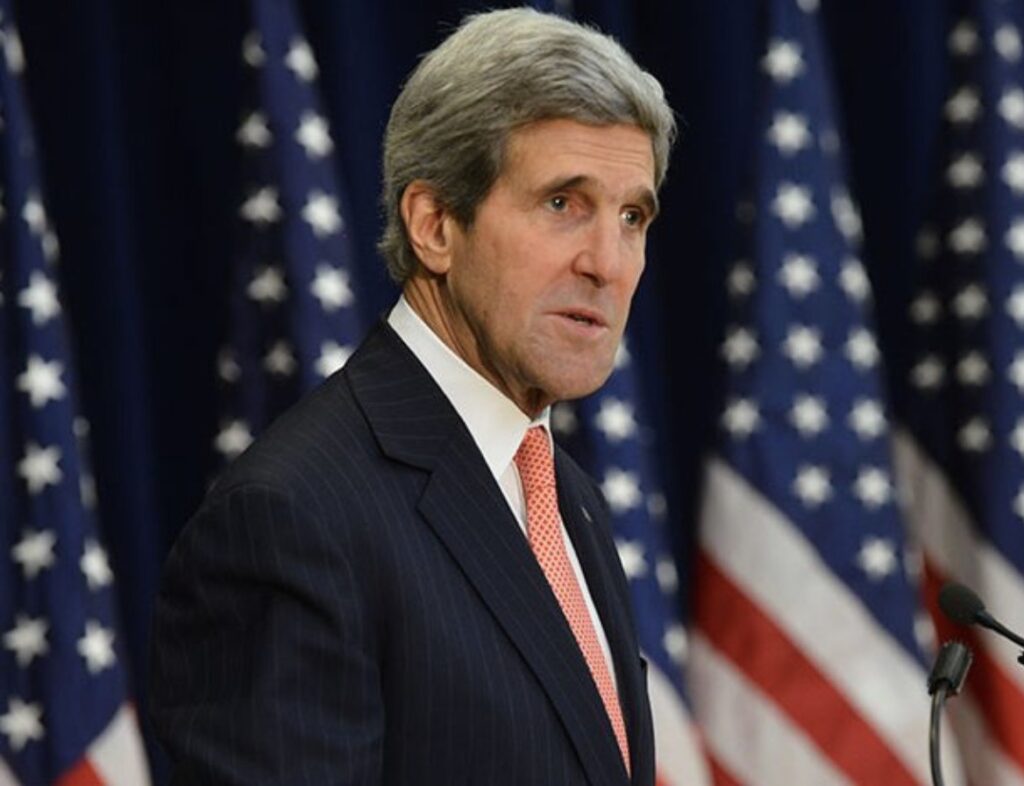
    Secretary John Kerry has dedicated his life to public service. He served the Commonwealth in a number of roles – as District Attorney for Middlesex County, Lieutenant Governor of Massachusetts, U.S. Senator for Massachusetts, and U.S. Secretary of State. Throughout his tenure, he tackled issues like combating acid rain as Lieutenant Governor, bringing attention to the warming planet to the U.N. as a Senator, and working with foreign governments to spearhead numerous efforts to combat climate change as Secretary of State. Notably, Secretary Kerry was a key architect of the Paris Climate Accord, signing the historic agreement to reduce carbon emissions in 2016.

    In 2019, Secretary Kerry launched World War Zero, a coalition of unlikely allies joining a global mobilization against the climate crisis. This group includes scientists, CEOs, military leaders, activists, artists, entertainers, political leaders from both sides of the aisle, business and industry leaders, and many more want to tackle this crisis. The coalition focuses on public education and community engagement to activate climate action at the massive and urgent scale necessary to win this war. Bringing together influencers like celebrities and politicians will help this message reach a broad, global audience. Messengers will make connections between climate change and the economy, jobs, and national security.

    ELM is pleased to award Secretary John Kerry a Commonwealth Environmental Leadership Award in recognition of his exemplary work in our community.

    For original post, please visit: https://www.environmentalleague.org/event/cela-2020/
  • Culture, Cheeseburgers, and Sustainable Fashion: Combating Our Disposable Mentality

    Osmium FashionWe live in a time of constant upgrades. That brand new smartphone? Replaced by the latest model in a matter of months. That top-of-the-line gaming rig? Obsolete by the end of the year. That hip new fashion trend? Only hip until the newest “latest and greatest” trend takes over. We buy things, use them until they break or go out of style, then we replace them, and the whole cycle begins again. To Mark Paigen of Osmium Apparel, this disposable mentality is not the answer.
    On one of the first truly beautiful days of the year, we sat down with Paigen to discuss his life, his company, and just why buying the same disposable products everyone else is buying is hurting us not only as consumers, but as a culture.

    “Increasingly,” Paigen said, “fashion and our preferences have become global. The same H&M store you see in Boston, you’ll see in Hong Kong and Berlin and Paris, and they’ll be selling the same styles across the continents.”

    To him, this homogony of fashion accomplishes little more than taking away what makes cultures unique. “When I go to Italy, I don’t want to eat a hamburger. I want to eat great Italian food. And I think the same should be true of style, and the things we buy. They should reflect our local culture, our communities. That’s what Osmium is about. Buy things that will last a long time; that will become your favorites and won’t be obsolete in six months.”

    Of course, even the highest quality items will eventually break, and Paigen acknowledges that. “I love fixing things,” he said, “I have a ski-jacket that I’ve had for a dozen years, the draw string blew out on it and I got it fixed. I really like that mentality of buying really good stuff, taking really good care of it, repairing it when it breaks.”

    Not just content with fixing things, Paigen also has a drive towards creating, which undoubtedly stems from his love of nature. We talked about his time as an organic farmer, the “Long Distance Running and Bread Baking” class he took in college, and other experiences which left us with the distinct impression that this is a man who loves being outside, loves working with his hands, and loves to take a unique approach to his work. He couldn’t help a sly smile as he told us about the history of Osmium’s distinct Mobius belt.

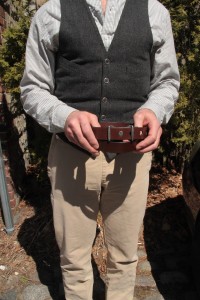
    “I had the idea [for the belt], the concept, and I sketched it out, went to a product development firm, and they gave me a price of $18,000 to prototype the buckle. So, I went to Home Depot, I bought a piece of aluminum, and some threaded parts, got my drill out and I prototyped one-half of this buckle. I tried the concept, and the concept worked.”

    Though perhaps what intrigued us most about Paigen was not his creative approach to problem solving nor his love for nature. Rather, it was his sincerity. When it came to his own shortcomings, Paigen was perfectly candid.

    “I consider myself an environmentalist, but I don’t do everything I could possibly do. I could ride my bike to work every day. I don’t. I could have bought a car with better mileage, but I needed more room. I’m painfully aware of all the choices I have made that are not perfect.”

    Just as with repairing items instead of replacing them, Paigen is a man who practices what he preaches. “When I look at someone else and they seem perhaps less perfect [in their care for the environment] than I am, it’s easy to judge. But who am I to judge? All of us could do better, and there has to be a way to reach out to people in a non-judgmental way.” One such way Osmium is giving back is through its membership in 1% For The Planet, a pledge which gives 1% of sales to deserving environmental organizations.

    The point is, like the clothing he designs, Mark Paigen is a distinct man with a distinct view. His and Osmium’s mission is to bring the local focus back to fashion. Green Lens feels in sync with Mark on his perspectives and his intentions; plus, we genuinely liked his style, too. And even if his products aren’t right for you, his philosophy is certainly something we can all strive to implement a little more.

    You can learn more about Mark and Osmium’s Made in the USA clothing line at his website, www.osmium.com.

  • The No-Brainer Business Venture and/or Education Decision

    This past weekend, on September 1st, 2013, Green Lens Media finally announced its newest service, The Filmmersive™ Workshop Series. This workshop series has been a year and a half in the making, and was much more demanding in its planning than was originally projected for multiple reasons. But we kept at it, because we knew as soon as we conceived of it, no matter how difficult it was to set up, we HAD to do it. It was just too perfect to not do it, as it fulfills multiple needs to multiple parties in a cost effective way. Through hard work and the will to succeed, we finally have it ready, and I am proud to officially proclaim our workshops are launched, public, and open for business – let the filming begin!

    Why is this such a big deal?

    Today, if you are a business, you want your product and service out there, circulating, known, because that leads to clients and customers. If you are a filmmaker or involved in video or marketing, you are looking for experience, for contacts, for resources, but really more than anything those are means to the end—you are looking for JOBS. If you are a writer, you want people to see your work, make connections, improve your storytelling skills, but more than anything, you want more and better JOBS. If you are an actor, you may want people to watch you onscreen, get your name out there, and meet people who can hook you up, but all of those things are to feed your ultimate goal, landing killer JOBS.

    I know this. Everyone knows this.

    But what is anyone DOING about it?

    As a filmmaker, I believe in video. I love making it, and I love telling a good story. As a business owner, I believe video can help a business in ways that almost all other forms of marketing fall short. Video presence is important, and will continue to increase as the years go on. And once everyone finally catches up and realizes video is important to attract attention, how will your video become more attractive than someone else’s?

    Film school is expensive, and a big decision. A fully customized video production is expensive, and also a big decision. Getting attention as a writer or actor is hard, because there are so many others out there, and so few really great jobs. I wanted GLM to solve these 3 problems faced by our community: 1) Attention, 2) Cost, and 3) Return On Investment (ROI). I believe our Filmmersive™ Workshops address these issues in a unique, smart way.

    I’m not advocating our workshops as a replacement for college degrees, program certificates, less expensive or free online training, or high-end custom productions, but as a supplement and booster for your career or business there is truly nothing like it. For some it may be just enough, while for others it will prove that only the surface has been scratched. From my perspective, it’s the kind of thing I wish had been available to me, both as a filmmaker AND a business, back when I was first starting out in the professional workplace.

    All the details can be found on the Training page of our website, so I won’t explain how it works in great detail other than this synopsis: the workshops are 5 days of intense filmmaking training for small 4-8 person groups given by experienced instructors. Workshop Attendees pay to learn filmmaking but also take part in actually executing a short video by the end of the week, start to finish, giving them a portfolio piece to showcase. In Narrative workshops we pay a modest fee to use a local writer’s 3-6 page fictitious script, which gives this writer heightened exposure. In Corporate workshops the Attendees do a 1-day shoot at a real company, each editing their own version of the video; the business gets to review all versions and decide at no obligation if they would like to purchase it for their website for a fraction of the normal cost.

    Basically, we structured our workshops to focus on the collaboration and the ROI for all involved. For Attendees, it’s a cost-effective, fun, and rewarding way to learn, and you wind up with a unique portfolio piece. For writers, actors, and sponsors, it’s a great opportunity for exposure with a limited commitment and with a quick turnaround final result. For businesses, it’s a risk free way to preview multiple videos about their business, since purchase costs are more affordable than highly customized projects and always no obligation to buy. For GLM, it’s a way to share our knowledge through training while continuing to operate in the field making productions. And for everybody, it is a great networking opportunity and an all around enjoyable and worthwhile experience.

    So what’s the catch?

    Honestly, I can’t think of one. This is the NO-BRAINER part of the whole concept – everyone benefits. Really, the only hesitation was in the idea of actually structuring the setup of the program, and then executing it. With all the variables involved it is a complex undertaking. As the host of the workshop, this responsibility falls on GLM’s shoulders, but I felt so strongly this model would strengthen the business and film community in Boston that it was worth every effort to see through. I would like to see new startups, particularly green / environmental ones (though we won’t be exclusive to them), benefit from this program, and begin to flourish and enhance our city. I would like to see Boston, which has already grown as a film town in the past decade, take this to a new, even higher level.

    The Filmmersive™ Workshops are not where your film education or video productions end, though it will be a good jumpstart. Every ingredient like this helps, and GLM will make its workshops one such ingredient of the overall recipe that promotes companies, individuals, and the film community. I hope you will check out what our program offers to see if it is right for you, but whatever you choose to do I hope you will continue to investigate how to get video on your site and / or learn the practices of filmmaking by whatever means make the most sense in your situation. 21st century communication is already headed in video’s direction, and riding the wave of the future should be one hell of a thrill, so let’s make it thrilling and catch the perfect wave.

  • Lean, Mean, Green Machine: Support the Cause for Tesla Motors

    As much as possible, I use public transport to get around.

    But the thing about Massachusetts is that, a lot of the time, there just aren’t enough trains and buses that go where I want to go. And that’s when I just have to bite the bullet, hail a taxi or get in a car to get somewhere. But it’s hard to enjoy the ride when all I can think about is the criminal waste of energy I’m participating in, not to mention the air pollution. Given a choice, I’d rather deal with the sweaty armpits and rambunctious Sox fans on the T than the looming prospect of a depleted ozone layer or energy scarcity.

    Enter Tesla Motors.

    In 2010, we worked with Renew America Roadtrip and its Tesla Roadster at the Northeast Sustainable Energy Association (NESEA) BuildingEnergy conference. We spoke with Michael Craner, co-founder of Renew America Roadtrip, about the ways in which the electrically powered Tesla Roadster helps people save energy, cut costs and enjoy a guilt-free ride. Not only does a Tesla car afford its driver the opportunity to save the environment and a large amount of money, it’s sleek, sporty design makes it a good-looking car worth bragging about.

    Amazed? We were too. Check out our video below:

    This is a great effort, and it will obviously make a difference for the environment.

    So what’s the catch?

    A new technology as well-researched and effective as Tesla’s stands as a threat to the outdated auto dealership model currently in place in most of the United States.

    According to Tesla’s website, they have a few galleries scattered across the United States but none of these galleries are authorized to initiate a sales transaction unless the customer goes through a substantial pile of paperwork and contacts their California office for sales and delivery.

    It seems unfair that the red tape and political buzz surrounding Tesla’s sales should restrict access to clean transportation for environmentally conscious consumers all over the country. There are in fact thousands of EV charging stations all over the country, and MSNBC predicts millions by 2020. A few of such charge stops recently sprouted up in our neighborhood of Porter Square in the parking lot by the Porter T Station. Basically, there’s no reason to allow an obsolete auto sales model to be an impediment in the path to a cleaner, greener America.

    There’s no reason to be stuck in the past when technology is rushing towards the future.

    You can change the status quo, and you can change it as soon as Friday. All you have to do is add your name to this petition. Deadline is Friday, June 5th, 2013, and 100,000 signatures are needed. Help us reach the tipping point—it’s so close!

  • Coalition of the Willing: Inspired Work, Inspiring Work

    I have a complicated relationship with film.

    For the most part, I love it. I love that it can inspire, empower and liberate people. As a medium, it is limitless – it can tell stories previously untold, tap emotions previously untapped and explore parts of the world previously unexplored.

    But here’s my problem: commercial film rarely ever does.

    Yes, Ryan Gosling is stunning. And so is Emma Stone. Alright, I get it.

    But why are we making a movie about it? That part, I don’t get.

    With all the fandoms, poster boys, Jennifer, and plotless excuses for movies popping up everywhere, I can’t help but feel disillusioned by film. But every once in a while, a movie comes along to remind me that Ryan Gosling and Emma Stone haven’t completely taken over. On one of my many afternoons spent idly browsing Vimeo for inspiration, I stumbled upon a film by Knife Party that reinstated my faith in the wonders of the medium.

    Coalition of the Willing, is, as the title suggests, the collective brainchild of a brilliant coalition. The film addresses an issue burning with actuality (pun intended!) – the issue of global warming. And yet…there are no pie charts, bar graphs or visuals of receding ice caps viewed from outer space.

    That’s the beautiful thing about this film. It succeeds not despite but because of the lack of statistics and infographics in its storytelling. Because when you really think about it, global warming isn’t an issue that’s as far away and distant as the statistics and satellite images often used to represent it.

    It’s personal. It’s a choice.

    Throughout the film, the visuals follow man and mankind. Our evolution, our changing times, our history, our politics, our sociology. Visually, it is absolutely stunning. I felt myself being increasingly drawn into the world of the film – our world – and it wasn’t difficult to understand why the movie walked away with the Best Short Award at the 2012 San Francisco Green Film Festival.

    The stunning animation and smooth flow of the film transports the viewer back in time, employing the memorable image of a ’50s businessman turning into a hippie to chronicle the radical individualism of the ’60s. As the colours get brighter and the backdrops increasingly complex, the individualism fades into consumerism and the whole movement eventually culminates in a lack of regard for the world around us. The status quo.

    Although humanity took a turn for the worse, the film isn’t pessimistic about it. Not in the least. There is a palpable vibrance in its visuals, a quirky hopefulness in its scoring and an awareness of the power of individual efforts. It connects the past with the present, muses about the many changes that humanity has undergone, and, above all, provides hope for the future. Its look, feel and message work together to do what film fundamentally ought to do: awaken and stimulate the minds absorbing it. The film brings the concept of coalition to life and itself stands a testament to the wonders achievable through creative minds coming together.

  • One Small Step for Man, One Giant Leap for Mankind: Boston Walk for Hunger

    If you look at an early map of the world, you’ll see a sphere. In that sphere is land – two large chunks of it – and water. If you look at a map of the world today, you’ll still see land and water. But they don’t exist within a sphere, nor do they exist in big large chunks. They’re divided. The creators of these divisions divided the large chunks of land into all kinds of odd shapes, colour coded them by money, population, economic power. Even the vast expanse of blue within which they all float is divided – this ocean, that plate, this channel.

    With these divisions so deeply ingrained within our cognitive understanding of the world, it is sometimes difficult to remember that these lines that divide up the world aren’t much more than what they appear to be: ink on paper. The interesting part about this ink on paper is that the ink was probably made in a completely different place than the paper; and the cartographer using the ink and paper sits on a wooden chair made in another chunk of land altogether. What the ink, paper and wood ultimately represent, then, is the people of the world whose needs brought them into existence: people, who, despite the divisions that separate them, partook in the shared experience of living on this planet and subsisting on its resources.

    Because the world gradually became bigger and more divided than it once was, it became easy for people to lose sight of the bigger picture. While words like “pollution,” “climate change” and “fossil fuels” began to pop up in the world’s vocabulary, they were written off as far-fetched, too conceptual to truly materialize. When they did begin to materialize, the first instinct was to worry. After all, the world is so much bigger than the people who consume its resources.

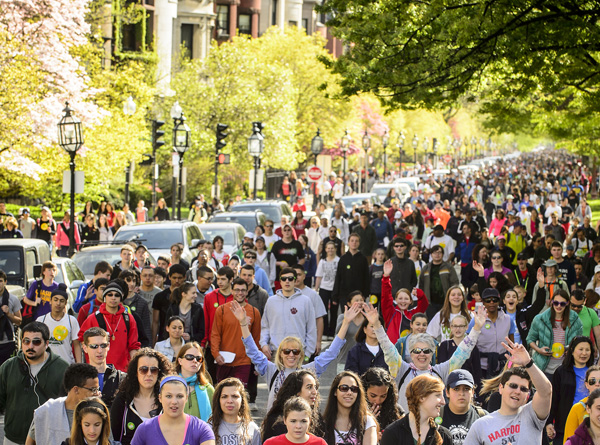
    The good thing about all this worrying, though, is that it has given rise to awareness. There is a desire to change things, and the citizens of the world are beginning to take things into their own hands. In the coffee shop down the road, a teenager is doing her part by getting her morning coffee in a reusable mug. On the other side of the world, someone is picking up an abandoned newspaper from a London Underground train and putting it in a recycling bin. Somewhere else in the world, a mother is picking up a candy wrapper from the sidewalk and admonishing her little boy for failing to throw it in a trash can. And this past Sunday, thousands of volunteers walked for Project Bread’s Walk for Hunger, raising thousands of dollars towards hunger in Massachusetts.

    According to Project Bread’s website, this annual walk has made ending hunger in Massachusetts a goal within reach. The simple gesture of walking has, year after year, had far-reaching consequences for schools and communities in Massachusetts. And if walking can spread the message and make a difference, so can the reusable mug, the recycle bin, the moralizing mom. Big change is ultimately a culmination of little steps towards it. Little steps that dare to shake the conviction that the world can’t be saved, or is too divided to be saved. The reason little gestures translate to big change is because the magnitude of the gesture transcends the action itself. All it takes is the simple recognition of the power that we have to bring about change, the ability to recall that first simple image of the world – as one big mass of land, with resources to be shared and maintained by all its citizens.

  • Cambridge Naturals: Local Eco Advise and Health Products

    Recently, we came across Cambridge Naturals in the Porter Square Shopping Center. Their mission, store, and service caught our eye and we thought we would share some of their story.

    We sat down with one of the owners, Michael Kanter, who discussed Cambridge Naturals’ role in the community.

    What is Cambridge Naturals’ mission?

    “While we are not a pharmacy,” answered Kanter, “our mission is to help people find solutions for their health issues. But our mission goes well beyond that. It includes trying to build a better society, and trying to promote locally owned independent businesses—to help be part of building a strong local economy.”

    Michael emphasized, “It’s about the relationships, not the initial sale. We want to provide the community with solutions.” In order to supply those solutions, Michael says that they spend a lot of time carefully researching their products, so that their customers get exactly what they need and so the community can thrive from it as well. “We research the brands really carefully both in natural medicines and supplements and in body care. We try and find products that are organic and fair trade. We try and find products that are made locally, or include some local ingredients.”

    Curious about the growth of the company, we asked Michael what the future was for Cambridge Naturals.

    “Our goal is to continue to thrive as a locally owned and independent business in Cambridge. We’ve almost tripled our business since we moved to our current location six and a half years ago. What we have in the works is to keep seeking out more products that are not available elsewhere and yet can help people enhance their lives.”

    So, here’s GLM’s take: If you are interested in natural health and want to support the Cambridge community, Cambridge Naturals is a solid recommendation. They supply everything from vitamins and herbs to groceries, books, body care, and even yoga and meditation items, many of which are made or grown locally. If you are in the area, stop in for a visit with the Cambridge Naturals team.

    Cambridge Naturals can be found at 23 White St, Cambridge, MA 02140, calling (617) 492-4452, or at www.cambridgenaturals.com

  • Cambridge Naturals: Local Eco Advice and Health Products

    Recently, we came across Cambridge Naturals in the Porter Square Shopping Center. Their mission, store, and service caught our eye and we thought we would share some of their story.

    We sat down with one of the owners, Michael Kanter, who discussed Cambridge Naturals’ role in the community.

    What is Cambridge Naturals’ mission?

    “While we are not a pharmacy,” answered Kanter, “our mission is to help people find solutions for their health issues. But our mission goes well beyond that. It includes trying to build a better society, and trying to promote locally owned independent businesses—to help be part of building a strong local economy.”

    Michael emphasized, “It’s about the relationships, not the initial sale. We want to provide the community with solutions.” In order to supply those solutions, Michael says that they spend a lot of time carefully researching their products, so that their customers get exactly what they need and so the community can thrive from it as well. “We research the brands really carefully both in natural medicines and supplements and in body care. We try and find products that are organic and fair trade. We try and find products that are made locally, or include some local ingredients.”

    Curious about the growth of the company, we asked Michael what the future was for Cambridge Naturals.

    “Our goal is to continue to thrive as a locally owned and independent business in Cambridge. We’ve almost tripled our business since we moved to our current location six and a half years ago. What we have in the works is to keep seeking out more products that are not available elsewhere and yet can help people enhance their lives.”

    So, here’s GLM’s take: If you are interested in natural health and want to support the Cambridge community, Cambridge Naturals is a solid recommendation. They supply everything from vitamins and herbs to groceries, books, body care, and even yoga and meditation items, many of which are made or grown locally. If you are in the area, stop in for a visit with the Cambridge Naturals team.

    Cambridge Naturals can be found at 23 White St, Cambridge, MA 02140, calling (617) 492-4452, or at www.cambridgenaturals.com

  • Moving Forward: How to Do What You Love for a Long Time

    As a filmmaker, to say you will be on your feet quite a bit is somewhat of an under statement. Part of me liked the idea of a filmmaking career because it wouldn’t be just a fun, challenging, creative job that exposes you to lots of different industries, varieties of life and culture, but it would be an active one. You have to get out of your chair if you want to make a film. If your reply is “I’m an animator; like the click-click kind, not the claymation or green screen shoot kind,” why not go out and take some photos of textures? Making your own textures is painless and much more rewarding, but the contents on this site is essentially what I’m talking about. If your excuse is “I’m just an editor,” well, I’m an editor too, and there are plenty of organic ways to edit. Just ask Oscar-Winning Hollywood editor Walter Murch (Apocalypse Now, The English Patient) how he edits. (For those who are looking for some balance, have a ball, or a kneeling chair). If your excuse is, “I don’t want to exercise—it’s hard,” there’s nothing I can do for you. You need this guy to help you.

    Proper ergonomics and health is a concern for everyone, filmmaker or not. As I mentioned, you have to get up to make a film. I know I’ll have to lug a bag or two or three, sometimes make a few trips or bring extra people just to set up a shot. At the end of a day of production it’s a good workout, and workouts give you energy to keep going during the day. But how many days really are you in production? As the guy running Green Lens can testify, productions are actually a small percentage of each project. There might be many weeks of pre-production planning, phone calls, emails, and meetings before getting on set. And once off set, now you are headed for that editing bay—sigh…more sitting.

    I founded GLM as a very green conscious entity, pulling from my own beliefs on environmental issues, so the encouragement of physical activity also fits nicely in with our business model. I try to promote this by biking to places when possible, taking public transport, and walking, all in an effort to support the reality that movement is a key ingredient to living and feeling well. Unfortunately, this for many has become an inconvenient, undesirable reality (wow, that was close—almost said an inconvenient you-know-what. Go see the film if you haven’t by the way; 7 years later it’s still an important piece of political, environmental, and film history).

    Apparently, we—Americans—aren’t walking a lot anymore.

    In fact, we are so comfortable taking our cars, and avoiding old-fashioned legwork, that reporter Franz Strasser of BBC World News America decided to do a story on it. According to his article, it seems the good Samaritans of Raleigh, North Carolina have been taking matters out of City Hall’s hands and into their own, posting signs telling pedestrians how far it is to walk from place to place. Where no city official has taken action or filed a permitting charge against the movement, it would appear the city approves of the initiative.

    The more reasons we have to be active, the greener, healthier, and happier we stand to be. With barely any Boston snow to speak of this past year, I think I‘ve seen more joggers outside this winter than the past 4 winters combined, so why not take advantage of the weather and treat yourself to a warm February stroll to the insert-your-nearby-store-here? (The ecological significance of the weather, or lack thereof, surely warrants its own post; we’ll save that one for later).

    Currently, I don’t have Murch’s upright editing station setup. However, I do have a small swiveling laptop stand that sits up on my desk at times throughout the day to give my seated self a healthy dose of stand. The takeaway here is whatever your industry is, see if there is a way to work in more exercise into the daily routine, whether it means a new chair, periodically standing while working, taking the elevator more, or walking to offices to give messages rather than emailing. It doesn’t need to be strenuous; just enough to give our bodies what they need to live a long, satisfying life. Don’t wind up like the humans in WALL-E with tiny bones swimming around in their bodies…somewhere…

    Focus of the Day:
    What do you do to keep moving?

    Film-tip: It’s tax time. iPad / iPhone users, if you haven’t already, check out Mint.com. It is a secure accounting management site you can use for free (there are paid upgrades), and there are some great apps to go along with. Mint is created by Intuit, the same guys responsible for Quickbooks. Credit to ColinReidDesign.com for telling us about this one way back when.

    Eco-tip: You remember to bring your reusable bags to the supermarket, but how many times do you say “yes” to the “do you want your chicken wrapped in plastic” question? If you are wary of raw meats coming into contact with the apples for you and your little ones, consider designating one small reusable bag as “the raw meats” bag. One more step to getting off the plastic bag bandwagon.