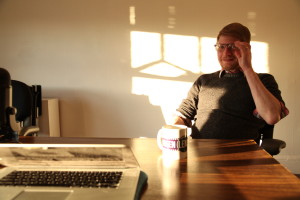
 Hello again, friends and compatriots! We’re jumping right back into our conversation with the head of Lesley’s Film and Animation department, Matthew Nash. Apart from his academic duties, Matt is an accomplished, award-winning filmmaker, most well-known for his powerful documentary film entitled 16 Photographs at Ohrdruf.
If you missed last week’s post, be sure to give it a look-see here!
———————————————————————————————————————————————-
ADAM GREENE: How did you decide to become a filmmaker?
MATTHEW NASH: Totally by accident. I’ve never been an artist who’s particularly wedded to a medium. It’s fine to be wedded to a medium, I’ve just found that for myself, I don’t like having to channel all of my ideas through a tool. I like to find the tool for my idea.
My creative partner, Jason, and I, had done a lot of videos. Experimental, weirdo goofy stuff. And then, super long story super short, we decided to make a mock version of Ross McElwee’s Sherman’s March, that actually turned into a serious project.
It was supposed to be a week-long gag, and we ended up doing it for two years. That’s a film that you should never watch. [laughs]
But, I learned a lot. I had moved into that mindset. We did an experimental, semi-narrative piece where the concept was basically two people, who are nowhere, talking using just a microphone and a speaker. [Jason] and I, over the course of several months, recorded all of our phone conversations, transcribed them, edited them, and then turned that into a script.
On its face, this could be a profoundly boring 15 minute short film. The solution that we came up with was that we wanted to take the production level to 11.
We rented 18 foot cranes, 20 feet of dolly track, really good microphones, really good production team, the whole nine yards. It was that experience that got me hooked on production, on process.
When [16 Photographs at] Ohrdruf fell into my lap, I didn’t even know what to do with it.
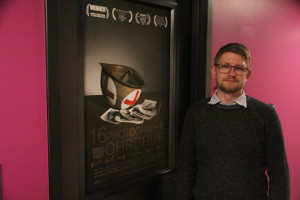
The backstory is that my grandfather died in 1991, and after he died, we found this packet of photos that he had taken at the liberation of a concentration camp called Ohrdruf.
In 2008, when Barrack Obama was campaigning for the presidency, on the campaign trail, he says something like, “My uncle liberated Auschwitz.” And of course, big scandal, because America didn’t liberate Auschwitz, the Russians did.
They found his uncle, and they interviewed him, and it turns out that he was at the Ohrdruf camp. So all of a sudden, I’ve got the uncle of the future president of the United States and my grandfather, and I can put them in the same place.
I dug out the photos, and honest to God, I didn’t know what I was going to do. Having just done the project inspired by Ross McElwee, his very personal narrative process, I thought, “That might be my approach to this. As I try to figure out these pictures, I’ll just bring a camera along, and see what happens.”
Initially it was just going to be some YouTube shorts, but a really close friend of mine is a high-end editor in New York, and he said, “I’ll edit this for you.” And my partner and producer in New York said, “I’ll produce this for you.” And he also wanted to do the soundtrack.
Once everything came together, and I started doing the research into the photographs, it followed its own course. If you watch the film, it more or less is chronological to what I did.
AG: How has your experience working on documentary filmmaking influenced your narrative filmmaking?
MN: I think I’m still getting my feet under my knee as a narrative filmmaker. I really enjoyed the sci-fi film, but when I watch it now, there’s some stilted dialogue or, you know, I could have given more direction at a certain point, things like that. These are the things you learn.
The big difference that I have found is that when you’re working in a doc mode, you lay out an outline, or sort of a trajectory that you want to take your viewer on. Then you set out to find people to interview, or find footage to meet the needs of each stage of the process. And as you find people, they tell you things that you hadn’t expected, so you’re constantly tweaking your script or your outline.
Whereas with narrative, the script is everything. You’ve made or broken your project before you’ve ever done a casting day. If you don’t have a good script, everything after that is wasted effort.
There are areas where editing, acting, rewrites can save you, but if you’ve set yourself out on a bad course, you’re stuck on that.
I have learned, as I look toward doing narrative work, to be much more upfront about flaws in scripts, whether they’re things I’m helping my friends on, or students are sending me, or my own scripts.
One of the big lessons from last summer was just making sure that you are on the right track, that you really understand what you are doing. You know how it is on set, your camera guy has a great shot, or your lighting guy can’t light the space that you want, and you have to be adaptable and you have to be flexible.
VIKTOR HERRMANN: Do you think your documentary background gives you an advantage in being flexible?
MN: I hope so. My own self criticism of when we did the sci-fi film is, I think, [that] I was too flexible. I think the project really would have benefited from a director, me, taking a much harder line about some compromises that were made. I think we would have made a stronger project if we had taken the extra two minutes to move that light or to reposition that tripod or whatever it is.
The thing that you can do with documentaries is you can go, “I’ll live with that.” I think the thing you can’t do with narrative is say, “I’ll live with that.”
AG: What advice would you give to students or filmmakers in general that are wading into the corporate sphere? A lot of corporate places don’t have time to help write scripts with you. They might say, “Well, just bring your camera and start unfolding the story, you’ll figure it out.”
MN: One of the things that I would advise people in that circumstance is to have your own script, air quotes here, ready to go. Have your default model firmly established. So if you’re hired in a corporate situation to do an on-the-fly thing, walk in the door knowing, “Here’s how I tell a story. It begins here, it goes here, it climbs to here, it falls to here, rises back up and ends.”
If you’re going to have to work on-the-fly, how do you assess which elements in front of you meet the needs of basic storytelling 101?
It takes skill, it takes practice, it takes an eye. It takes being able to recognize when the world is giving you the thing [that you’re looking for], and getting a camera on it.
If you’re just pointing your camera at things because somebody gave you a paycheck, you’re not going to make a good product.
One thing I say to my students is all of the thinking and understanding and planning and research and immersion into your medium, all of that happens before you ever take the lens cap off.
If you haven’t done that work, if you don’t understand your medium or how you speak with it, you’re just making footage.
AG: Why is video important as a teaching or marketing tool?
MN: I think where we have gotten with our video tools is that it democratizes things. It makes it fast. It makes it accessible. When I was a student, if you wanted to make a film, the process was arduous. But today, I could grab a video camera, and tell a story really quickly.
Nowadays folks who are working in video have to incorporate a vocabulary of cinema, of narrative. It doesn’t matter if you’re going into a corporate environment, an academic environment. You’re bringing to the tool all of its history and all of its vocabulary.
Partially because we are so media saturated, I think people are bringing a lot of that stuff intuitively now.
VH: Would you say there are benefits, even if you’re not pursuing film or video as a career, to having video skills?
MN: Oh, I think so. It’s one of the major and rising vocabularies that we have. Your phone shoots video now. Your phone shoots photos too, but more and more as I scroll through Facebook, I notice: It’s video. And frankly, there’s a lot of bad video out there.
One of the things that I know we’re going to face when we launch the digital filmmaking program, because we already face this in the photography program, is, “Oh, hey, I shot some cool pictures with my phone. I’m a photographer.”
This is not to devalue our students; anywhere a student develops a love for photography is totally valuable. But the ease of use and the ease of access [has made it so] amateurs can very quickly think that they’re professionals.
I think the same is going to hold true for filmmaking. “I shot a great short video on my phone.” Awesome! You know what? You can do professional quality work with your phone. But it has nothing to do with the phone. [laughs]
It has to do with whether you can use a cinematic vocabulary.
VH: Is there something that has influenced your filmmaking that perhaps doesn’t come from film, that perhaps would surprise people?
MN: Sure. So many things. One of the things that I talk about with my students is that inspiration comes from everywhere. You can go to the library and get the art history books, but you might be sitting at home watching an episode of The Simpsons, and it just clicks.
What goes in eventually comes out. I consume as much as I can get my hands on. I love 1950s horror comics. In fact, film students are all going to be required to read at least one volume of something from Tales from the Crypt, The Vault of Horror, Weird Science, the classic EC 1950-1955 Golden Age.
I think filmmakers should fall in love with this stuff, because it’s formulaic storytelling 101. By the time you’ve read 5 or 6 Tales from the Crypt stories, you’re like, “Oh, this is just formula.”
If you can take your brain to the next step, you can be like, “You know what? It’s a formula that I should probably learn.” If you go back to the 80s, HBO did what, 9 or 10 seasons of Tales from the Crypt episodes.
These comics are the script, the formula that allows you to do a successful 9 or 10 season series. Every episode is standalone. Think about The Twilight Zone.
It’s very formulaic. It begins in a certain way, it unfolds in a certain way, it reveals in a certain way, it climaxes in a certain way, it concludes in a certain way. Every time.
VH: And yet it’s still one of the greatest pieces of television ever.
MN: Exactly. Because you know what you’re going to get. And even though it’s different actors, different characters, different stories, you know.
And on one hand, it’s boring television watching. If you’re an educated viewer, you’re like, “Yawn.” But if you’re going to make this stuff? The thing I always tell my students is, “You can’t break the rules until you know the rules.”
To a certain extent, these are our rules.
AG: Can you talk about collaboration and the importance of developing good working relationships?
MN: Sure. I have lots of friends doing cool stuff, but it’s not like I picked my friends because they were going to be film producers or anything. I met some these guys when I was 16. I always tell my students, “If you surround yourself with cool and interesting and motivated people, they’re going to grow up to be cool, interesting, motivated people who do cool stuff.”
AG: I would say that applies to crews, too. I’d much rather work with somebody that I really click with, that I think is a really smart, reliable person, rather than just somebody who knows how to operate a camera really well. Because that first person will be able to learn how to use the camera really well with time. You can teach people, and you can teach skills, but it’s much harder to teach people skills.
MN: Yeah! On my sci-fi film last summer, we were a small crew so everybody wore multiple hats. Our associate producer, Rob, was also our lighting guy. And he brought this guy that he had been working with and liked, and the guy just flaked. He worked for half the morning, checked his phone, was like, “Oh, I’m bored,” and left.
This was a volunteer gig, whatever. But Rob cut him loose. This was his number one guy, and he dropped to the bottom of the list. Meanwhile, the boyfriend of somebody on my crew, his name was Joe, shows up, does an amazing job, and ends up getting hired.
Rule number one is just don’t be a dick.
AG: [laughs] That’s a great rule.
VH: Just for life in general.
MN: Yeah! It’s a people based business. You hire who you trust. I got offered a job in Hawaii a couple of years ago, and one of the things that absolutely terrified me was leaving behind this whole network of people that were beer-and-pizza friends, and I know if I called them up and was like, “Hey, I want to do a short film,” – I actually did this recently, I said, “Hey, Rob, I’m interesting in doing a short film,” and he said yes before I even told him the title or when it was or anything.
Having that network of people who trust each other… that’s how it works.
———————————————————————————————————————————————-
16 Photographs at Ohdruf can be found on Hulu, Vimeo, or Amazon Prime. Be sure to check out Matt’s, http://www.mr-nash.com, to find out even more about the man and stay current on what he’s cooking up next.