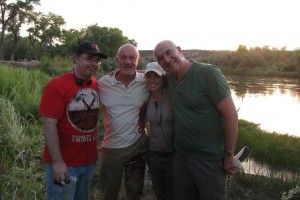
 Anybody who knows me knows that I love “Breaking Bad”. Hell, to say I love “Breaking Bad” is to say World War II was a minor international conflict. I adore the show. Every aspect. The performances, the production design, the editing, the cinematography, the music (both needle drops and score)—all of it is absolutely masterful.
But in themselves, great production, performances, etc, a compelling show do not make. What is absolutely mandatory for a terrific final product is a terrific script. A script worthy of the work put in by all those people on the production staff. Over the course of its 62 episode run, “Breaking Bad” has had 62 terrific scripts.
And some of the best (and certainly most kick-ass) of the bunch have been written by Tom Schnauz. Remember the one where Hank is attacked by the Cousins in a mall parking lot? That was him. Or how about when Walt buries all of his money in the desert and Marie confronts Skyler about the secrets she’s been keeping? Also him. Or the one in which (SPOILERS, YO) Walt murders Mike? Yeah, he wrote and directed that one.
All of this to say: when I reached out to Tom Schnauz for an interview, and he said yes—I was pretty freaking excited. A Breaking Bad fan himself, Adam Greene was also able to join the discussion. With that set-up out of the way, let’s not waste any more time, and get to the goods.
VIKTOR HERRMANN: So, I want to let you know that the moment in “Say My Name”, in 507, when it’s a medium shot of Walt, and he’s fuming, he’s just had the fight with Mike, and he walks out of frame and then he walks back into frame – that made my heart stop.
TOM SCHNAUZ: Thank you so much. We had a substitute camera man that day, and I remember he kept wanting to pan with Walt as he walked off, and I said “No, no, lock it off. Let him exit and then come back in.”
Vince had no idea. We usually write a lot of our shots in the script, even when we’re not directing, we’ll kind of direct it on the page, and that was not something that was written on the page. I remember I was very happy when Vince liked it when he saw it, because Vince has final say over everything and that was something I was glad made it into the show.
VH: I’m glad it did too, because that’s one of my favorite moments of the whole series. On that episode, on 507. The teaser is basically five or six minutes of dialogue, so when you went to shoot that, how did you prioritize what coverage you were going to get?
TS: That was almost a full day, that teaser. We also shot the stuff right after, the beginning of Act One, when Mike’s in the truck with the money and Jesse’s saying “what about me?” You can sort of tell that’s done right after. The sun is setting, it’s almost done in a oner, but we cut with a little bit of coverage.
We started the day, I remember I asked Bryan if he wanted to go first or wait. And I pretty much knew I was going to film Bryan’s side all up through lunch. So we got the opening, the face meeting, and then I went in for the close coverage on Walt, and just got a bunch of different sizes. I got as much as I could leading up to lunchtime. And I think I ended on his closer stuff, I think I worked wider and worked my way in.
I had everything storyboarded, I drew little sketches. And I think as time was going by, as lunchtime was approaching and I knew I had to switch sides based off that, I started dropping shots. But I knew I wanted the really wide wides, the great backgrounds and then, couple of mediums, and then went in for the tight stuff. His speech was covered almost all the way through, except for the really tight shots at the end when he says “You’re goddamn right”.
It was a learning experience. It was my first time directing, so there was a bit of a, you know, learning curve. But I had a great AD, Nina Jack, an amazing DP, Michael Slovis, so they held my hand through the process. [laughs]
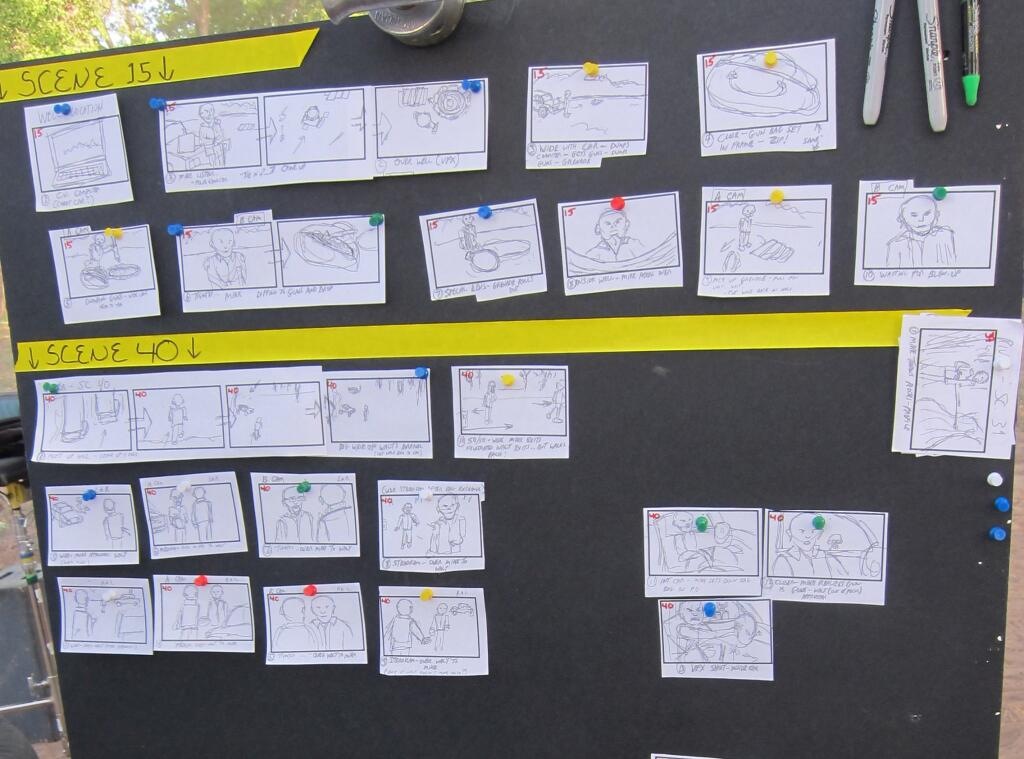
VH: Did you storyboard everything? The meth-cooking montage?
TS: Of all the things you’d think would be the more storyboarded one, but it was actually kind of the loosest. I didn’t exactly know what the set was going to be. I had a rough idea and I went in there knowing I wanted this movement from left to right, as if we’re circling the cook area. So I knew the majority of the shots would be “Okay, they’re at this station, the camera is moving left or right in a straight line.” And then we had B-Camera just picking up all these little bits and pieces. I ended up using those little B-Camera bits and pieces a lot more than I thought I would, thanks to our, at the time Assistant Editor, Sharidan [Sotello], who later went on to become a full Editor on my episode, “Buried”; she co-edited it. She was really responsible for a lot of that montage looking the way it did.
VH: Switching over to writing. What are your writing habits like? Are you someone who writes for a certain amount of time, or do you work towards a specific page count?
TS: I am a night writer. For some reason, my brain doesn’t start functioning until later in the evening. [laughs] When I have to, I’ll write in the daytime. I just came off this show “Resurrection” where we did a lot of writing in the offices, so I would write in the daytime there, but I get a majority of the work done at night. I tend to put some music on, and usually around nine o’ clock at night, I feel this sort of momentum happening, and at some point I sort of get on a tare. If there’s a deadline, I’ll stay up until four in the morning, or more if I have to. Whatever the deadline is.
I never say to myself “I’m gonna finish five pages tonight” or whatever. I’ll just keep going. And there are days where you get a page done. [laughs]
I just wrote my outline for my first episode of “Better Call Saul”, and I’m not a big fan of writing outlines, so it took me a really long time to write this thing. Just because I’m in the room and we’re breaking and I wasn’t getting a lot done at night. So I mostly did my writing on the weekends. I need a long stretch of time that’s allotted to writing. It’s a momentum thing. Once I get rolling, I feel like I can do a bunch, but if I do it in starts and stops, it’s not very productive.
VH: That’s kind of how I am, so I sympathize. Correct me if I’m wrong, but from Season 3 and onwards, all of the writers, except for Genny Huttchison, were producers, right?
TS: That sounds correct, yeah.
VH: How important do you think that was in delivering the uncompromised vision of every writer to the screen?
TS: You know, Genny was as a producer as much as the rest of us. The producer title is a writers’ guild bump, pretty much. Once you’re around a certain amount of time, you get a producer’s title. From my first show on, when I was on “X-Files”, I didn’t have a producer’s title, but I don’t do very much different now than I did then.
That was just the nature of Chris Carter’s and Vince and Frank Spotniz and John Shiban, their way of letting the writers be involved all through the process. It’s different on different shows, but I’ve always been lucky to work under their umbrella, where the writer comes in and they’re involved in casting and editing and every step of the way. For me, having that title is just an indication that you’ve been around a little longer.
VH: Hopefully a little bit of a paycheck bump too.
TS: Yeah. [laughs] But every writer, including Genny, produced their own shows. Genny was on set for her episodes, it was just because she was new, she didn’t have the title.
VH: Being on set, was that a major influence on how you directed your episode? Obviously you worked with Michelle MacLaren a bunch of times.
TS: Oh, yeah! I got to be in the shadow of a lot of really great directors, Michelle MacLaren being probably the most important person in my life as far as that’s concerned. And I got to be around Kim Manners on the “X-Files”, and Rob Bowman, he directed an episode of “Night Stalker” that I did. Yeah, I can’t say how important it was, watching them work. Especially Michelle MacLaren, on 307, 311, and 405. I met with her privately to get directing tips, so she was really important to me. If 507 is considered a success, I owe a lot to her.
VH: About 307. Jesse has the whole “What happens now” speech. How much of that was broken in the room, and how much was you just writing the dialogue?
TS: I remember specifically the stuff about wanting him [Hank] to put a gun up his mouth, that I can say for sure was me. And burn his house to the ground, because I remember I was kind of riffing on Clint Eastwood in “Unforgiven” when he says, you know, “I’ll kill your family, I’ll burn your house down.” I always had that in my head as a great threat to say to somebody. So, a lot of that stuff, I remember I specifically wrote.
Having said that, the talk in 307, between Marie and Hank on the bed, when he’s talking about “I’m not the man I thought I was”, that particular line I wrote with the help of John Shiban. We talked and he kind of got me to that point. But a lot of the talk leading up to that final line, I remember Vince was pitching out what the scene was in his head, so a lot of that dialogue came from Vince. Dialogue wise, I can say is credited to me, but that section was a lot of me copying down what Vince was saying in the room.
VH: You mentioned John Shiban and that just got me thinking; you wrote an episode with him, and I believe two with Moira Walley-Beckett. What was that process like? Did you just split it up, “I’ll take Act One and Act Two”, or was it more collaborative than that?
TS: I think racing for time on a lot of those episodes, it was a lot of “Okay, you do Teaser, Act One, Act Two”. I think on 311 with John, I did Teaser, [Act] One and Two, and John did Three and Four. I know I got a little dialogue in Three and Four, Saul talking about convincing a woman he was Kevin Costner.
On 409 and 412, Moira and I just divided up Acts. We ended up trading Acts and giving each other little notes, but not a lot.
VH: I’m curious about the gunsalesman character in 307. How do you approach writing a character like that, a walk-on?
TS: That was the very first thing I wrote for a Breaking Bad script. I went to that scene first cause I thought, this will just be goofy. I came up with all that nonsense about the woman who likes to be urinated on, but I was sure, I could have bet money that Vince was going to laugh at this and want to cut it or tone it down. And right from the beginning he loved it. Then we shot it, and I was like, “Okay, we’re going to cut this down”, then Vince in the editing room would laugh at it every single time. So, it was one of those things where I thought “Let me shoot for crazy, outrageous dumb stuff and see what happens”, and it stuck.
Honestly, for me, it borders on being a little too unreal. It’s a little too cartoonish with the comedy, but it stuck.
VH: Considering how dark that episode gets by the end, it was good to have that humor there.
TS: We always try to get as much comedy into these scripts as possible. I just had lunch with a friend who told me that watching the show, he always got excited seeing Bob Odenkirk’s name in the beginning. Especially in the later seasons, everything was so dark, and he when he knew Bob Odenkirk was in it, he knew there would at least be a moment of lightness, some comedy, amidst all the horror.
VH: I still love that whole “Star Trek” talk between Badger and Skinny Pete.
TS: Boy, Vince was pitching that forever. As long as I can remember, he’s been talking about that as a “Star Trek” episode, and it finally made it into an episode.
VH: Skipping towards the end, I know in the [Breaking Bad Insider] Podcasts, you guys talked about considering the “everyone BUT Walt dies” ending. So, what was it ultimately that made you decide that wasn’t the right direction to go?
TS: That’s one of those things, I don’t know if we could ever define why we made the decision we made, except that it felt right. That’s as much as I can really say about it. You kind of get a feeling that this story has to come to an end with him and his death. It started with him getting cancer, his death sentence, and once you have a character who has a death sentence, there’s no turning back. He’s going to die, either from cancer or because of his activities. You sort of have to reach that conclusion.
I mean, could it have worked if we had killed everybody else off? Yeah, but it would have been a different feeling we’d leave the audience with. I think we were all pretty much in agreement in the room. I don’t remember anybody clamoring to go that other direction. We definitely talked about it, but I think we were just exploring every option.
——————————————————————————-
That’s it for now, folks. Come back next week for the second half of our interview with Tom Schnauz, where he gives a spectacular answer to the old “what advice would you give” question, and tells us what we can expect to see from “Better Call Saul”!
 Rewriting is a sobering experience. All too quickly that story you’ve been convinced is better than anything Hollywood’s churned out in the last twelve years isn’t so great anymore. Suddenly the holes seem a lot more apparent. The little sections you knew needed to be rethought grow much larger. You realize you’ve got a lot of work left to do. You realize it’s time to rewrite.