Tag: Robert DeNiro

  • Harold Ramis Shares Some Words of Wisdom About Film’s Future

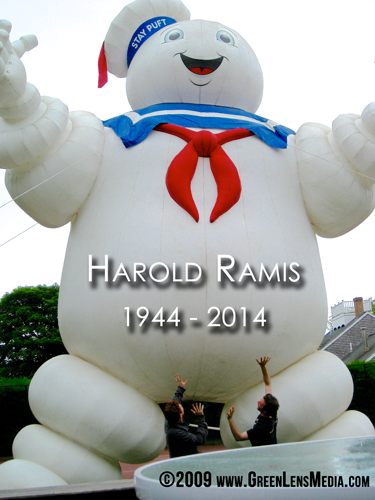
    Mr. Stay Puft lives again during the 25th Anniversary screening of Ghostbusters at the 2009 Nantucket Film Festival
    Mr. Stay Puft lives again during the 25th Anniversary screening of Ghostbusters at the 2009 Nantucket Film Festival
    What a blow. By now you’ve probably heard Harold Ramis, the force behind such movies as Caddyshack, Ghostbusters, Groundhog Day, and Analyze This, has passed at the age of 69. In honor of his legacy, I thought I would skip the circumstances of his death and the array of films he gave us, which you undoubtedly already know by now, and instead tell you an inspirational story of my brief interaction with him at the Nantucket Film Festival in 2009.

    The highlight of the festival that year had to have been Ramis himself, who was in attendance for three main reasons: to receive the Screenwriter’s Tribute, to premiere his new film Year One, and to celebrate the 25th anniversary of Ghostbusters. As someone who grew up with Ghostbusters, was completely transfixed by the multilayered themes and messages of one of my all time favorites Groundhog Day, and depended on Analyze This for more than one DVD date night, it was a particularly meaningful few days for me.

    First of all, I was tasked to be on the team blowing up the actual 25 foot Stay Puft Marshmallow Man that was used to market Ghostbusters when it premiered in 1984. Come on—does it get any cooler than that? This float dominated the skies, and stared out at the Atlantic from Siasconset’s Casino theater on the south side of the island. Getting Mr. Stay Puft to cooperate was a challenge, but somehow the group was able to cross the streams and get him into his new 2009 role as Mr. Stay Put. As guests arrived for a special screening of a brand new 35mm print of the film, he greeted them to their awe and delight.

    I met Ramis during the screening of Year One, while I was in the front entryway waiting for the film to end. With everyone seated in the theater watching the movie, Ramis stepped out some point near the middle to have some time to himself. Year One turned out to be not one his better movies (4.9 on IMDB, a 14% on Rotten Tomatoes), so perhaps the typical “director in the back gauging the audience reaction” wasn’t necessary in his mind. Factor in how many times he must have seen the film while editing, and perhaps it’s easy to understand why he would be stepping out. Whatever the reason, Ramis chose a wooden bench by the ticket booth, and got involved with some game or texting activity on his phone—I can’t recall which, though if I had to guess I’d say some kind of game.

    After a few minutes of this he took a brief nap, but must have had some internal clock wake him about 10 minutes before the end of the film. As he looked around, no phone in hand, I thought “if I’m ever going to talk to him this would be the chance,” so I did.

    It’s amazing how cool and collected you can head into a conversation with someone of his stature, and then completely out of character get all tongue twisted once you started speaking. That was me, but fortunately I found my steady voice before we got to a level of embarrassment. He smiled as I sputtered, knowing we both knew he was being very gracious to let me occupy some of his time, something no doubt countless fans and filmmakers had done before. I think he was amused not by the fact that I was trying to tell him how much I respected his work, but more by the direction I took our talk, which he seemed surprisingly engaged by.

    After the pleasantries and unnecessary gushing, I finally got to what I thought would be the most relevant and purposeful discussion I could come up with on the spot. I asked him if he thought film as we knew it would survive. Did he feel the access digital video gave filmmakers, with its ease, price, and increasing quality, would implode the professional market, and ultimately for those reasons overcome “Hollywood” looking content? Would the storytelling suffer? Would the good stuff be able to compete with quality gear getting so cheap, and the potential noisy flood of bad content springing up online more every day? And more so, would there even be a career in film by the time I “made it,” if that time ever came?

    He thought for a moment, and after reflecting on this told me that while the technology had changed in the past few decades, the core of filmmaking, the very root of motion pictures, was in capturing and telling a good story. “We can’t stop the way society is changing this profession,” he said, “so while it may become harder to get your work in front of large audiences, or into traditional theaters, or to get your film backed by a big studio so you can make the big bucks, in the end whoever can adapt and embrace the circumstances best will come out okay. If you love making films, just keep making films.”

    He asked me what I had done to advance my career, so I told him about starting Green Lens Media, and about making my first feature in high school years ago under a SAG student contract. He reiterated that while film as a format and industry would change, there would always be room for new stories and new filmmakers, who yes, could make careers of it if they worked hard enough for it. It was a sobering thing to hear that the industry I’d been pursuing for nearly a decade at the time was, according to this Hollywood insider, bound to be different, but also refreshing that he was so optimistic about its future considering.

    I was fortunate to get to hear this insight from Ramis, and it stuck with me despite the many other speaking events I saw him at throughout the festival. Most people wanted answers to things like “what was it like working with Bill Murray,” and “what’s the funniest thing that happened behind the scenes on such-and-such movie?” It’s sometimes easy to forget while starstruck that these are just people after all; people who, of course, are talented, but are also hard-working and even a little lucky. They might be able to point to a particular instance where they were in the right place at the right time to catch some opportune “break,” but isn’t that just something that would have happened eventually another way anyway, if not that way? In other words, if you work hard enough, if you “just keep making films,” eventually that lucky break will find you.

    Thanks, Harold, for all of your comedic genius for the time you were here. Thank you for your reassurances about the film business, and for believing in film’s future, as murky as it seems sometimes. I’d like to think that when we see an Egon hard at work inventing something, or a Dr. Sobel trying to figure out how to not die this time, or a Phil Connors making humor when there was none despite a desperate situation, there is in each instance an inevitable and eventual hope that evolves at some moment into something we have been looking forward to. It’s a great message, one that I and other filmmakers are inspired to see and be reminded of. You will be greatly missed, and I wish you all the best on your journey as I continue down mine, and continue making films.

    On a side note, if you ever care to haunt GLM (especially our scriptwriting software), that would be just fine; I promise you would be given Slimer status (the endeared, free-to-roam friend Slimer, not streamed-into-the-Trap Slimer).

    All the best,
    Adam

    Leave a comment! What are some of your favorite Harold Ramis movie moments, and what is your opinion on the future of the film industry?
  • The Right Song, The Right Movie

    piano&script06_fixed_v1.1I love all forms of art: visual art, music, performance, storytelling, etc. Movies are great because they combine so many of them. Among the best examples of this is the use of the perfect song in a film—the right song coming together with the right image. The combination creates moments that resonate with us. They make us think about the images the movie showed us anytime we hear the song. In fact, a very strong argument could be made that these are the most cinematic moments in movies.

    There’s far too many to choose from, but let’s break down just a few memorable moments, and attempt to examine closely why it is they work so well.

    GOODFELLAS – “Atlantis” by Donovan

    Here, I could just write “the entire movie” and move on. Martin Scorsese’s always been a director famous for the brilliant use of soundtracks in his movies. Goodfellas is perhaps the finest example of that. From Tony Bennett’s “Rags to Riches” launching us into the world of the gangster, the famous dead-body montage set to the outro of “Layla”, to the schizophrenic medley of classic rock and blues hits that take us through the paranoid, unbelievably fast moving life of a coked-out Henry Hill. The music reflects the emotional and mental state of the characters throughout all these sections of the story, and that’s why it’s so effective.

    Goodfellas is filled to the brim with amazing uses of popular songs, but perhaps my favorite is the scene in which Billy Batts is brutally beaten within an inch of his life, set to Donovan’s peaceful, beautiful hippie anthem “Atlantis”.

    At first, the song is very much in the background, almost unnoticeable on a first viewing. Donovan’s poetry (no singing here) over mellow chords comes in as Billy Batts and Jimmy (Robert DeNiro) are having a seemingly friendly chat at a bar. Tommy (Joe Pesci) enters the bar, the look on his face (and the fact that he was just insulted by Batts in the previous scene) telling us that some heavy stuff is about to go down.

    The calm, gentle music makes this quick rise in tension even more unbearable. Then… as Batts notices Pesci behind him, and DeNiro grabs a hold of his neck, a powerful drum fill takes us into the chorus. The music then gets bumped up in the mix, and the combination of its serene, catchy melody with the brutal beating we’re witnessing is shocking and horrifying—as the director intends it to be. Above all, though, it’s unforgettable.

    The cherry on top comes towards the end of the scene. The music dips down a little as Pesci looks over to Ray Liotta and says “I didn’t wanna get blood on your floor,” then it picks up again as we cut from his reaction—stunned and made all the more powerful by the music’s increase in volume.

    SPIDER-MAN 2 – “Raindrops Keep Fallin’ On My Head” by B.J. Thompson

    You rarely hear pop songs in superhero movies, and if this scene is any indication of how well the combo can work, it’s a shame. To set the scene up for those of you who might not be familiar with Spider-Man 2 (and if you’re not, shame on you!), the film is all about Peter Parker’s struggle to balance his personal life (his desires) with his job as Spider-Man (his responsibility). About halfway though the movie, he gets fed up and decides he’s not going to be Spider-Man anymore. So much so that he throws his costume in the trash! Gasp! Fade to black.

    From the darkness… the most beautiful ukulele chords, followed by the sun shining brightly at us. Then, right as the vocals come in, Peter walks into frame. Smiling. Blissful. Relaxed. The first time we’ve seen him be this way in the entire film. I really do consider this to be an almost magical sequence in the film. “Raindrops Keep Fallin” has been used in a number of movies (Forrest Gump, Clerks II), but never so perfectly as it’s used here.

    The lyrics, all about a person who has decided to be happy, even if raindrops keep falling on his head, fit so well with Peter’s state of mind during this portion of the movie, it’s scary. I almost feel like I don’t need to explain any further. Just watch the scene, and you’ll see exactly what I’m talking about.

    This is true movie magic. It’s as if the song was recorded specifically to be used over this scene. I honestly can’t even begin to think of another song that would have fit better.

    DJANGO UNCHAINED – “Freedom” by Anthony Hamilton and Elayna Boynton

    Like Scorsese, Quentin Tarantino is a filmmaker known for the exceptional use of popular music in his films. Pulp Fiction practically invites the audience to dance at certain points. Even though his last two movies have been period pieces (this and Inglourious Basterds), Tarantino doesn’t let that be a boundary. While neither Django nor Basterds are filled with pop music the way Pulp Fiction, Reservoir Dogs and Jackie Brown are, he still does use it, and to shockingly effective degrees.

    Take this scene: Django asks a slave on a plantation if she’s seen the Brittle brothers—his former owners, and the men he is looking for. She points one of them out to Django, he takes out one of those old-style retractable telescopes, and observes. As he spots him, the song’s rhythmic drums and tribal-style background vocals kick in.

    We cut to a flashback. The Brittle brothers. Tying Django’s wife, ready to whip her. Django pleads to spare her. The music is quite loud here, but the focus remains on Django’s desperate begging, and Broomhilda’s resilient face, getting ready for what she knows is coming.

    The song continues, loud and powerful, as we cut from Django and Broomhilda getting ready to escape, to Broomhilda about to be punished and Django pleading. Then… the whip cracks. Broomhilda’s gut wrenching scream fades into the chorus, now louder and more booming than ever.

    It’s horrifying. It literally sends goosebumps up my arm every time I watch the movie. This is a hard, hard scene to watch. The music’s loud, unrelenting bass line underlines the horror of this, and is one of the main reasons why this scene is not only so tough to watch, but also so gripping.

    As I said at the beginning of this post, there are COUNTLESS other examples of great songs used to great effects in great movies. What are some of your favorites?