 As of writing this, I am just a little over a month shy of graduating from Lesley University. It has been a fantastic four years, and I’ve been fortunate enough to meet some wonderful peers and professors.
My only complaint throughout was, “Geez, I wish there was more film stuff.” And wouldn’t you know it, right on the cusp of my graduation, Lesley announces that it’s starting a film program.
Ain’t it always the way?
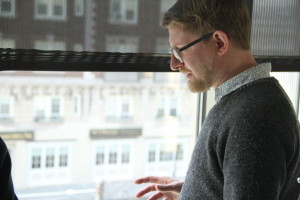
Adam and I sat down with Matthew Nash, who is the head of Lesley’s Video and Animation Department. As of the Fall of 2015, the department will include the brand new Digital Filmmaking program. We spoke with Matt about what potential film students could expect.
————————————————————————————————————————————————-
VIKTOR HERRMANN: Can you talk about the film program and what your plans are for that?
MATTHEW NASH: The film program launches in the Fall of 2015. We’re aiming to have 15-20 students in our first Freshmen class; obviously if we get more, it’ll be better. But that’s our goal. We’re going to roll it out over four years.
The four year program will have students doing filmmaking from day one. On average, they’ll take two to three film classes per semester. In the first year, Fall and Spring, their two core courses each semester are Concepts of Cinema, and Cinema Techniques. They’ll be working with an award winning filmmaker, who’s originally from Syria, a guy named Ziad Hamzeh. He’s a fantastic filmmaker.
He’ll be doing Concepts, introducing them to how to tell stories; all of the thinking stuff that goes into making television commercials, or experimental media, or narrative media. The rules are the rules are the rules, right?
And as he’s giving them assignments that push the way that they think about filmmaking, I’ll be meeting that with a technical course, giving them the skills and the techniques, whether it’s camera work, rigging, lighting, etc, to meet the assignments that he’s doing.
We want, at every stage, to be feeding their brain and how they think, and then to back that with the skills to make it happen. The whole four year program is designed that way. It’s different from year to year, but we’re always backing ideas with skills.
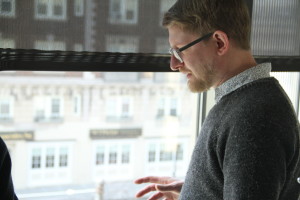
In the Junior year, the goal is to put them into teams that will actually shoot a short film over the course of the year. So they’ll do pre-production and production in the fall, and production and post-production in the spring.
It’s really important that our students get a chance to wear a lot of hats. Not everybody is the director, and you’re not the director all the time. So, if you can be a good sound-tech for somebody’s project, or a good gaffer, or a good production member on somebody’s team, you’re still valuable. We all came up through the ranks being a part of other people’s projects first.
And then, Senior year is thesis year. We want our students to walk out the door with film festival winning, high-quality short films, whether they’re experimental or narrative. We want them to have a whole year to build up to something that showcases how awesome they are, and how awesome our program is. So that’s the goal.
VH: That sounds fantastic.
ADAM GREENE: It does, and it also raises some questions about some of the other well known film schools in the area. Is Lesley trying something different that those schools aren’t doing?
MN: I think there are three things that will really set this program apart. One, all of our students, no matter what program they’re in, are required to do a professional internship. Getting into the industry you want to be in is hugely important to us.
We’ve shot some great Hollywood films in Boston, but there’s a lot of independent film going on here, a lot of independent documentaries going on here. And not all of that stuff is permanently fixed in a building where you can go and knock on the door. We’re getting our ear to the ground so our students can get in on some of these things that might only exist for the length of a production.
And at the same time, talking to guys like you, where there are great internship opportunities. That’s one thing that our program has always been really strong on: Internships. We are a professional school. We talk a lot about professional practice.
Students are coming to us because they want to do this for their livelihood. You don’t spend four years and God knows how much money to then graduate and never do the thing.
But at the same time, our educational background means that we’re not just making you a technician. We’re making you a full-rounded thinker.
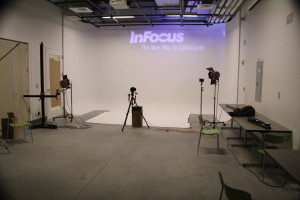
Two, we’re launching a program in 2015. We’re not burdened by a past of how it was always done. We’re not anchored in any way to any history. We can look at the state of the market in 2015 and say, “These are the things that our students need to be successful.”
Three, when I talk with potential students and their parents, one of the things that I talk about is the fact that we all consume huge amounts of media nowadays, and a lot of it is short form. The standard 22 minute television show, the standard 90 or 120 minute movie, those still exist, but Hulu, Netflix, Amazon… they’re changing the game.
Our students will be graduating into a media market that is not locked into a lot of the standards that we have taken for granted for so long. We’re baking that right into the cake from day one, and thinking, “How do we get students making strong work that will survive?”
Our first graduating class will be in 2019. So, what is a successful digital filmmaker in 2019 going to look like? There’s a lot of question marks around that, but you can trace some trends, and you can make some educated guesses.
Obviously it would great to have students who go off to New York or Hollywood, but we also know that they can be successful doing the kind of stuff that Green Lens Media is doing. Corporate work, short form work, advertising, short web narrative.
Every time you go to YouTube, you have to watch a commercial. Somebody got paid to make that 30 second ad that you don’t want to sit through! It’s maybe not the most glamorous side of the business, but these are all paying gigs that can support real professional creative practice.
AG: I can definitely tell you, as someone who came from a bunch of film related programs… the one thing that would have made the most difference would be a background in business. How to communicate with clients. That is so huge, and it’s not even being talked about.
MN: That’s funny, you almost took the words right out of my mouth. Most of my friends in New York who are quote-unquote “film industry types,” they’re on the production-house side.
They’re not running cameras or dealing with actors, they’re either dealing with budgets or managing production teams. They’re line producers, they’re production coordinators. They’re not talking about the glamour, hanging out with celebrities every day. They’re talking about booking flights and renting camera gear; which is just as much a part of the business as anything else.
We’re sneaking some of that in through those Junior and Senior year classes, where students have to do pre-production, production and post. You can’t do pre-production, even on a student project, without making a budget. Without organizing your team. Without scheduling. Without planning.
If you walk in and tell students, “Alright, this is a business planning class,” they’re all going to get up and walk out the door. But if you say, “This is pre-production for the movie you want to make,” then all of a sudden it’s like, “Yeah, okay, now a spreadsheet sounds interesting.” [laughs]
A spreadsheet is a tool. Just like a camera or a tripod is a tool. So we’ll just have to get students to appreciate the spreadsheet when it’s appropriate, when it’s useful, and in its context.
AG: That’s very valuable. Everybody thinks, “Oh, I’m going to be the next Peter Jackson, and not need to bother with that, I’m just going to focus on my art.” But the fact is that in order to build up enough capital to do those kind of projects, you have to work in the trenches, and you have to do some of these very basic business things. So, it’s good that Lesley’s working that in.
MN: Yeah. Last summer we did a little short sci-fi film, and it was an all volunteer thing, lots of students, people doing it for the experience. And even that ended up running about $10,000 dollars when it was all said and done. Just for a couple weekends of shooting, pizzas and coffee, renting gear and hotel rooms. It adds up super fast.
That’s one of the reasons that we’re not going to emphasize the feature [film] in this program, because it’s an undergraduate program, and because it’s prohibitively expensive to do a feature. Even a five or a ten minute short, on a student budget, could get prohibitively expensive.
AG: It comes back to what you were saying before. The landscape is changing anyway. So why not embrace it? And say, “We’re going to focus on short form, and even corporate advertisement.”
MN: Yeah. So much of the basic stuff transfers over. A lot of nice cameras have been showing up, so a handful of students have been like, “You got a Blackmagic 4K? I want to shoot with that!” Great. First thing you have to do is buy 8 terabytes worth of hard drive space, so that we can work with this footage.
And they’re like, “Wait. What? I’ve got to go buy four hundred dollars worth of hard drives before I can even consider starting this project?” That’s the kind of prohibitive thing that we’re talking about. You have to create infrastructure inside your college for boring stuff like data. For footage. People who look at it from the outside see it as sort of, “It’s easy, you just get a camera.”
VH: Talking about changing landscapes, do you have any overarching visions for this film program five, ten years down the road?
MN: I think where the program will really shine, will really have its character, is in our elective packages. At this point we’re at least a year away from really implementing those, but I threw up a Google Doc, and I asked some of the development team, the faculty, to make a list of everything they’d like to do in the electives.
Things like green screening and compositing, which would be great with our animation classes, of course. A course entirely dedicated to music videos. Some really whacky ones. One professor pitched a low-budget DYI special effects class.
VH: Not visual effects but special effects?
MN: Yeah, like practical effects. Anybody who’s ever seen the making of Saving Private Ryan, you see Steven Spielberg talking about how they would put a little stick in the ground with some dirt on top of it, and if you stepped on it really hard, it made it look like a landmine exploding. Practical effects like that for student projects and lower budget projects, what a great thing to give our students.
AG: Home Depot 101.
MN: [laughs] Exactly. There are great things you can do with 3D animation, with game engines, and in post. But sometimes you just want the practical effect. Those are some of the areas where my brain is churning right now. I think when we start having real serious conversations about which elective we’re going to roll out first, frankly, it’s going to involve the students.
Part of my pitch to potential incoming students for the fall is saying, “This is the wild west. You are pioneers. This is the Oregon Trail. Nobody has done this before. You will be the first. Which means you’ll have a huge amount of say in what we do.”
The 2015-2016 group and the 2016-2017 group, those first two classes are probably going to influence this program more than I ever could.
Unlike the folks who are maybe more in the fine arts, as a film student, you are immersed just as much in pop culture as you are in fine arts. There’s tons of film out there that’s cinema, you can go watch your Felini, or David Lynch’s early work, there’s experimental stuff. But most of our students are arriving at our door because they loved watching Gladiator and Transformers.
It’s really interesting to hear their different motivations. I have robust e-mail lives with a lot of the folks who are looking at our program. Each one’s motivation is different. One guy just wants to do horror thrillers, another guy’s done all comedy pieces. A lot of them don’t know what they want yet, they’re just mimicking what they see and what they like. So it’s a program that’s going to have a really interesting relationship to the mainstream, which you don’t necessarily see in a fine arts program.
————————————————————————————————————————————————-
Sounds exciting, doesn’t it? By all accounts, Lesley intends to create not just talented filmmakers, but working, successful ones. Even though personally I won’t get to be a student in the program, its existence makes me both very excited and very happy.
Tune in next week to the 2nd part of our conversation with Matthew Nash, which will delve into his personal experiences and influences (some of which you might be surprised to learn).