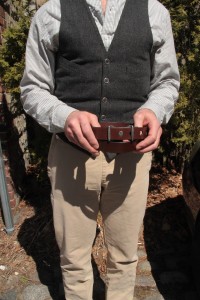
 We live in a time of constant upgrades. That brand new smartphone? Replaced by the latest model in a matter of months. That top-of-the-line gaming rig? Obsolete by the end of the year. That hip new fashion trend? Only hip until the newest “latest and greatest” trend takes over. We buy things, use them until they break or go out of style, then we replace them, and the whole cycle begins again. To Mark Paigen of Osmium Apparel, this disposable mentality is not the answer.
On one of the first truly beautiful days of the year, we sat down with Paigen to discuss his life, his company, and just why buying the same disposable products everyone else is buying is hurting us not only as consumers, but as a culture.
“Increasingly,” Paigen said, “fashion and our preferences have become global. The same H&M store you see in Boston, you’ll see in Hong Kong and Berlin and Paris, and they’ll be selling the same styles across the continents.”
To him, this homogony of fashion accomplishes little more than taking away what makes cultures unique. “When I go to Italy, I don’t want to eat a hamburger. I want to eat great Italian food. And I think the same should be true of style, and the things we buy. They should reflect our local culture, our communities. That’s what Osmium is about. Buy things that will last a long time; that will become your favorites and won’t be obsolete in six months.”
Of course, even the highest quality items will eventually break, and Paigen acknowledges that. “I love fixing things,” he said, “I have a ski-jacket that I’ve had for a dozen years, the draw string blew out on it and I got it fixed. I really like that mentality of buying really good stuff, taking really good care of it, repairing it when it breaks.”
Not just content with fixing things, Paigen also has a drive towards creating, which undoubtedly stems from his love of nature. We talked about his time as an organic farmer, the “Long Distance Running and Bread Baking” class he took in college, and other experiences which left us with the distinct impression that this is a man who loves being outside, loves working with his hands, and loves to take a unique approach to his work. He couldn’t help a sly smile as he told us about the history of Osmium’s distinct Mobius belt.
“I had the idea [for the belt], the concept, and I sketched it out, went to a product development firm, and they gave me a price of $18,000 to prototype the buckle. So, I went to Home Depot, I bought a piece of aluminum, and some threaded parts, got my drill out and I prototyped one-half of this buckle. I tried the concept, and the concept worked.”
Though perhaps what intrigued us most about Paigen was not his creative approach to problem solving nor his love for nature. Rather, it was his sincerity. When it came to his own shortcomings, Paigen was perfectly candid.
“I consider myself an environmentalist, but I don’t do everything I could possibly do. I could ride my bike to work every day. I don’t. I could have bought a car with better mileage, but I needed more room. I’m painfully aware of all the choices I have made that are not perfect.”
Just as with repairing items instead of replacing them, Paigen is a man who practices what he preaches. “When I look at someone else and they seem perhaps less perfect [in their care for the environment] than I am, it’s easy to judge. But who am I to judge? All of us could do better, and there has to be a way to reach out to people in a non-judgmental way.” One such way Osmium is giving back is through its membership in 1% For The Planet, a pledge which gives 1% of sales to deserving environmental organizations.
The point is, like the clothing he designs, Mark Paigen is a distinct man with a distinct view. His and Osmium’s mission is to bring the local focus back to fashion. Green Lens feels in sync with Mark on his perspectives and his intentions; plus, we genuinely liked his style, too. And even if his products aren’t right for you, his philosophy is certainly something we can all strive to implement a little more.
You can learn more about Mark and Osmium’s Made in the USA clothing line at his website, www.osmium.com.