Tag: future

  • To Film or Not to Film? That Is The Question

    Being in film school makes you feel like you’ve aged 50 years in the span of two. Don’t get me wrong. It’s not a bad thing.

    I grew up in India, a country with brilliant minds and bold hearts. A country where your average young person is capable – and driven – enough to be exactly what they want to be, and be successful at it. But for the young Indian, being successful isn’t even the difficult part. The difficult part is self-knowledge. Knowing what you want to do. Finding the power to know, in a country where your future is determined as soon as you’re born: doctor, lawyer, engineer, business executive.

    When I applied to college, I applied as a journalism major. Far enough from the Indian career mold to be creative, but not so far that I can’t bank on the degree to get me a job when I graduate. The perfect balance.

    But coming to college changed everything.

    The idea of getting involved with filmmaking emerged from the experience of moving to the United States. I was in a new city, a new country, a new world. I was given a chance to rewrite my story, make new memories and, most importantly, get to know the person I would become. Suddenly, I was exposed to people from all over the world – my roommate was Korean, my best friend was Mexican, my study partner was half-Polish. Being surrounded by interesting people and interesting stories makes you fall into storytelling, even if you didn’t set out to do it.

    I’d always been interested in film, but it had never occurred to me that it was something I could do forever. There was something so exhilarating about the concept of creating something from nothing: of engaging in a craft founded in emotion and unpredictability; an outlier in the textbook-and-problem-set world of conventional knowledge.

    Think about the great directors of the world, for example. Alfred Hitchcock, Quentin Tarantino, Stanley Kubrick, Martin Scorsese (to name a few.)

    Now try separating film from filmmaker. You can’t.

    Every storyteller is unique. They vary in so many ways, but are great storytellers nonetheless. There are no formulas and numbers involved in storytelling. No right answers. No wrong answers. Just instinct and imagination.

    Terrifying, isn’t it? Having no rules? I can’t say it isn’t.

    But I wouldn’t be able to call my life a full life without stories. My life has been characterized by change. I’ve lived in Mumbai, Boston, Paris and London – I’ve been challenged, pushed out of my comfort zone and made to build up from scratch. By being exposed to stories and the storytellers that tell them, I’ve grown beyond the 20 years I’ve spent on this planet, because none of the places I lived in ever came with rules. But they came with faces, places and stories that are such an important part of my life. And that’s why I could never be a doctor, lawyer, engineer or business person.

    It might be human nature to fear the unknown, but it’s a filmmaker’s instinct to embrace it.

    Is it terrifying? Yes. Is it worth it? Absolutely.
  • Coalition of the Willing: Inspired Work, Inspiring Work

    I have a complicated relationship with film.

    For the most part, I love it. I love that it can inspire, empower and liberate people. As a medium, it is limitless – it can tell stories previously untold, tap emotions previously untapped and explore parts of the world previously unexplored.

    But here’s my problem: commercial film rarely ever does.

    Yes, Ryan Gosling is stunning. And so is Emma Stone. Alright, I get it.

    But why are we making a movie about it? That part, I don’t get.

    With all the fandoms, poster boys, Jennifer, and plotless excuses for movies popping up everywhere, I can’t help but feel disillusioned by film. But every once in a while, a movie comes along to remind me that Ryan Gosling and Emma Stone haven’t completely taken over. On one of my many afternoons spent idly browsing Vimeo for inspiration, I stumbled upon a film by Knife Party that reinstated my faith in the wonders of the medium.

    Coalition of the Willing, is, as the title suggests, the collective brainchild of a brilliant coalition. The film addresses an issue burning with actuality (pun intended!) – the issue of global warming. And yet…there are no pie charts, bar graphs or visuals of receding ice caps viewed from outer space.

    That’s the beautiful thing about this film. It succeeds not despite but because of the lack of statistics and infographics in its storytelling. Because when you really think about it, global warming isn’t an issue that’s as far away and distant as the statistics and satellite images often used to represent it.

    It’s personal. It’s a choice.

    Throughout the film, the visuals follow man and mankind. Our evolution, our changing times, our history, our politics, our sociology. Visually, it is absolutely stunning. I felt myself being increasingly drawn into the world of the film – our world – and it wasn’t difficult to understand why the movie walked away with the Best Short Award at the 2012 San Francisco Green Film Festival.

    The stunning animation and smooth flow of the film transports the viewer back in time, employing the memorable image of a ’50s businessman turning into a hippie to chronicle the radical individualism of the ’60s. As the colours get brighter and the backdrops increasingly complex, the individualism fades into consumerism and the whole movement eventually culminates in a lack of regard for the world around us. The status quo.

    Although humanity took a turn for the worse, the film isn’t pessimistic about it. Not in the least. There is a palpable vibrance in its visuals, a quirky hopefulness in its scoring and an awareness of the power of individual efforts. It connects the past with the present, muses about the many changes that humanity has undergone, and, above all, provides hope for the future. Its look, feel and message work together to do what film fundamentally ought to do: awaken and stimulate the minds absorbing it. The film brings the concept of coalition to life and itself stands a testament to the wonders achievable through creative minds coming together.

  • One Small Step for Man, One Giant Leap for Mankind: Boston Walk for Hunger

    If you look at an early map of the world, you’ll see a sphere. In that sphere is land – two large chunks of it – and water. If you look at a map of the world today, you’ll still see land and water. But they don’t exist within a sphere, nor do they exist in big large chunks. They’re divided. The creators of these divisions divided the large chunks of land into all kinds of odd shapes, colour coded them by money, population, economic power. Even the vast expanse of blue within which they all float is divided – this ocean, that plate, this channel.

    With these divisions so deeply ingrained within our cognitive understanding of the world, it is sometimes difficult to remember that these lines that divide up the world aren’t much more than what they appear to be: ink on paper. The interesting part about this ink on paper is that the ink was probably made in a completely different place than the paper; and the cartographer using the ink and paper sits on a wooden chair made in another chunk of land altogether. What the ink, paper and wood ultimately represent, then, is the people of the world whose needs brought them into existence: people, who, despite the divisions that separate them, partook in the shared experience of living on this planet and subsisting on its resources.

    Because the world gradually became bigger and more divided than it once was, it became easy for people to lose sight of the bigger picture. While words like “pollution,” “climate change” and “fossil fuels” began to pop up in the world’s vocabulary, they were written off as far-fetched, too conceptual to truly materialize. When they did begin to materialize, the first instinct was to worry. After all, the world is so much bigger than the people who consume its resources.

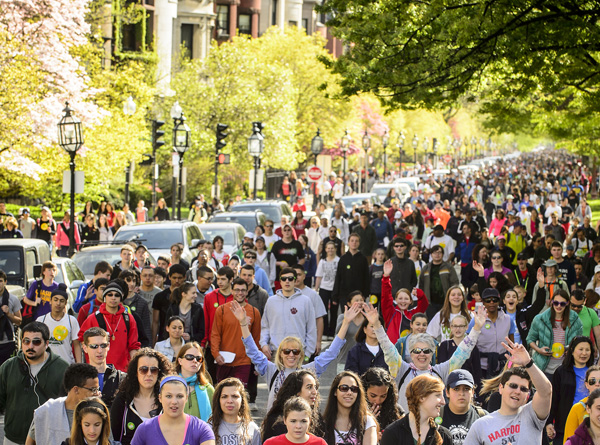
    The good thing about all this worrying, though, is that it has given rise to awareness. There is a desire to change things, and the citizens of the world are beginning to take things into their own hands. In the coffee shop down the road, a teenager is doing her part by getting her morning coffee in a reusable mug. On the other side of the world, someone is picking up an abandoned newspaper from a London Underground train and putting it in a recycling bin. Somewhere else in the world, a mother is picking up a candy wrapper from the sidewalk and admonishing her little boy for failing to throw it in a trash can. And this past Sunday, thousands of volunteers walked for Project Bread’s Walk for Hunger, raising thousands of dollars towards hunger in Massachusetts.

    According to Project Bread’s website, this annual walk has made ending hunger in Massachusetts a goal within reach. The simple gesture of walking has, year after year, had far-reaching consequences for schools and communities in Massachusetts. And if walking can spread the message and make a difference, so can the reusable mug, the recycle bin, the moralizing mom. Big change is ultimately a culmination of little steps towards it. Little steps that dare to shake the conviction that the world can’t be saved, or is too divided to be saved. The reason little gestures translate to big change is because the magnitude of the gesture transcends the action itself. All it takes is the simple recognition of the power that we have to bring about change, the ability to recall that first simple image of the world – as one big mass of land, with resources to be shared and maintained by all its citizens.