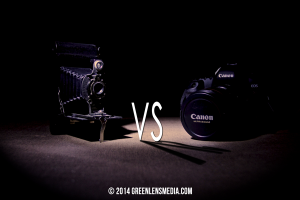
 Oh, this here, folks, is a fun one. Film vs. Digital is one of those debates that movie fans just cannot seem to stop having. If you’re not familiar with the difference, basically it boils down to this. Film means literally shooting footage on rolls of film (traditionally 35mm), and it’s the way movies have been shot for decades. It provides a beautiful, warm image that many consider to be cinema. But it also has its drawbacks.
Digital, on the other hand, is usually more cost effective, allows you to shoot to your heart’s content, and, unlike film, isn’t vulnerable to physical damage. Unless you smash your camera with a hammer, I guess.
For many, film’s inconveniences are plenty worth putting up with for the finished product. They swear that digital can never look as beautiful as film, or (if they’re of the more radical nature) that it’s ruining cinema all together. Personally, I happen to lean more on the film side of the argument. I think well shot film is stunning and I love the alive feeling it gives an image, with its grain and little imperfections.
BUT. There are also plenty of movies shot on digital that I think look miles better than the majority of “film films” out there. In the hands of a talented cinematographer, digital filmmaking can look absolutely glorious—and achieve effects that film can’t.
So, in the spirit of playing devil’s advocate, I decided to create a list (in no particular order) of movies shot on digital that do just that. If you’re a die hard fanatic of “film films” and think anything else is just a rip-off, hopefully this can make you see the enemy in a kinder light.
Hugo – This really could be the start and end of the argument. If digital is good enough for Martin Scorsese, then it’s damn well good enough for you. Hugo looks like a storybook brought to life. Crisp, vivid and breathtaking. I haven’t gotten a chance to see it in 3D, and though I don’t usually like 3D, I have a feeling in this case, it might really add to the experience.
Sin City – With Sin City, Robert Rodriguez managed to bring a comic book world to life like no one ever had, or has since. A perfect example of using digital filmmaking together with stellar visual effects to create a unique style that is unlike anything else out there.
Gravity – If you didn’t get to experience this movie in theaters, then I’m sorry. As pretty much any review will tell you, Gravity is a visceral experience that ties the audience into the seat of a roller coaster and refuses to slow down. The beautiful imagery, combined with basically flawless CGI, creates a thrill ride that is one of the quickest 90 minutes I’ve ever had in a movie theater.
Red State – Okay, so I know you’re thinking that all of the previous movies were special effects driven pictures which would of course work better with digital. Well, calm down, cowboy. Cause here’s Red State. Kevin Smith’s $4 million horror flick creeps up on you and forces your eyes wide open. The sharp, almost clinical look of the digital photography gives the movie an unsettling feel that resonates in the audience’s mind from first frame to last. To put it simply: film would have been too pretty for Red State.
Collateral – Michael Mann can do amazing things with very little. It’d be hard to find a better example of that then Collateral . What’s essentially a basic, almost clichéd, noir story is made into a thrilling, personal narrative about people and the city of Los Angeles. Mann’s digital filmmaking gives the movie an extremely realistic, almost documentary-like look; a major reason why it works so well.
The Girl With the Dragon Tattoo – I could have just easily put The Social Network or Zodiac here, but there’s something magical about The Girl With the Dragon Tattoo’s bleakness. From the pitch black apartments to the paper white Swedish snow, there’s intensity and suspense almost every frame. It’s hard to describe, but it’s immediately sensed while watching the movie. It’s an effect digital filmmaking helps achieve.
Drive – Drive feels like a dream. A strange, violent dream with pulsating dance beats and lush, absorbing colors. It’s a testament to the power of visual storytelling, and the beautiful cinematography has a lot to do with that. When I found out that Drive was shot digitally, I was shocked. I couldn’t believe colors that deep, that rich, could be achieved with anything short of the highest quality film camera. Drive is proof that they can.
Skyfall – Roger Deakins is one of the most talented people to ever hold a camera. That’s about all that needs to be said. Legendary filmmakers from the Coen brothers to Sam Mendes have called on him time and time again to give their movies that exquisite visual touch. Deakins’s work on Skyfall doesn’t reestablish, it only confirms his well deserved reputation as the master of the camera. Every single shot in the movie is a gorgeous painting, worthy of hanging in a museum. And you need look no further to find as compelling an argument for digital filmmaking.