 Alright, friends, let’s not waste any time here. Diving right back into the second half of my and Adam’s interview with Breaking Bad writer/director/producer Tom Schnauz!
VIKTOR HERRMANN: About the end [of the series], this is just a little aside, but do you know whose idea it was to use “Baby Blue” as the outro song?
TOM SCHNAUZ: I’ll say with 96% certainty that it was Vince. He used to come in a lot of times and say “Here, I heard this on the radio.” Certainly the… holy moly, I’m drawing a complete blank. The song we used in 508.
VH: “Crystal Blue Persuasion”?
TS: Yeah, that was definitely a song Vince had been wanting to use for a long time. So I’m pretty sure “Baby Blue” was the same, too.
VH: What did it feel like when you finished the “Buried” script and you realized this was the last Breaking Bad script you would ever write?
TS: It was pretty depressing. [laughs] I gotta say, it was really, really tough. It was a very strange time for me. My own father passed away from cancer right in the middle of filming, and that episode is dedicated to him. There was a sadness to the Breaking Bad family breaking up, but I was going through my own thing with my own family, so maybe I would have been more emotionally torn by Breaking Bad ending if I didn’t have this other stuff going on in my life that was devastating.
VH: I don’t think anyone could blame you for that. So, now, you are in a way, still writing the characters. Now that you’ve been in the Better Call Saul writers’ room for a while, how has the idea of what the show would be like changed from what you thought it would be like before you got into the room?
TS: I don’t know if I had a clear idea. I think some part of me knew it was going to be, kind of carrying on the tradition of Breaking Bad, that same feeling. I think if you had asked me before we started, I may have said that this is going to be a more comedic version of the show. But part of me probably knew, inside, that it was going to have that same mix of drama.
We are attacking this just like our Breaking Bad episodes. We wonder where the character’s head is at and go from there. We don’t try to think “What’s the big comedic set piece?” or “What’s the funny thing we’re going to do?”, we do it from an emotional “What does our character need” type of thing and go from there. If it’s funny, great. Bob Odenkirk is incredibly funny and I think even the serious scenes, he’s going to find, you know, the little flash of humor here and there.
VH: So far, is Better Call Saul as serialized as Breaking Bad or is each episode more of its own thing?
TS: I’ll say it’s just as serialized at this point. We’re only five episodes in, but I mean, we’re just doing the kind of writing we know how to do. Which is serialized, following the character and his development.
The interesting thing is, you know, this is a prequel to Breaking Bad, of course, Mike Ehrmantraut’s coming back… so we’re in this really interesting situation where we know where the characters are going so instead of having this freedom of letting a character, you know, go off wherever it needs to go, we sort of know where we have to end up. So it’s like we’re fitting these puzzle pieces into this space.
We’ve created the start point, and we know the end point. We’re really trying to maneuver within the reality and history that we already have.
VH: Has that been challenging? Have you found something maybe you’d like to do but it would conflict with the Breaking Bad continuity?
TS: I think so, I think there’s been a couple of times where we’ve been like, “Oh, this is good!” and then someone will say, “Well, you know what, in episode 208, when Saul’s introduced, he says this and that”, and we’re like, “Oh, shit.” [laughs]
You know, we have what we’ve established with Mike and his granddaughter, Kaylee, and Kaylee’s mom, and what that situation is. We’re trying to explore why is mom there but not dad? We’re exploring that a little bit. I don’t want to say too much without spoiling things.
VH: Of course. When we e-mailed, you mentioned you were working on your first Saul outline. I’m assuming I can answer this question myself based on what you said, but are the Saul outlines so far just as detailed as those legendary Breaking Bad outlines that none of the fans have ever gotten to see?
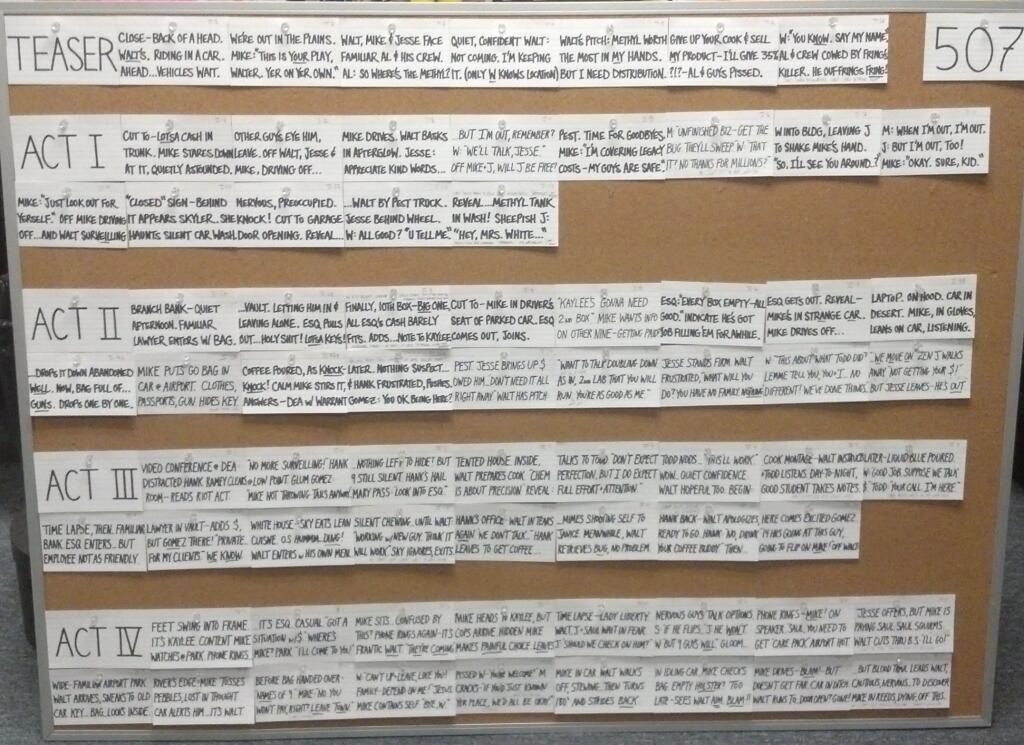
TS: Yeah, they’re the same. I think the first outline we did, for the first episode, was 17 pages, [laughs] which is a good sized outline for us. My outline I tried to keep a little more conservative. Right now it’s a 12 page outline. We carded them exactly the same – actually that reminds me I should take pictures of these boards before they disappear – so eventually on Twitter, after they air, I can post them. We’re pretty detailed.
ADAM GREENE: Tom, do you find it more preferable to write or to direct?
TS: Oh, I love directing. I’ve only gotten to do it the one time, except for when I was back at college. Preferable? You know, I need to do it some more before I can give you a straight answer. I mean, I love writing and I think the hardest part is the writing, getting that right.
I feel like when you’re directing you have a lot of people supporting you. A lot of departments and a lot of very skilled people doing things, contributing ideas. The writing is a little more solitary, even though we have our core group who we break the story with, it just feels harder to break a story and get it right. Certainly all the heavy lifting’s been done, so when it comes time to direct, I’m not going to say it’s easy… but I had fun directing, for sure.
AG: A question about Walt’s character: he has two sides, the everyday normal Walt, and the conniving, evil Walt. How do you effectively ride that line between his Jekyll and Hyde?
TS: So much of that is credited to Bryan. We were lucky to have an actor who, you could write down the subtext of what we want to say as writers without having dialogue there, and he, through a squint of his eyes, we get what’s going on in his head. So when he’s saying one thing you know he means another.
AG: Was there anything in particular that comes to mind that you learned working with the cast and crew? Whenever I get onto a new set, or start a new project, I always seem to gain from someone something that I didn’t have before, and I just wondered if something rubbed off on you that might influence your future projects?
TS: Yeah, it’s just being open to everybody’s ideas. Like I said, I drew storyboards for everything, but I didn’t stick to them rigidly. They were more of a guide into going in and having a feeling of what I wanted to do, but a lot of times Michael Slovis would come in and say “Hey, look at this” and it would be much better than what I originally drew. And Bryan would have a thought about the way a line should be read.
It’s just… always being open to everybody else’s ideas. I learned that in the writers’ room too. The most effective writers’ rooms are the ones where you feel completely safe. You get into a writers’ room where there’s one person who’s judgmental, it is completely damaging. It just shuts down creativity and people don’t want to say things because they think they’re going to get made fun of. That is something I luckily learned very early on, that you cannot, you cannot have that personality or be that personality in a writers’ room.
You want to be free to say the worst idea ever and not be laughed out of the room, because you never know what good thing is going to come out of it.
AG: My final question, and then I want to wrap up, because you’ve been so generous with your time. Do you have any advice for writers that are trying to get into the business while also trying to maintain their voice?
TS: Yeah, I always hate giving this answer cause it sounds like… bullshit, a lot of the time. [laughs] So much of this business depends on luck and timing, and so what you have to do as a writer is to keep writing and keep generating products, keep churning out ideas, and creating scripts that make you happy. Make yourself happy, that is.
I think early on, one of my first screenplays was, “Oh, what is the public going to love? What am I going to sell?” And it was just a disaster, it went nowhere. Finally, the script that I had optioned was one that I was just like, “Screw it, I’m gonna write a script for myself, I’m somehow going to get the money together, and I’m going to make this film myself.” And once I started writing to make myself happy, I think that’s when things gelled for me as a writer, and then, fortunately, it just fell into the right hands at the right time.
This was back in 1995, I wrote, again, my first feature screenplay that was really for myself. The screenplay never got made, but it got me in the door with an agent and a producer, and it got the ball rolling for me when I started thinking “Yes, I can do this for a living” so I think what you have to do is keep trying to write things that make you happy, things that you are proud of. And then, the unfortunate thing is that you need to keep shooting those bullets out there until one lands in the right hands.
Again, if it’s something you really want to do, and you keep trying and going for it, you gotta hope that your script lands in the person that is looking for that particular kind of thing at that moment. A lot of times you can have a really well written script, and it’s just gonna, you know, cross the desk of people who either A.) don’t have good taste, or B.) they’re just not looking for that thing at that moment. You know, you wrote a quiet little dramatic independent film, and they’re looking for an action comedy. But there is somebody out there looking for the thing you have written, so you gotta keep, you know, putting that arrow in the bow and keep shooting until it lands in the right spot. I think persistence is what it takes.
If I can give any bit of advice, keep trying, if it’s something you really want to do, keep going for it until you get your script in the eyes of the person who is looking for it.
VH: That’s great, I don’t think that was a bullshit answer at all.
TS: [laughs] I hate using the word “luck”. It sounds like bullshit, but luck is… as a concept for right moment, right time, or needing the planets to align, or whatever that other bullshit stuff is. [laughs] I don’t believe in the mystical things but you just gotta wait for the right things to align.