Tag: billy crystal

  • Harold Ramis Shares Some Words of Wisdom About Film’s Future

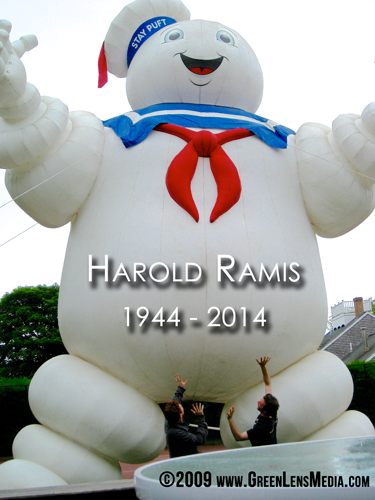
    Mr. Stay Puft lives again during the 25th Anniversary screening of Ghostbusters at the 2009 Nantucket Film Festival
    Mr. Stay Puft lives again during the 25th Anniversary screening of Ghostbusters at the 2009 Nantucket Film Festival
    What a blow. By now you’ve probably heard Harold Ramis, the force behind such movies as Caddyshack, Ghostbusters, Groundhog Day, and Analyze This, has passed at the age of 69. In honor of his legacy, I thought I would skip the circumstances of his death and the array of films he gave us, which you undoubtedly already know by now, and instead tell you an inspirational story of my brief interaction with him at the Nantucket Film Festival in 2009.

    The highlight of the festival that year had to have been Ramis himself, who was in attendance for three main reasons: to receive the Screenwriter’s Tribute, to premiere his new film Year One, and to celebrate the 25th anniversary of Ghostbusters. As someone who grew up with Ghostbusters, was completely transfixed by the multilayered themes and messages of one of my all time favorites Groundhog Day, and depended on Analyze This for more than one DVD date night, it was a particularly meaningful few days for me.

    First of all, I was tasked to be on the team blowing up the actual 25 foot Stay Puft Marshmallow Man that was used to market Ghostbusters when it premiered in 1984. Come on—does it get any cooler than that? This float dominated the skies, and stared out at the Atlantic from Siasconset’s Casino theater on the south side of the island. Getting Mr. Stay Puft to cooperate was a challenge, but somehow the group was able to cross the streams and get him into his new 2009 role as Mr. Stay Put. As guests arrived for a special screening of a brand new 35mm print of the film, he greeted them to their awe and delight.

    I met Ramis during the screening of Year One, while I was in the front entryway waiting for the film to end. With everyone seated in the theater watching the movie, Ramis stepped out some point near the middle to have some time to himself. Year One turned out to be not one his better movies (4.9 on IMDB, a 14% on Rotten Tomatoes), so perhaps the typical “director in the back gauging the audience reaction” wasn’t necessary in his mind. Factor in how many times he must have seen the film while editing, and perhaps it’s easy to understand why he would be stepping out. Whatever the reason, Ramis chose a wooden bench by the ticket booth, and got involved with some game or texting activity on his phone—I can’t recall which, though if I had to guess I’d say some kind of game.

    After a few minutes of this he took a brief nap, but must have had some internal clock wake him about 10 minutes before the end of the film. As he looked around, no phone in hand, I thought “if I’m ever going to talk to him this would be the chance,” so I did.

    It’s amazing how cool and collected you can head into a conversation with someone of his stature, and then completely out of character get all tongue twisted once you started speaking. That was me, but fortunately I found my steady voice before we got to a level of embarrassment. He smiled as I sputtered, knowing we both knew he was being very gracious to let me occupy some of his time, something no doubt countless fans and filmmakers had done before. I think he was amused not by the fact that I was trying to tell him how much I respected his work, but more by the direction I took our talk, which he seemed surprisingly engaged by.

    After the pleasantries and unnecessary gushing, I finally got to what I thought would be the most relevant and purposeful discussion I could come up with on the spot. I asked him if he thought film as we knew it would survive. Did he feel the access digital video gave filmmakers, with its ease, price, and increasing quality, would implode the professional market, and ultimately for those reasons overcome “Hollywood” looking content? Would the storytelling suffer? Would the good stuff be able to compete with quality gear getting so cheap, and the potential noisy flood of bad content springing up online more every day? And more so, would there even be a career in film by the time I “made it,” if that time ever came?

    He thought for a moment, and after reflecting on this told me that while the technology had changed in the past few decades, the core of filmmaking, the very root of motion pictures, was in capturing and telling a good story. “We can’t stop the way society is changing this profession,” he said, “so while it may become harder to get your work in front of large audiences, or into traditional theaters, or to get your film backed by a big studio so you can make the big bucks, in the end whoever can adapt and embrace the circumstances best will come out okay. If you love making films, just keep making films.”

    He asked me what I had done to advance my career, so I told him about starting Green Lens Media, and about making my first feature in high school years ago under a SAG student contract. He reiterated that while film as a format and industry would change, there would always be room for new stories and new filmmakers, who yes, could make careers of it if they worked hard enough for it. It was a sobering thing to hear that the industry I’d been pursuing for nearly a decade at the time was, according to this Hollywood insider, bound to be different, but also refreshing that he was so optimistic about its future considering.

    I was fortunate to get to hear this insight from Ramis, and it stuck with me despite the many other speaking events I saw him at throughout the festival. Most people wanted answers to things like “what was it like working with Bill Murray,” and “what’s the funniest thing that happened behind the scenes on such-and-such movie?” It’s sometimes easy to forget while starstruck that these are just people after all; people who, of course, are talented, but are also hard-working and even a little lucky. They might be able to point to a particular instance where they were in the right place at the right time to catch some opportune “break,” but isn’t that just something that would have happened eventually another way anyway, if not that way? In other words, if you work hard enough, if you “just keep making films,” eventually that lucky break will find you.

    Thanks, Harold, for all of your comedic genius for the time you were here. Thank you for your reassurances about the film business, and for believing in film’s future, as murky as it seems sometimes. I’d like to think that when we see an Egon hard at work inventing something, or a Dr. Sobel trying to figure out how to not die this time, or a Phil Connors making humor when there was none despite a desperate situation, there is in each instance an inevitable and eventual hope that evolves at some moment into something we have been looking forward to. It’s a great message, one that I and other filmmakers are inspired to see and be reminded of. You will be greatly missed, and I wish you all the best on your journey as I continue down mine, and continue making films.

    On a side note, if you ever care to haunt GLM (especially our scriptwriting software), that would be just fine; I promise you would be given Slimer status (the endeared, free-to-roam friend Slimer, not streamed-into-the-Trap Slimer).

    All the best,
    Adam

    Leave a comment! What are some of your favorite Harold Ramis movie moments, and what is your opinion on the future of the film industry?

  • The Power of Film Freedom

    I watched the 84th Academy Awards, like many professional and aspiring filmmakers did, only this time it seemed just a little more…unsure of itself. We had Billy Crystal up there reprising his host role having taken an 8-year hiatus. Though the intro was heartfelt, the jokes were cute, and it reminded me of how I’ve watched City Slickers II about 50 times with my grandfather chuckling the whole way through, it still was missing something.

    On the red carpet, which I was somehow forced to watch in my company, the commentators were as electrifying as ever: “What an outfit…Who are you wearing? Do I sound introspective and look as magnificent as you this year? Wait, before you go, I have one more shot for you. .” Like Crystal (don’t get me wrong, I will always love the guy), let me reiterate—the event was missing something. More than anything I heard the commentators talking about how classy, and old Hollywood it was this year, just like they claimed last year, the year before, and the year before. Hollywood seems to be fixated on retaining a time period when things made sense, and where the studios controlled everything from production to content, distribution to demographic. The movie industry is not about control anymore, it’s about fluidity, exposure and instant gratification. Whoever can get the most eyes on their product seems to be doing quite well for themselves.

    These are interesting times for filmmakers, independent or Hollywood, what with an evolving landscape changing every year for movies in the What, Where, Why, When, Who, How and How Much.

    What
    In Hollywood, the What is for the most part getting less intelligent and lazier. I swear, any day now we will get the prequel to Dumb and Dumbererer 5. We had some good movies this year, but were any of them really great movies? If it weren’t for the refreshing creation of The Artist (an homage to old Hollywood with some modern touch), I would say we’ve seen better years. The independent films I’m sure were great, but unless you go to festivals or subscribe to an independent on-demand channel, it is sometimes hard to find out about those films, much less see them.

    Where
    Movies out of Hollywood are being made more and more out of single locations, many able to claim that location as a post-production CGI house. The Where may be determined for tax reasons, logistics, convenience, but in the end the ultimate answer is money. Even though ticket prices are anywhere from $9 to $18 depending on how big the screen is and if the picture is in 3D, piracy has no doubt hit Hollywood hard, and the economy tanking hasn’t helped much either. Independent projects however are expanding outside their home base origins, with gear being less expensive and more portable than ever.

    Why
    Why Hollywood movies are being made (sorry if this is a shocker to anyone) is still about the money, as it always has been. You might have the best, most artistic, thought-provoking, culturally changing, life-altering script of all time, but if a producer can’t see it succeeding at the box office, good luck. That is perhaps the Oscars one redeeming quality. Out of all the junk the LA machine pumps out each year, it does make a few good artistic pieces worth recognition and worth seeing—movies that make us think. I wish there were more of them. Wait a minute, there are more of them! Only they aren’t Hollywood, they are independent, or even more so, they are really independent. Like the filmmakers going out themselves or with a small crew and uploading to Vimeo. Why are they doing it? Because they love it, because they care, and because they simply have to do it. They won’t feel complete unless they do it. Those are the movies you want to see.

    When
    Hollywood is making movies all the time, but not at the same volume or pace that the independent and online community is producing. Not even close. We have a democratizing revolution going on in the video industry now, where you can make a movie on an iPhone if you really want to. Whatever Hollywood movies come out that are worth seeing, you can usually expect them to release around fall or winter—right before the Oscars so it is hot and in folks’ minds. However, movies made on REDs, Alexas, and HDSLRs are being released all the time. There is no time like the present, and the sooner you can provide new content the happier your followers will be.

    Who
    Who is making movies is actually more of a question of who isn’t making movies? Hollywood of course makes movies, and filmmakers make movies, but it’s much broader than that. With a camera on every phone, the iPad, and HDSLRs, it is easier than ever to make a video, however short, low budget, or planned out. It is parents, business owners, students, doctors, salesmen, cooks—almost every industry there’s going to be someone who has zero training in videography, or even interest in filmmaking, and yet are still making films. It would be an interesting statistic to learn just how many people in the past year made at least one video clip, even if it was just a shot of their cat on their phone. Who is making good movies is another story.

    How
    The How I find the most exciting of all. Hollywood is making their films the same way they always have—big budgets, A list actors, huge crews, lavish locations, unparalleled cutting edge graphics, and the same formulaic scripts they’ve relied on for years with a couple diamonds in the rough. Independents are still looking for their moderate budgets, decent sized crews, and best locations possible for their scripts. But if you watch the content (particularly the short film content) coming in on sites like Vimeo, Blip.tv or occasionally YouTube once in a blue moon, you will find some incredible ratios of production value and resources to budget spent.

    How Much
    The trick is figuring out, in that last category of small online distribution, how to monetize it so you can both make a living and make more content, while not also selling your soul to the advertising devil. As of right now, I’m not certain how advertising dollars can’t be involved to make it work, though sites like Kickstarter and IndieGoGo may be on the right track. By crowdsourcing, and funding your projects with an audience that is already interested in your idea, it seems like everybody wins. I noticed the other day a project for a video game called Double Fine Adventure asking for $400,000. At the time of my writing this post they have secured 2.4 million dollars and have 5 days left. Wow. I think their success is not just due to what they are promising, but their attention to producing a professional looking video that allows fans a window into the behind the scenes, which helps sell their idea and convince people to donate. They decided to show (not just tell) what they doing, and it came back to them many fold.

    My point here is that the content you create matters. The story. With all the other noise out there online, in people’s ears and at the water coolers, you need some good content to help you stand out. This is true if you are trying to create the next LA Confidential, a corporate marketing video for your website, or an assembly of family home videos. You want it to not just inform, but entertain and engage. If you are thinking about budget, think about how much it might cost you later, when you’re forced to clean up a PR mess from a poorly produced video done in-house. If you’re thinking, “Well, only my family is going to see this,” consider your great great grandkids when they watch it. Wouldn’t it be ideal that they feel something, as opposed to just witness something? To achieve the emotional experience, to make it more than just the factual heritage connection, that takes some careful attention to timing and editorial decisions.

    The beautiful thing is, it’s true, anyone these days can make a movie. In fact, if you are outside the Hollywood machine, the filmmaking experience can actually be quite liberating creatively, since now you are the one in control. You may hear the followup, “Yes, but not everyone should make a movie / video.” If you love the process and ability to express yourself by making films, then I disagree with those pessimists; please make lots of movies to evolve your skills and your voice. Simply realize that when ready for a serious production, it can also be a very scary thing in the wrong hands, not just for you and the team but for your desired audience.

    What I am advocating is that after some experimentation and tests, once you get to a project you know matters to you, put some thought into how it will get accomplished the right way. Perhaps then we can look forward to increased interest in shows like the Vimeo Awards and Webby Awards, which stand to be much more in tune with viewers on an individual level. Everything is moving to the web whether we like it or not. I think the natural progression points to these more relatable, personalized shows thriving, while shows like the Academies focus on surviving. For non-filmmaker consumers, these new shows will only become more entertaining with age. From a filmmaker’s perspective, it is fun to watch these newer web-based award shows because the awards themselves seem so much more accessible and attainable. It still means you need to put care into your work; cats playing keyboards only gets you so far. Whether you are creating work for your friends and family, your peers and colleagues, or your customers and clients, think through your mission and make it cutting edge but still appropriately classy. And not swan dress classy; that is so 2001 old Hollywood.

    Focus of the Day:
    How do you make your content stand out?

    Film-tip: Learn the language. The more vocab you know on set, especially in the area that you are not a specialist in, the more you can communicate with the crew about what you want. It sounds simple and repetitious, but it really can take what should be a 4 hour shoot and make it an 8-10 hour shoot if you mess it up.

    Eco-tip: Help get support going for the coolest mode of transport out there yet. If you haven’t seen the Shweeb yet, you’re really missing out. Let’s get these into our cities and actually have fun getting to and from work.