Category: Writing

  • Writer Cathryn Humphris of Mad Men, Under the Dome, and Supernatural, Speaks On The Realities of Working in TV

    Writer Cathryn Humphris of Mad Men, Under the Dome, and Supernatural, Speaks On The Realities of Working in TV

    I moved around a lot as a kid. First off, I started life all the way across the world in the little country of Bulgaria, before getting on a plane at the age of eight and heading to the big ol’ US of A. From there, I moved almost every year, spending brief periods in various towns and cities across New England as my parents bounced from job to job. At the time? Frankly, I hated it. I hated having to be reintroduced to a new area, having to make new friends, I hated all of it. But now, as I reflect on those years, I see just how valuable they were. How much I gained from every new experience, every new person I met.

    Television writers, for better or worse, often find themselves as the new kid in class. And Cathryn Humphris is no exception. Over the course of nearly a decade, she has worked on shows like Mad Men, V, Under the Dome, Mob Doctor, Elementary, Supernatural, and many more.

    Cathryn was kind enough to get on the phone with me and Adam, and spend some time talking about just what it’s like to be a working writer in today’s industry, and all of the positives and negatives that come with that.

    ———————————————————————————————————————————————

    VIKTOR HERRMANN: What I’d like to start off talking about first is your early days. The struggle years. Can you talk about the days before you could support yourself solely on writing. What was that like, and what was the transition like?
    Humphris 1

    CATHRYN HUMPHRIS: It was nice. It’s nice to be able to support yourself doing what you wanted to do. It took me about eight years. I came to Los Angeles right out of college. I was a Radio, Television, Film and Communications Major. I was lucky that I had some friends out here already who had paved the way for me and helped me find my first job. 

    There’s a lot of different routes to breaking in, and I went the assistant route. I got early jobs through friends and connections from my school—I went to Northwestern and they have a big alumni community out in Los Angeles. So I started just working low paying assistant jobs. 

    Originally I wasn’t sure if I wanted to write for movies or do something else, and I had a friend early on who said, “I think you should look at television, because I know you love writing, but I know you also want to be part of the overall process.” And also television is much more stable than just going from job to job in film.

    So, early on I got a job in television. Once and Again was the first TV show I worked on. I was a writer’s PA, which is kind of like the lowest position in the business. Literally getting lunches and coffees and running errands for people.

    I just kind of worked my way up through that. I worked for writers who had development deals, I worked for small development companies, I worked for a couple different shows, and just got as much experience as I could get, and also made as many connections as I could make. Which was another huge part of it.

    I know you interviewed Genny Hutchison a while back. Genny and I worked together a long, long time ago on X-Files. She worked for Vince Gilligan and John Shiban, and I worked for Gillian Anderson, and we got to know each other that way. And years, years later, when I was looking for another job, John Shiban was looking for an assistant, and Genny recommended me. And that’s part of how I got the job on Supernatural, which ultimately ended up being the show where I got my big break.

    Along with working different jobs, I was obviously writing on the side. The great thing about being a writers’ assistant is that you can actually be in the writers’ room. You’re seeing how the process works. You are getting to know the show better than almost anyone.

    You know the bosses, you know the dynamics, you know everything. Being in the writers’ room is great practice for learning what you’ll be doing as a TV writer and also for being able to try out your craft a little bit. 

    I had also done a program called the Warner Brothers Writing Program, which is a great program that helped people get their foot in the door. Sometimes you get staffed right out of that program. I didn’t get staffed right out of that program, but Eric Kripke [the Supernatural showrunner] certainly knew that I had done it, and people at Warner Brothers were supportive of me and pushing for me.

    Ultimately what ended up happening was in the first season of that show, John Shiban and I wrote a script together. John mentored me and shepherded me through the process, and everyone was very happy with the script. And then in the second season of that show, I came back again as a writers’ assistant, and by that point I had gotten an agent off of doing the Warner Brothers program. So, my agent was out trying to get me meetings, and John and other writers I had met were super, super supportive.

    I got a job offer on another show, and Supernatural basically was faced with the fact that they might lose me, and so literally overnight they made me an offer to go from being a writer’s assistant to a writer. And I ended up staying there for three years.

    VH: It’s pretty clear that you’ve had quite a varied resumé, which I think is indicative of a lot of TV writers. Could you talk about how hard it is to jump onto an existing show, and how you adapt to that show’s characters and writing style?

    CH: Yeah, that’s an interesting question. I think I have ended up jumping so many times that it’s kind of become secondhand nature for me. 

    I was on Supernatural for a total of four years, and so at that point, people would have known me as a genre writer. Which is funny, because I’m not someone who is particularly a big genre fan; I would consider myself more of a character writer. But there are genre shows that I love because they’re fancy packages for telling great character stories. 

    So, I’m always the person where, in my writers’ room, they’re talking Star Wars or Blade Runner, or the complicated mythology of some show, and I’m like, “What are you guys talking about again?” I just wasn’t into that world. But the great thing about having that background is that genre shows will always want to hire you.

    [But] when you’re a genre writer, particularly a woman who writes genre, you can get put in a box. And it’s great because they’ll offer you jobs on genre shows, but it can be harder for people to take you seriously outside of that world. 

    I had gotten the great piece of advice of, “Write a script that is the opposite of genre. That’s exactly what you want to do.” So, I wrote a very character driven script that my amazing agent ended up getting into Matt Weiner’s hands. I always say Mad Men was the easiest job I’ve ever gotten in my life. Matt read my script, Matt liked my script, he interviewed me and he hired me. It happened within a week or something.

    On Mad Men, the thing that was great about it was that because it’s a cable show and it’s only 13 episodes a year, we spent the first two or three months just getting to know each other, really talking about the characters and what you wanted to accomplish. There wasn’t a huge time pressure, [versus] network television [where] you start a job and six weeks later you’ve got to film an episode. 

    I think on Mad Men I just had a lot of time to ramp into the show. I watched all of the episodes from the first two seasons multiple times. Matt assigned a lot of reading, so I did a lot of reading, I watched a lot of movies of the time period, I spent a lot of time just getting to know my co-workers. 

    You just kind of ease into it that way. You’re spending eight to ten hours a day in a room with people just obsessively talking about the show, so you just kind of catch up. And then I guess going forward, I’ve jumped into a lot of second and third season shows, and I’ve never felt like it’s been that much of an issue for me. There’s something nice about already having a template already laid out. 

    I always go back to watching the episodes. Multiple times. And picking up on who the characters seem to be. I do this less now, but earlier in my career, before I would write a script, I would just obsessively read the other scripts. When I wrote my first Mad Men, I spent fifteen hours a day writing or reading the other scripts.

    ADAM GREENE: That’s a good transition to our next question: your habits. What would you say are some of the things that you do habitually to get you in the mood for writing? How do you overcome different writer’s block situations or difficult scenes to write?

    CH: This is a great question. I am totally a procrastinator as a writer. [laughs] So, television is great for me because you can’t procrastinate, you can’t have writer’s block for very long.

    I love being in the writers’ room. I love breaking story. I’m really social; I love working with other writers. I would be a terrible feature writer, sitting alone in a room writing. That’s kind of the part of the process that I like the least.

    For me, it all starts with the story and the structure. By the time I go off to write a script, I’m meticulous about making sure that I understand the story that I’m trying to tell. With character driven shows, with a show like Mad Men, the structure is a little less important because you’re really digging into the character work, but even then, if the structure doesn’t work, it’s going to be a lot harder to write. By the time I leave to go off and write a script, I want to understand what I’m writing. The work that should be left to be done is the character work.

    You’re always going to find stuff that doesn’t completely work, that you need to make adjustments to. I just make sure we do a really, really good break, that I understand what all of the characters’ motivations are, that I understand the story that I’m trying to tell. Anything that still needs to be fixed, I try to fix in the outline.

    In terms of pure habit, the thing about television—which is a blessing and a curse—is that you’re on a really tight timeframe. If you’re on a show like Mad Men, you might have two weeks to write a script. But a lot of the shows that I’m on, a week is a luxury.

    That was something I was nervous about early on in my career, and I used to take a full two weeks to write a script. And now, I’m on shows sometimes where, if I’m co-writing a script, we have two days to write it.

    I will always procrastinate as much as I can, and so sometimes that means I spend three days surfing the internet before I do much writing, and other times it means I spend thirty minutes surfing the internet. I procrastinate for as long as I can, and then I just dig in. I disappear into the world that I’m writing.

    I think for me the hardest thing is overcoming the fear of, “What if it’s not good this time?”

    AG: That’s a shared feeling for a lot of writers, I would think.

    CH: Yeah, I think so. And that’s been kind of a blessing of my career, of jumping around to so many shows. I’m definitely able to take it a lot less seriously than I used to take it. I’ve been on shows where by the time the show premieres, you wake up the next morning and you read the ratings and say, “Oh, well, this show is going to die soon.”

    That’s a horrible feeling, but I think it also helps you keep things in perspective. Which is that I’m exceptionally lucky to be doing the job that I do, and hopefully my career is going to be long and I’m going to work on a lot of different shows. Some of them are going to be easier than others and harder than others and more fun than others. That helps me now with the pressure.

    VH: That reminds me, we read an essay you wrote, “Why We Write.” In that, you talk a lot about the fear and dread that writing can cause in writers. Can you elaborate on that? Maybe talk about a time either career-wise or when you were working on a script where everything seemed to be going wrong? What kept you climbing back into the ring?

    CH: It’s funny thinking back to that essay, because when I wrote that, I had probably only been a TV writer for two years. The battle to get in was fresh. There were a lot of times as an assistant where I just felt like I’m never going to get my break, this is never going to happen for me. And I kind of just made the decision to keep going for as long as I felt the good outweighed the bad.

    This business can be really, really hard. There’s a lot of nastiness that happens. There’s a lot of times where you get close, and then it doesn’t work out. But I think I kept going for the same reason all young writers keep going.

    You feel like you have something to say. You feel like you’re pretty good at this, like it’s a lot more interesting of a job than most jobs that you could do. I’ve loved television and movies all of my life. The idea that I could be part of that was really, really fun.

    But the fear part was, for me, sitting down and facing that blank page. That’s when it’s all on you. It’s probably part of why I’m so meticulous about the story break, because the more that I can stack the odds in my favor, that’s a good thing.

    I think most of us feel like, “What if we fail this time?” I think that’s a huge fear for young writers. I think for some writers that’s probably the fear that drives them their entire life.

    It’s interesting, because now, having worked on so many different shows, there’s a lot less of that fear [for me]. There’s a lot more of, “You know what? I’m making television, and it’s awesome, and I wouldn’t trade this for any other job.” But it’s a television show, and some episodes are going to be better than other episodes.

    I hope most of my episodes are good, but I’ve written some crappy episodes of television. [laughs] Usually for things that are only partially in my control. There’s so many forces at work: the show that you’re working for, the boss that you’re working for, production realities, the studio and the network. There’s just so many different things.

    If you have two weeks, and a network and a studio and a boss that are fully supportive, you’re probably going to have a better script than if you have two days and a show that might not even make it to air because your ratings are so bad.

    I feel like more often than not, I’m able to be proud of what I do, but I keep it in context. One of my favorite experiences was being on the show Ringer, and that’s not a show that probably a lot of people saw or remember—it only lasted a season. I loved every second of that show, and I’m incredibly proud of the work I did on that. I’m incredibly proud of the work I did on Mob Doctor, even though that’s not a show that’s going to be remembered in history the way Mad Men is remembered, but I had a great experience on it.

    I just try now to enjoy the things you get to enjoy about [the business], and not take it quite so seriously as I think I did at the beginning.
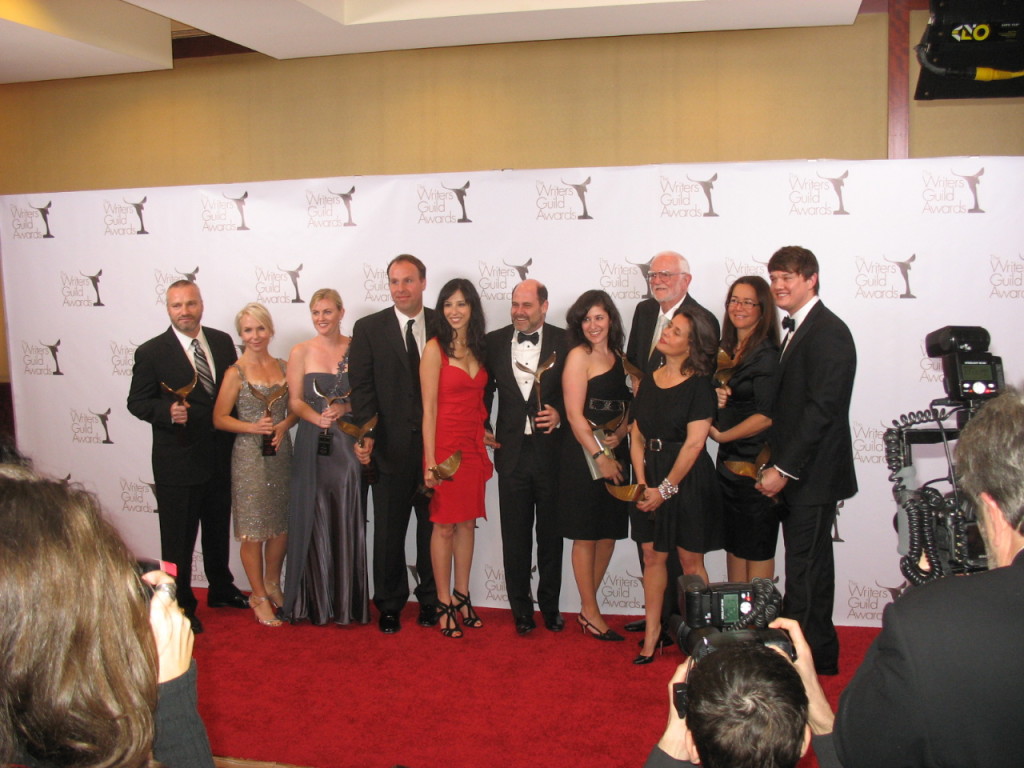
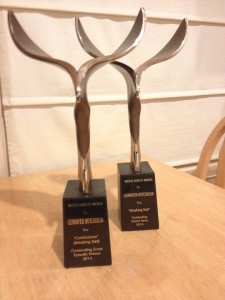
    Humphris 2 - awards

    AG: You worked on episodes 302 and 311 of Mad Men. Episode 311 especially was a pivotal episode. You have these strong female characters being able to voice their frustrations in Joan and in Betty, and Don being knocked down a peg and having to come to terms with who he really is. So, that’s a big episode. How did it come about that you were able to write for that episode, and what was it like working with Matthew Weiner?

    CH: I was really lucky. Matt is incredibly talented, and it was an incredible room filled with writing heroes of mine. I got to co-write episode 311 with Marti Noxon, who was a writing hero, and it was just a room filled with amazing writers; the majority being women, which is rare in Hollywood.

    It was an incredibly collaborative room. Matt gave you a ton of breathing room. He was wearing a lot of hats, and he was in and out of the room a lot, so you’d do a lot of the work collaboratively, breaking story with the other writers.

    One of the things I’ve always loved about Matt is that he was a very good showrunner in terms of being able to come in having twenty minutes to listen to a pitch, you’d pitch out what you came up with, and he was always clear on saying “I don’t like that, I don’t like that, I don’t like that, I like this—this is the heart of your story. Re-break it around this.”

    And I think that’s a gift from a showrunner, because you work for a lot of people that don’t have that clear vision, but also maybe other people [who do] that aren’t able to collaborate.

    Matt certainly has a reputation for doing a lot of on-the-page rewriting. He has a lot of ownership. But I have to say, at least my experience in the room was that he was very open to what other people brought to the table.

    I had a great experience on that show. I learned probably more—in the room, on set, and in the writing—than ever before.

    And the way it works with Matt, at least when I was there, is that he wouldn’t assign episodes ahead of time. A lot of shows, you know it’s your episode, and you take ownership of breaking that episode. But on Mad Men, we would just break all the episodes, and Matt would turn to you and say, “You’re writing this episode.”

    At the beginning of the season, for my first episode, I had two full weeks. And then he gave me a bunch of notes, and I did a second pass, and at that point he took it over and did a rewrite. As the season goes on, things get more crunched, and so for episode 311, that Marti and I wrote, I think we probably had four or five days to do it.

    I knew that episode was going to be a huge episode, but I had no idea that was going to be the one he assigned to me. I was quite grateful when I got assigned it, and I was thrilled to be writing with Marti. That was one of the greatest experiences of my career, to get to co-write an episode with Marti Noxon.

    I was a low level writer, and she was a showrunner. She was amazingly collaborative. She was so generous with me, she gave me amazing feedback. I just loved writing that episode, and I knew it was going to be a big episode. But I guess that’s another place where, even at that point in my career, I just don’t understand being too precious about that stuff. Any of the people on staff could have done a beautiful job writing that episode.

    If you’re coming into the TV business and you’re going to hold on to every word that you’ve written, this is not going to be a good business for you; you should probably think about writing a book instead. Your stuff is going to be gone over by your boss, by the studio, by your network, by your actors. There’s going to be a lot of changes.

    One of the things that I think Matt is good at is, we would go back into the room after we did a table read, and we’d go through the script. If there were lines that weren’t working, you would change them. That’s an important thing to learn. If a better line comes from your co-worker or from an actor suggesting something, you shouldn’t be afraid to be collaborative. This is a collaborative business we’re in.

    VH: What is your unwritten rule of screenwriting? Something that is perhaps ignored by a lot of teachers or by a lot of the so-called “guide books” on the craft, but is something you consider paramount to writing?

    CH: I guess, this is maybe less about writing in general but more about television writing, which is that perspective is huge. When we talk about these rules, or we talk about, “it has to be this way, it can’t be that way, this is good writing, this is bad writing.” Whoever you are working for or whoever is making the final decision is actually the person that’s in charge of deciding what they think is good or bad writing.

    Having gone back and forth between so many shows and so many showrunners, I will literally be on a show one day where a showrunner will say, “If you do X, I’m firing you, it’s the worst thing you could possibly do in your scripts,” and then you go to the next show and the showrunner says, “I LOVE it when people do X.”

    It took me a whole lot of years to understand that it’s all perspective. There are certain things that I personally think make for a good script or for good writing, and they can be totally opposite of what someone else thinks makes for a good script or good writing.

    There’s obviously honing your craft, and there’s obviously certain things that a lot of us can agree on that are better or worse to do. But I think anyone who watches the landscape of television, and the many varied things that are out there, in a certain sense, who’s to say what is wrong or right?

    AG: You’re working on Under the Dome. Where and when can people check that out?

    CH: It is going to be coming back to CBS for the third season this summer. We’re going to be on Thursday nights, which we’re very excited about. I believe it starts June 22nd with a two-hour premiere, and I’m writing episode 4 and then I’m slated to co-write the finale, so hopefully people will check that out this summer.

    ———————————————————————————————————————————————

    And we hope people check it out too! As with our previous interviews, I think there’s some invaluable advice and experience Cathryn shared with us in the above interview. Hopefully you will find it helpful. Ms. Humphris dropped some truth and science on us all, folks. So study up, and get writing, get filming, get creative.

    You can also check out her essay on the blog series Why We Write from Feb 5 2008—a time before she had the experience or resume she now enjoys.

  • Filmmaker Matthew Nash Talks About His Work, Influences and Style

    Filmmaker Matthew Nash Talks About His Work, Influences and Style

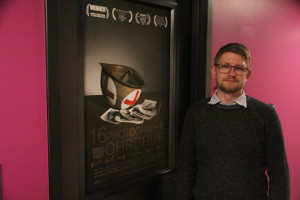
    IMG_8242Hello again, friends and compatriots! We’re jumping right back into our conversation with the head of Lesley’s Film and Animation department, Matthew Nash. Apart from his academic duties, Matt is an accomplished, award-winning filmmaker, most well-known for his powerful documentary film entitled 16 Photographs at Ohrdruf.

    If you missed last week’s post, be sure to give it a look-see here!

    ———————————————————————————————————————————————-

    ADAM GREENE: How did you decide to become a filmmaker?

    MATTHEW NASH: Totally by accident. I’ve never been an artist who’s particularly wedded to a medium. It’s fine to be wedded to a medium, I’ve just found that for myself, I don’t like having to channel all of my ideas through a tool. I like to find the tool for my idea.

    My creative partner, Jason, and I, had done a lot of videos. Experimental, weirdo goofy stuff. And then, super long story super short, we decided to make a mock version of Ross McElwee’s Sherman’s March, that actually turned into a serious project.

    It was supposed to be a week-long gag, and we ended up doing it for two years. That’s a film that you should never watch. [laughs]

    But, I learned a lot. I had moved into that mindset. We did an experimental, semi-narrative piece where the concept was basically two people, who are nowhere, talking using just a microphone and a speaker. [Jason] and I, over the course of several months, recorded all of our phone conversations, transcribed them, edited them, and then turned that into a script.

    On its face, this could be a profoundly boring 15 minute short film. The solution that we came up with was that we wanted to take the production level to 11.

    We rented 18 foot cranes, 20 feet of dolly track, really good microphones, really good production team, the whole nine yards. It was that experience that got me hooked on production, on process.

    When [16 Photographs at] Ohrdruf fell into my lap, I didn’t even know what to do with it.

    7DA20202

    The backstory is that my grandfather died in 1991, and after he died, we found this packet of photos that he had taken at the liberation of a concentration camp called Ohrdruf.

    In 2008, when Barrack Obama was campaigning for the presidency, on the campaign trail, he says something like, “My uncle liberated Auschwitz.” And of course, big scandal, because America didn’t liberate Auschwitz, the Russians did.

    They found his uncle, and they interviewed him, and it turns out that he was at the Ohrdruf camp. So all of a sudden, I’ve got the uncle of the future president of the United States and my grandfather, and I can put them in the same place.

    I dug out the photos, and honest to God, I didn’t know what I was going to do. Having just done the project inspired by Ross McElwee, his very personal narrative process, I thought, “That might be my approach to this. As I try to figure out these pictures, I’ll just bring a camera along, and see what happens.”

    Initially it was just going to be some YouTube shorts, but a really close friend of mine is a high-end editor in New York, and he said, “I’ll edit this for you.” And my partner and producer in New York said, “I’ll produce this for you.” And he also wanted to do the soundtrack.

    Once everything came together, and I started doing the research into the photographs, it followed its own course. If you watch the film, it more or less is chronological to what I did.

    AG: How has your experience working on documentary filmmaking influenced your narrative filmmaking?

    MN: I think I’m still getting my feet under my knee as a narrative filmmaker. I really enjoyed the sci-fi film, but when I watch it now, there’s some stilted dialogue or, you know, I could have given more direction at a certain point, things like that. These are the things you learn.

    The big difference that I have found is that when you’re working in a doc mode, you lay out an outline, or sort of a trajectory that you want to take your viewer on. Then you set out to find people to interview, or find footage to meet the needs of each stage of the process. And as you find people, they tell you things that you hadn’t expected, so you’re constantly tweaking your script or your outline.

    7DA20189

    Whereas with narrative, the script is everything. You’ve made or broken your project before you’ve ever done a casting day. If you don’t have a good script, everything after that is wasted effort.

    There are areas where editing, acting, rewrites can save you, but if you’ve set yourself out on a bad course, you’re stuck on that.

    I have learned, as I look toward doing narrative work, to be much more upfront about flaws in scripts, whether they’re things I’m helping my friends on, or students are sending me, or my own scripts.

    One of the big lessons from last summer was just making sure that you are on the right track, that you really understand what you are doing. You know how it is on set, your camera guy has a great shot, or your lighting guy can’t light the space that you want, and you have to be adaptable and you have to be flexible.

    VIKTOR HERRMANN: Do you think your documentary background gives you an advantage in being flexible?

    MN: I hope so. My own self criticism of when we did the sci-fi film is, I think, [that] I was too flexible. I think the project really would have benefited from a director, me, taking a much harder line about some compromises that were made. I think we would have made a stronger project if we had taken the extra two minutes to move that light or to reposition that tripod or whatever it is.

    The thing that you can do with documentaries is you can go, “I’ll live with that.” I think the thing you can’t do with narrative is say, “I’ll live with that.”

    AG: What advice would you give to students or filmmakers in general that are wading into the corporate sphere? A lot of corporate places don’t have time to help write scripts with you. They might say, “Well, just bring your camera and start unfolding the story, you’ll figure it out.”

    MN: One of the things that I would advise people in that circumstance is to have your own script, air quotes here, ready to go. Have your default model firmly established. So if you’re hired in a corporate situation to do an on-the-fly thing, walk in the door knowing, “Here’s how I tell a story. It begins here, it goes here, it climbs to here, it falls to here, rises back up and ends.”

    If you’re going to have to work on-the-fly, how do you assess which elements in front of you meet the needs of basic storytelling 101?

    It takes skill, it takes practice, it takes an eye. It takes being able to recognize when the world is giving you the thing [that you’re looking for], and getting a camera on it.

    If you’re just pointing your camera at things because somebody gave you a paycheck, you’re not going to make a good product.

    One thing I say to my students is all of the thinking and understanding and planning and research and immersion into your medium, all of that happens before you ever take the lens cap off.

    If you haven’t done that work, if you don’t understand your medium or how you speak with it, you’re just making footage.

    AG: Why is video important as a teaching or marketing tool?

    7DA20117_modified

    MN: I think where we have gotten with our video tools is that it democratizes things. It makes it fast. It makes it accessible. When I was a student, if you wanted to make a film, the process was arduous. But today, I could grab a video camera, and tell a story really quickly.

    Nowadays folks who are working in video have to incorporate a vocabulary of cinema, of narrative. It doesn’t matter if you’re going into a corporate environment, an academic environment. You’re bringing to the tool all of its history and all of its vocabulary.

    Partially because we are so media saturated, I think people are bringing a lot of that stuff intuitively now.

    VH: Would you say there are benefits, even if you’re not pursuing film or video as a career, to having video skills?

    MN: Oh, I think so. It’s one of the major and rising vocabularies that we have. Your phone shoots video now. Your phone shoots photos too, but more and more as I scroll through Facebook, I notice: It’s video. And frankly, there’s a lot of bad video out there.

    One of the things that I know we’re going to face when we launch the digital filmmaking program, because we already face this in the photography program, is, “Oh, hey, I shot some cool pictures with my phone. I’m a photographer.”

    This is not to devalue our students; anywhere a student develops a love for photography is totally valuable. But the ease of use and the ease of access [has made it so] amateurs can very quickly think that they’re professionals.

    I think the same is going to hold true for filmmaking. “I shot a great short video on my phone.” Awesome! You know what? You can do professional quality work with your phone. But it has nothing to do with the phone. [laughs]

    It has to do with whether you can use a cinematic vocabulary.

    VH: Is there something that has influenced your filmmaking that perhaps doesn’t come from film, that perhaps would surprise people?

    MN: Sure. So many things. One of the things that I talk about with my students is that inspiration comes from everywhere. You can go to the library and get the art history books, but you might be sitting at home watching an episode of The Simpsons, and it just clicks.

    What goes in eventually comes out. I consume as much as I can get my hands on. I love 1950s horror comics. In fact, film students are all going to be required to read at least one volume of something from Tales from the Crypt, The Vault of Horror, Weird Science, the classic EC 1950-1955 Golden Age.

    I think filmmakers should fall in love with this stuff, because it’s formulaic storytelling 101. By the time you’ve read 5 or 6 Tales from the Crypt stories, you’re like, “Oh, this is just formula.”

    If you can take your brain to the next step, you can be like, “You know what? It’s a formula that I should probably learn.” If you go back to the 80s, HBO did what, 9 or 10 seasons of Tales from the Crypt episodes.

    These comics are the script, the formula that allows you to do a successful 9 or 10 season series. Every episode is standalone. Think about The Twilight Zone.

    It’s very formulaic. It begins in a certain way, it unfolds in a certain way, it reveals in a certain way, it climaxes in a certain way, it concludes in a certain way. Every time.

    7DA20121

    VH: And yet it’s still one of the greatest pieces of television ever.

    MN: Exactly. Because you know what you’re going to get. And even though it’s different actors, different characters, different stories, you know.

    And on one hand, it’s boring television watching. If you’re an educated viewer, you’re like, “Yawn.” But if you’re going to make this stuff? The thing I always tell my students is, “You can’t break the rules until you know the rules.”

    To a certain extent, these are our rules.

    AG: Can you talk about collaboration and the importance of developing good working relationships?

    MN: Sure. I have lots of friends doing cool stuff, but it’s not like I picked my friends because they were going to be film producers or anything. I met some these guys when I was 16. I always tell my students, “If you surround yourself with cool and interesting and motivated people, they’re going to grow up to be cool, interesting, motivated people who do cool stuff.”

    AG: I would say that applies to crews, too. I’d much rather work with somebody that I really click with, that I think is a really smart, reliable person, rather than just somebody who knows how to operate a camera really well. Because that first person will be able to learn how to use the camera really well with time. You can teach people, and you can teach skills, but it’s much harder to teach people skills.

    MN: Yeah! On my sci-fi film last summer, we were a small crew so everybody wore multiple hats. Our associate producer, Rob, was also our lighting guy. And he brought this guy that he had been working with and liked, and the guy just flaked. He worked for half the morning, checked his phone, was like, “Oh, I’m bored,” and left.

    This was a volunteer gig, whatever. But Rob cut him loose. This was his number one guy, and he dropped to the bottom of the list. Meanwhile, the boyfriend of somebody on my crew, his name was Joe, shows up, does an amazing job, and ends up getting hired.

    Rule number one is just don’t be a dick.

    AG: [laughs] That’s a great rule.

    VH: Just for life in general.

    MN: Yeah! It’s a people based business. You hire who you trust. I got offered a job in Hawaii a couple of years ago, and one of the things that absolutely terrified me was leaving behind this whole network of people that were beer-and-pizza friends, and I know if I called them up and was like, “Hey, I want to do a short film,” – I actually did this recently, I said, “Hey, Rob, I’m interesting in doing a short film,” and he said yes before I even told him the title or when it was or anything.

    Having that network of people who trust each other… that’s how it works.

    7DA20145

    ———————————————————————————————————————————————-

    16 Photographs at Ohdruf can be found on Hulu, Vimeo, or Amazon Prime. Be sure to check out Matt’s, http://www.mr-nash.com, to find out even more about the man and stay current on what he’s cooking up next.

  • “Better Call Saul” Writer Gennifer Hutchison Discusses Her Craft and Career

    “Better Call Saul” Writer Gennifer Hutchison Discusses Her Craft and Career

    IMG_20150315_124833 As of writing this, we are over halfway done with the first season of the Breaking Bad spinoff, Better Call Saul, and I think by this point, we can all breathe a sigh of relief.

    Not only does Better Call Saul avoid the pitfalls of most failed spinoffs, it rockets past them to become a truly great piece of fiction. In hindsight, we probably didn’t have anything to worry about anyway.

    Why? Well, because so many of the people that made Breaking Bad a masterpiece returned, and it’s not like they weren’t going to give the show their all.

    One of those Breaking Bad alums is writer/producer Gennifer Hutchison, who wrote some of that show’s finest episodes, including “Confessions” and “Cornered”, which gave us the now-famous “I am the one who knocks” line.

    So needless to say, when Adam and I sat down on spooky Friday the 13th to have a phone call with Gennifer Hutchison, we were both pretty jazzed.

    ———————————————

    VIKTOR HERRMANN: What were the early days of your career like? How difficult was it to get where you are now, and what kept you going through the years?

    GENNIFER HUTCHISON: That’s a good question. My first job in LA was as a PA in the writers’ office at the X-Files, which was a pretty awesome opportunity. I ended up becoming Vince Gilligan’s assistant in, I think, Season 8.

    That was sort of my start. And then from there I kept moving up and I eventually kept consistently getting jobs as either a writers’ assistant or a producers’ assistant. But every show I got on would either get cancelled, or my boss would leave, or I would have to leave, and so after X-Files, every show I was on I was only on for a season.

    This went on for quite a while. It was pretty difficult because I was never able to really get any traction, as far as an assistant who could then pitch possibly writing a freelance [episode]. I was writing my own stuff, but I definitely had some days where I was like, “what could I do instead?” [laughs]

    But I kept doing it, mostly because I just didn’t know what else I would do. It was the only thing I could think of that I wanted to do.

    Then I was working on Mad Men in Season 1, for Matthew Weiner. Season 1 was wrapping up, and one of the AMC producers said, “Oh, we’re working with your old boss, Vince Gilligan,” and I was like, “What is the show?” and they said, “It’s this thing called Breaking Bad.” And so I immediately contacted him and said, “Please hire me in any capacity.”

    So he brought me on as his assistant, and then it just kind of hit, where I managed to get on a show that was great and sustained. And since I had this prior relationship with Vince, he knew what my goals were, and he had always been really supportive. When I came back for Season 2, I had a conversation with him and said, “I want to write for the show. What do I need to do to show you that I’m ready?”

    And he said, “I need to read your stuff, any extra work there is on the show, webisodes, blogs, do those, and just show me.” So basically Season 2 was kind of my audition. [laughs]

    And by the end of that, I said, “So, what do you think?” And he was like, “Well, why don’t we give you a freelance in Season 3 and see how that goes?” And it went really well, and that’s when he ended up staffing me.

    IMG_20150315_124856
    VH: What was it like in those days, both as an assistant and when you first came on to the writing staff? How comfortable were you pitching ideas, versus how often you bit your tongue?

    GH: When you’re a writers’ assistant you tend to not pitch as much. It varies by room. Some rooms don’t really like writers’ assistants to pitch, some do. You basically wait until everybody else has talked. [laughs] And then, if you have a pitch, you’ll volunteer it.

    The difference of pitching as an assistant as opposed to pitching as a writer is you only want to pitch your best ideas. You want to make sure that it’s a great idea that you’re really confident in. When you’re on staff, your job is to keep the flow going, so a lot of times you pitch, “Oh, this is the bad version, but here’s what I’m trying to get to.”

    As an assistant, you’re never really pitching the bad version. You want to pitch your absolute best. So transitioning from that? My first season as a full writer, that was interesting. It’s like, “Oh, I don’t have to be 100% sure of every detail of my pitch. I can take a flier, and it’s going to be okay. I’m not disappointing them.”

    As a staff writer, you want to make sure that your pitches are great, but there’s definitely a little more freedom. You’re on staff. That’s your job. They believe in you, at least to a certain extent. [laughs] There’s more comfort.

    ADAM GREENE: As we know, in Hollywood and pro-filmmaking, it’s pretty male dominated. What advice would you give to female writers for how to get to where they want to go?

    GH: It’s tricky, and I think that there’s more attention being paid to it now. There’s definitely a huge disparity. I think it really comes down to, honestly, just being your best. There’s the idea that with women you have to be twice as good to be considered half as good. But it’s generally advice I would give to anybody who’s trying.

    Do your best job, no matter what job you’re in. So if you’ve got that writers’ assistant job, be the best writers’ assistant. But make sure, especially for women, that people understand that you have goals beyond that.

    Don’t be afraid to speak up; don’t be pushy, there’s a difference between being persistent and harassing people. But I think a lot of times, women tend to be quieter. They tend to not self-promote, just because of the culture we’re raised in.

    It took me a long time to speak up, and say, “Vince, this is what I want.” And I think if I had spoken up earlier he would have been just as open to it. So I think it’s mostly about having that confidence in yourself, and being able to self-promote.

    Whereas I think guys are told, “Go in there! Go in there! Do it!” And I think women need to start being told that as well, and people need to listen.

    IMG_20150313_172535

    VH: What are your writing habits like, and do you find that those habits change based on different projects you’re working on, or do you tend to stay consistent?

    GH: With this show, we break all the stories together. We do all of them on 3×5 cards and then you take those to write your outline, and from there you write your script.

    When I write on my own projects, I tend to do something similar. I like to break on cards, or I might skip the cards and go straight to outlining, but I definitely do the outlining.

    As far as my personal writing habits, I tend to write in bursts. I’ll write for 45 minutes, and then I’ll take a 20 minute break, and then I’ll write for 30 minutes, and take a 10 minute break. I’m very bad about procrastinating, so deadlines are very good for me.

    On my own projects, I tend to have to impose deadlines, or I tend to languish a bit more. That’s why TV is a really good place for me. It’s a world of deadlines. [laughs]

    VH: I don’t think you’re the only writer who struggles with procrastination.

    GH: [laughs] No, no, it’s something I always beat myself up about. And then once I started working, I was like, “Oh, everybody does this.”

    AG: When you are faced with no idea how to continue or resolve or even start a scene, what gets you in the zone, as a writer?

    GH: Other than fear?

    AG: Other than fear and coffee.

    GH: [laughs] You know, I actually don’t drink coffee. Mostly what I tend to do is I try to step away for a minute. I might sit and play a video game for half an hour, or go outside and take a walk. And then it just comes to a point where you have to force yourself to sit down.

    It also helps me to talk to other people. The TV shows I’ve worked on, and TV in general, is very collaborative. Talking out ideas helps get you past writers block in a lot of ways. Sometimes I’ll just go and talk to my husband and say, “I’m having a real problem.”

    He’s not a writer, and usually he won’t give me an answer. As I’m talking, I’ll figure out the answer. But just being able to say it out loud to someone helps get past the issue.

    VH: Your first episode, 308, “I See You,” I imagine was a tough episode to write. It’s very different than most Breaking Bad episodes. It’s much quieter. What was your process writing that, and what were the challenges? I’m sure there was a lot of pressure to get it right.

    IMG_20150315_124954

    GH: Yeah, there was. You don’t want to let your boss down, especially when they’ve taken a chance on you. Breaking that episode was tricky, and the big sequence with the Cousin crawling across the floor on his severed legs was a late addition.

    I remember when it got pitched in the room and Vince was really excited about it. I had this moment of panic, where I was like, “I have to do what?” Our most iconic scenes actually came from a pitch where we thought, “That’s completely insane, we can never do that.” And the more we talk about it, and refine it, we realize that it will totally work. That was sort of my first panic moment, and then, ultimately it ended up being great.

    The other thing that was interesting about that episode is that it was the first of my Walter White monologues; I tend to get monologues of his in my episodes. That was really fun for me write, but getting it right was a lot of pressure.

    I remember when Vince gave me notes. “This direction is good, but I think you need to do a little bit more of this. Why don’t you take another stab at it?” And I was able to refine it from there.

    Vince was really great through the whole process, and really allowed me to address my own notes, and find my way through the script.

    AG: What is your unwritten rule of screenwriting? What’s something that’s maybe overlooked by aspiring writers or teachers, but you consider crucial?

    GH: Honestly, I’m a character driven person, and I don’t think that’s necessarily overlooked, but I think there can be this idea that the idea should come from a concept instead of a character. I think you can have amazing concepts, but if you don’t have this great character driving your story, then it’s just not going to get where you want it to go. I think getting trapped in the plot as opposed to letting the character guide the plot can be a real problem.

    A lot of times when I’m working on my own stuff, I’ll find myself thinking, “Okay, and then I need a run-and-jump here,” and it’s like, “No, no, no. What would the character actually do here?” That’s where you’re going to get the best drama. How would a real person, your real person that you’ve created, react in this situation?

    AG: It might not even be something that you want to happen to the character.

    GH: Exactly. We found ourselves in that situation a lot on Breaking Bad, and we would always go, “Why isn’t this working? We need this, we need that,” and it’s like, “Okay, no, no, no. Where’s Walt’s head at? What would he do?” And that usually got us through.

    VH: Moving onto Saul. So far this first season feels to me very, very deliberate. Even more than Breaking Bad did. Sometimes things are set up very subtly, and they take several episodes to pay off. Can you talk about the process in the Better Call Saul writers’ room compared to Breaking Bad, and how broadly you might have planned things out this time around?

    GH: Sure. It’s funny, because I think Better Call Saul benefits from the fact that we did five seasons of Breaking Bad, and so many of us came from there. We really had that basis, and we really refined our process. Coming in [to Better Call Saul], it was more about figuring out what the show was, and not how do we get there. We know the best way to break stories for us as a group.

    And yeah, it is really serialized in a lot of ways. Which is funny because I think a lot of people expected it to be, you know, Saul deals with a whacky client every week. And that’s not at all what it ended up being.

    It was really a learning process for us when we started. It’s interesting that you say we placed so many things that don’t pay off until later. As we were going through, we really took it step-by-step. And there were definitely points where we had discoveries. So sometimes we went back to make sure we had laid the groundwork.

    It really was a brick-by-brick process with Season 1 on this show. Because [Jimmy] doesn’t have this thing of, “I’m learning how to be a drug dealer,” it really is about, “How does this Jimmy guy become Saul?”

    IMG_20150313_172530

    AG: Knowing that you have to be true to the Breaking Bad world, has that been a challenge or something that’s been good?

    GH: Both. [laughs] It’s good to have parameters when you’re writing, because if you can do anything, you often can’t decide on what’s best. We know that there are certain characters that just don’t exist in Albuquerque at this point, so that’s good.

    But there are other times where we’re like, “Oh, what if we did this?” But we can’t because we know that in Breaking Bad era, this character is not in jail, or isn’t here. So it really was a mix of feeling constrained, but then seeing opportunities, and wanting to pull as much of the Breaking Bad mythology as we could.

    VH: Do you have any nightmare stories? A scene that was particularly tough and memorable to write?

    GH: You know, it’s mostly in the breaks. When we’re putting an episode together on the board, that’s the hardest part. On both these shows, we tend to break in such detail that once you get to script, usually you have a really good idea of where you’re going.

    As far as being in the room, all the Tuco stuff was very tricky. We wanted Tuco to be not exactly where he was in Breaking Bad, and we needed to introduce this new character, Nacho, in an interesting way.

    As far as writing, the salon scene in “Hero,” when Kim and Jimmy are talking and she brings the cease and desist, was really interesting for me, because there’s a couple different things going on in that scene.

    It was a challenging scene, not in a bad way, but just making sure that you establish their rapport, you show that she doesn’t like that she has to give this thing to him, but she also thinks that he needs to stop what he’s doing. He’s kind of trying to let her know his feelings for her. There’s a lot of little things going on in that scene. That was definitely something I spent a lot of time on, but it ultimately ended up being a great scene.

    I just think Rhea and Bob did such an amazing job with it, and it was probably my favorite scene in the episode.

    VH: In the performances, but in the writing too, there’s such a humanity between those two characters and how they interact. It’s wonderful.

    GH: Yeah, those two have such great chemistry.

    AG: Who came up with the allergic to electricity psychosis condition that Chuck faces? And has that world been fun to play in?

    GH: That was pretty early. We knew that we wanted Chuck to have some sort of condition that kept him housebound. We liked the idea of it being something that was like, “Is this a real thing? Or is this a psychosomatic condition for him?”

    As far as the electricity thing, I don’t know who specifically came up with it; it may have been Vince. I remember it coming up pretty early. Refined from, “This guy is stuck in his house, what is it that’s keeping him there?”

    That’s been fun. Although, it causes problems, because a lot of stuff is like, “Okay, and then Chuck calls Jimmy,” and we’re like, “Chuck cannot call Jimmy.” [laughs] It’s fun, but it is very challenging.

    Chuck also maintains such a sense of dignity, so you want to keep that balance. You don’t want him to come off like this stereotypical crazy guy in his house. You want him to feel like a real person. That’s definitely a fine line to walk.

    IMG_20150315_124905

    VH: One last question: We already know that you’re a fantastic writer, but do you have any plans or aspirations to direct in the coming seasons?

    GH: It’s funny, when I was in college, I wanted to be a director. I think that’s what everybody knows. But I had always written, and so I was like, “Oh, you can do that too. Great!” And so I started heading down the writing path, and I didn’t really think about directing for a while, but it is something that I still have interest in.

    I would love to direct down the line, for sure. It’s something that I would hope to be able to do. It’s also a really tough job, and a specific skill set. So there’s definitely a lot of learning to be done. [laughs]

    —————————————-

    You hear that, kids? You can be one of the best writers working in television, and there will always still be learning to be done.

    I hope fans of the shows and of Gennifer’s work found this entertaining, but more than anything, I hope aspiring writers found it useful. Mrs. Hutchison gives out the kind of sage advice people usually charge multiple digits for, so study up, writers!

    PS: If you enjoyed this interview, check out our earlier conversation with another Breaking Bad/Better Call Saul writer, Tom Schnauz. Some of the hints he gave us as to what Saul would contain are only now becoming evident.

  • Breaking Bad’s Tom Schnauz Talks Writing, Directing, and “Better Call Saul” – PART 2

    image_04Alright, friends, let’s not waste any time here. Diving right back into the second half of my and Adam’s interview with Breaking Bad writer/director/producer Tom Schnauz!

    VIKTOR HERRMANN: About the end [of the series], this is just a little aside, but do you know whose idea it was to use “Baby Blue” as the outro song?

    TOM SCHNAUZ: I’ll say with 96% certainty that it was Vince. He used to come in a lot of times and say “Here, I heard this on the radio.” Certainly the… holy moly, I’m drawing a complete blank. The song we used in 508.

    VH:Crystal Blue Persuasion”?

    TS: Yeah, that was definitely a song Vince had been wanting to use for a long time. So I’m pretty sure “Baby Blue” was the same, too.

    VH: What did it feel like when you finished the “Buried” script and you realized this was the last Breaking Bad script you would ever write?

    TS: It was pretty depressing. [laughs] I gotta say, it was really, really tough. It was a very strange time for me. My own father passed away from cancer right in the middle of filming, and that episode is dedicated to him. There was a sadness to the Breaking Bad family breaking up, but I was going through my own thing with my own family, so maybe I would have been more emotionally torn by Breaking Bad ending if I didn’t have this other stuff going on in my life that was devastating.

    VH: I don’t think anyone could blame you for that. So, now, you are in a way, still writing the characters. Now that you’ve been in the Better Call Saul writers’ room for a while, how has the idea of what the show would be like changed from what you thought it would be like before you got into the room?

    TS: I don’t know if I had a clear idea. I think some part of me knew it was going to be, kind of carrying on the tradition of Breaking Bad, that same feeling. I think if you had asked me before we started, I may have said that this is going to be a more comedic version of the show. But part of me probably knew, inside, that it was going to have that same mix of drama.

    We are attacking this just like our Breaking Bad episodes. We wonder where the character’s head is at and go from there. We don’t try to think “What’s the big comedic set piece?” or “What’s the funny thing we’re going to do?”, we do it from an emotional “What does our character need” type of thing and go from there. If it’s funny, great. Bob Odenkirk is incredibly funny and I think even the serious scenes, he’s going to find, you know, the little flash of humor here and there.

    VH: So far, is Better Call Saul as serialized as Breaking Bad or is each episode more of its own thing?

    TS: I’ll say it’s just as serialized at this point. We’re only five episodes in, but I mean, we’re just doing the kind of writing we know how to do. Which is serialized, following the character and his development.

    The interesting thing is, you know, this is a prequel to Breaking Bad, of course, Mike Ehrmantraut’s coming back… so we’re in this really interesting situation where we know where the characters are going so instead of having this freedom of letting a character, you know, go off wherever it needs to go, we sort of know where we have to end up. So it’s like we’re fitting these puzzle pieces into this space.

    We’ve created the start point, and we know the end point. We’re really trying to maneuver within the reality and history that we already have.

    VH: Has that been challenging? Have you found something maybe you’d like to do but it would conflict with the Breaking Bad continuity?

    TS: I think so, I think there’s been a couple of times where we’ve been like, “Oh, this is good!” and then someone will say, “Well, you know what, in episode 208, when Saul’s introduced, he says this and that”, and we’re like, “Oh, shit.” [laughs]

    You know, we have what we’ve established with Mike and his granddaughter, Kaylee, and Kaylee’s mom, and what that situation is. We’re trying to explore why is mom there but not dad? We’re exploring that a little bit. I don’t want to say too much without spoiling things.

    VH: Of course. When we e-mailed, you mentioned you were working on your first Saul outline. I’m assuming I can answer this question myself based on what you said, but are the Saul outlines so far just as detailed as those legendary Breaking Bad outlines that none of the fans have ever gotten to see?

    TS: Yeah, they’re the same. I think the first outline we did, for the first episode, was 17 pages, [laughs] which is a good sized outline for us. My outline I tried to keep a little more conservative. Right now it’s a 12 page outline. We carded them exactly the same – actually that reminds me I should take pictures of these boards before they disappear – so eventually on Twitter, after they air, I can post them. We’re pretty detailed.

    ADAM GREENE: Tom, do you find it more preferable to write or to direct?

    TS: Oh, I love directing. I’ve only gotten to do it the one time, except for when I was back at college. Preferable? You know, I need to do it some more before I can give you a straight answer. I mean, I love writing and I think the hardest part is the writing, getting that right.

    I feel like when you’re directing you have a lot of people supporting you. A lot of departments and a lot of very skilled people doing things, contributing ideas. The writing is a little more solitary, even though we have our core group who we break the story with, it just feels harder to break a story and get it right. Certainly all the heavy lifting’s been done, so when it comes time to direct, I’m not going to say it’s easy… but I had fun directing, for sure.

    image_02

    AG: A question about Walt’s character: he has two sides, the everyday normal Walt, and the conniving, evil Walt. How do you effectively ride that line between his Jekyll and Hyde?

    TS: So much of that is credited to Bryan. We were lucky to have an actor who, you could write down the subtext of what we want to say as writers without having dialogue there, and he, through a squint of his eyes, we get what’s going on in his head. So when he’s saying one thing you know he means another.

    AG: Was there anything in particular that comes to mind that you learned working with the cast and crew? Whenever I get onto a new set, or start a new project, I always seem to gain from someone something that I didn’t have before, and I just wondered if something rubbed off on you that might influence your future projects?

    TS: Yeah, it’s just being open to everybody’s ideas. Like I said, I drew storyboards for everything, but I didn’t stick to them rigidly. They were more of a guide into going in and having a feeling of what I wanted to do, but a lot of times Michael Slovis would come in and say “Hey, look at this” and it would be much better than what I originally drew. And Bryan would have a thought about the way a line should be read.

    It’s just… always being open to everybody else’s ideas. I learned that in the writers’ room too. The most effective writers’ rooms are the ones where you feel completely safe. You get into a writers’ room where there’s one person who’s judgmental, it is completely damaging. It just shuts down creativity and people don’t want to say things because they think they’re going to get made fun of. That is something I luckily learned very early on, that you cannot, you cannot have that personality or be that personality in a writers’ room.

    You want to be free to say the worst idea ever and not be laughed out of the room, because you never know what good thing is going to come out of it.

    AG: My final question, and then I want to wrap up, because you’ve been so generous with your time. Do you have any advice for writers that are trying to get into the business while also trying to maintain their voice?

    TS: Yeah, I always hate giving this answer cause it sounds like… bullshit, a lot of the time. [laughs] So much of this business depends on luck and timing, and so what you have to do as a writer is to keep writing and keep generating products, keep churning out ideas, and creating scripts that make you happy. Make yourself happy, that is.

    I think early on, one of my first screenplays was, “Oh, what is the public going to love? What am I going to sell?” And it was just a disaster, it went nowhere. Finally, the script that I had optioned was one that I was just like, “Screw it, I’m gonna write a script for myself, I’m somehow going to get the money together, and I’m going to make this film myself.” And once I started writing to make myself happy, I think that’s when things gelled for me as a writer, and then, fortunately, it just fell into the right hands at the right time.

    This was back in 1995, I wrote, again, my first feature screenplay that was really for myself. The screenplay never got made, but it got me in the door with an agent and a producer, and it got the ball rolling for me when I started thinking “Yes, I can do this for a living” so I think what you have to do is keep trying to write things that make you happy, things that you are proud of. And then, the unfortunate thing is that you need to keep shooting those bullets out there until one lands in the right hands.

    Again, if it’s something you really want to do, and you keep trying and going for it, you gotta hope that your script lands in the person that is looking for that particular kind of thing at that moment. A lot of times you can have a really well written script, and it’s just gonna, you know, cross the desk of people who either A.) don’t have good taste, or B.) they’re just not looking for that thing at that moment. You know, you wrote a quiet little dramatic independent film, and they’re looking for an action comedy. But there is somebody out there looking for the thing you have written, so you gotta keep, you know, putting that arrow in the bow and keep shooting until it lands in the right spot. I think persistence is what it takes.

    If I can give any bit of advice, keep trying, if it’s something you really want to do, keep going for it until you get your script in the eyes of the person who is looking for it.

    VH: That’s great, I don’t think that was a bullshit answer at all.

    TS: [laughs] I hate using the word “luck”. It sounds like bullshit, but luck is… as a concept for right moment, right time, or needing the planets to align, or whatever that other bullshit stuff is. [laughs] I don’t believe in the mystical things but you just gotta wait for the right things to align.

  • Breaking Bad’s Tom Schnauz Talks Writing, Directing, and “Better Call Saul”

    Mike from Breaking BadAnybody who knows me knows that I love “Breaking Bad”. Hell, to say I love “Breaking Bad” is to say World War II was a minor international conflict. I adore the show. Every aspect. The performances, the production design, the editing, the cinematography, the music (both needle drops and score)—all of it is absolutely masterful.
    But in themselves, great production, performances, etc, a compelling show do not make. What is absolutely mandatory for a terrific final product is a terrific script. A script worthy of the work put in by all those people on the production staff. Over the course of its 62 episode run, “Breaking Bad” has had 62 terrific scripts.

    And some of the best (and certainly most kick-ass) of the bunch have been written by Tom Schnauz. Remember the one where Hank is attacked by the Cousins in a mall parking lot? That was him. Or how about when Walt buries all of his money in the desert and Marie confronts Skyler about the secrets she’s been keeping? Also him. Or the one in which (SPOILERS, YO) Walt murders Mike? Yeah, he wrote and directed that one.

    All of this to say: when I reached out to Tom Schnauz for an interview, and he said yes—I was pretty freaking excited. A Breaking Bad fan himself, Adam Greene was also able to join the discussion. With that set-up out of the way, let’s not waste any more time, and get to the goods.

    VIKTOR HERRMANN: So, I want to let you know that the moment in “Say My Name”, in 507, when it’s a medium shot of Walt, and he’s fuming, he’s just had the fight with Mike, and he walks out of frame and then he walks back into frame – that made my heart stop.

    TOM SCHNAUZ: Thank you so much. We had a substitute camera man that day, and I remember he kept wanting to pan with Walt as he walked off, and I said “No, no, lock it off. Let him exit and then come back in.”

    Vince had no idea. We usually write a lot of our shots in the script, even when we’re not directing, we’ll kind of direct it on the page, and that was not something that was written on the page. I remember I was very happy when Vince liked it when he saw it, because Vince has final say over everything and that was something I was glad made it into the show.

    VH: I’m glad it did too, because that’s one of my favorite moments of the whole series. On that episode, on 507. The teaser is basically five or six minutes of dialogue, so when you went to shoot that, how did you prioritize what coverage you were going to get?

    TS: That was almost a full day, that teaser. We also shot the stuff right after, the beginning of Act One, when Mike’s in the truck with the money and Jesse’s saying “what about me?” You can sort of tell that’s done right after. The sun is setting, it’s almost done in a oner, but we cut with a little bit of coverage.

    We started the day, I remember I asked Bryan if he wanted to go first or wait. And I pretty much knew I was going to film Bryan’s side all up through lunch. So we got the opening, the face meeting, and then I went in for the close coverage on Walt, and just got a bunch of different sizes. I got as much as I could leading up to lunchtime. And I think I ended on his closer stuff, I think I worked wider and worked my way in.

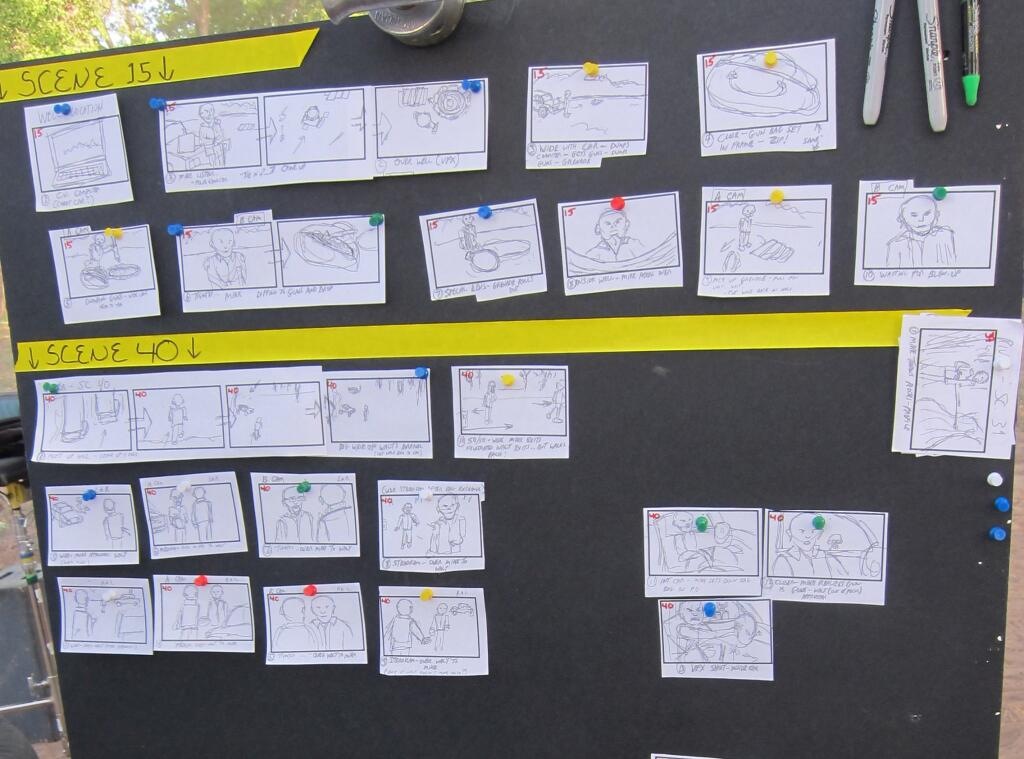
    I had everything storyboarded, I drew little sketches. And I think as time was going by, as lunchtime was approaching and I knew I had to switch sides based off that, I started dropping shots. But I knew I wanted the really wide wides, the great backgrounds and then, couple of mediums, and then went in for the tight stuff. His speech was covered almost all the way through, except for the really tight shots at the end when he says “You’re goddamn right”.

    It was a learning experience. It was my first time directing, so there was a bit of a, you know, learning curve. But I had a great AD, Nina Jack, an amazing DP, Michael Slovis, so they held my hand through the process. [laughs] Breaking Bad storyboards
    VH: Did you storyboard everything? The meth-cooking montage?

    TS: Of all the things you’d think would be the more storyboarded one, but it was actually kind of the loosest. I didn’t exactly know what the set was going to be. I had a rough idea and I went in there knowing I wanted this movement from left to right, as if we’re circling the cook area. So I knew the majority of the shots would be “Okay, they’re at this station, the camera is moving left or right in a straight line.” And then we had B-Camera just picking up all these little bits and pieces. I ended up using those little B-Camera bits and pieces a lot more than I thought I would, thanks to our, at the time Assistant Editor, Sharidan [Sotello], who later went on to become a full Editor on my episode, “Buried”; she co-edited it. She was really responsible for a lot of that montage looking the way it did.

    VH: Switching over to writing. What are your writing habits like? Are you someone who writes for a certain amount of time, or do you work towards a specific page count?

    TS: I am a night writer. For some reason, my brain doesn’t start functioning until later in the evening. [laughs] When I have to, I’ll write in the daytime. I just came off this show “Resurrection” where we did a lot of writing in the offices, so I would write in the daytime there, but I get a majority of the work done at night. I tend to put some music on, and usually around nine o’ clock at night, I feel this sort of momentum happening, and at some point I sort of get on a tare. If there’s a deadline, I’ll stay up until four in the morning, or more if I have to. Whatever the deadline is.

    I never say to myself “I’m gonna finish five pages tonight” or whatever. I’ll just keep going. And there are days where you get a page done. [laughs]

    I just wrote my outline for my first episode of “Better Call Saul”, and I’m not a big fan of writing outlines, so it took me a really long time to write this thing. Just because I’m in the room and we’re breaking and I wasn’t getting a lot done at night. So I mostly did my writing on the weekends. I need a long stretch of time that’s allotted to writing. It’s a momentum thing. Once I get rolling, I feel like I can do a bunch, but if I do it in starts and stops, it’s not very productive.

    VH: That’s kind of how I am, so I sympathize. Correct me if I’m wrong, but from Season 3 and onwards, all of the writers, except for Genny Huttchison, were producers, right?

    TS: That sounds correct, yeah.

    VH: How important do you think that was in delivering the uncompromised vision of every writer to the screen?

    TS: You know, Genny was as a producer as much as the rest of us. The producer title is a writers’ guild bump, pretty much. Once you’re around a certain amount of time, you get a producer’s title. From my first show on, when I was on “X-Files”, I didn’t have a producer’s title, but I don’t do very much different now than I did then.

    That was just the nature of Chris Carter’s and Vince and Frank Spotniz and John Shiban, their way of letting the writers be involved all through the process. It’s different on different shows, but I’ve always been lucky to work under their umbrella, where the writer comes in and they’re involved in casting and editing and every step of the way. For me, having that title is just an indication that you’ve been around a little longer.

    VH: Hopefully a little bit of a paycheck bump too.

    TS: Yeah. [laughs] But every writer, including Genny, produced their own shows. Genny was on set for her episodes, it was just because she was new, she didn’t have the title.

    VH: Being on set, was that a major influence on how you directed your episode? Obviously you worked with Michelle MacLaren a bunch of times.

    TS: Oh, yeah! I got to be in the shadow of a lot of really great directors, Michelle MacLaren being probably the most important person in my life as far as that’s concerned. And I got to be around Kim Manners on the “X-Files”, and Rob Bowman, he directed an episode of “Night Stalker” that I did. Yeah, I can’t say how important it was, watching them work. Especially Michelle MacLaren, on 307, 311, and 405. I met with her privately to get directing tips, so she was really important to me. If 507 is considered a success, I owe a lot to her.

    VH: About 307. Jesse has the whole “What happens now” speech. How much of that was broken in the room, and how much was you just writing the dialogue?

    TS: I remember specifically the stuff about wanting him [Hank] to put a gun up his mouth, that I can say for sure was me. And burn his house to the ground, because I remember I was kind of riffing on Clint Eastwood in “Unforgiven” when he says, you know, “I’ll kill your family, I’ll burn your house down.” I always had that in my head as a great threat to say to somebody. So, a lot of that stuff, I remember I specifically wrote.

    Having said that, the talk in 307, between Marie and Hank on the bed, when he’s talking about “I’m not the man I thought I was”, that particular line I wrote with the help of John Shiban. We talked and he kind of got me to that point. But a lot of the talk leading up to that final line, I remember Vince was pitching out what the scene was in his head, so a lot of that dialogue came from Vince. Dialogue wise, I can say is credited to me, but that section was a lot of me copying down what Vince was saying in the room.

    VH: You mentioned John Shiban and that just got me thinking; you wrote an episode with him, and I believe two with Moira Walley-Beckett. What was that process like? Did you just split it up, “I’ll take Act One and Act Two”, or was it more collaborative than that?

    TS: I think racing for time on a lot of those episodes, it was a lot of “Okay, you do Teaser, Act One, Act Two”. I think on 311 with John, I did Teaser, [Act] One and Two, and John did Three and Four. I know I got a little dialogue in Three and Four, Saul talking about convincing a woman he was Kevin Costner.

    On 409 and 412, Moira and I just divided up Acts. We ended up trading Acts and giving each other little notes, but not a lot.

    VH: I’m curious about the gunsalesman character in 307. How do you approach writing a character like that, a walk-on?

    TS: That was the very first thing I wrote for a Breaking Bad script. I went to that scene first cause I thought, this will just be goofy. I came up with all that nonsense about the woman who likes to be urinated on, but I was sure, I could have bet money that Vince was going to laugh at this and want to cut it or tone it down. And right from the beginning he loved it. Then we shot it, and I was like, “Okay, we’re going to cut this down”, then Vince in the editing room would laugh at it every single time. So, it was one of those things where I thought “Let me shoot for crazy, outrageous dumb stuff and see what happens”, and it stuck.

    Honestly, for me, it borders on being a little too unreal. It’s a little too cartoonish with the comedy, but it stuck.

    VH: Considering how dark that episode gets by the end, it was good to have that humor there.

    TS: We always try to get as much comedy into these scripts as possible. I just had lunch with a friend who told me that watching the show, he always got excited seeing Bob Odenkirk’s name in the beginning. Especially in the later seasons, everything was so dark, and he when he knew Bob Odenkirk was in it, he knew there would at least be a moment of lightness, some comedy, amidst all the horror.

    VH: I still love that whole “Star Trek” talk between Badger and Skinny Pete.

    TS: Boy, Vince was pitching that forever. As long as I can remember, he’s been talking about that as a “Star Trek” episode, and it finally made it into an episode.

    VH: Skipping towards the end, I know in the [Breaking Bad Insider] Podcasts, you guys talked about considering the “everyone BUT Walt dies” ending. So, what was it ultimately that made you decide that wasn’t the right direction to go?

    TS: That’s one of those things, I don’t know if we could ever define why we made the decision we made, except that it felt right. That’s as much as I can really say about it. You kind of get a feeling that this story has to come to an end with him and his death. It started with him getting cancer, his death sentence, and once you have a character who has a death sentence, there’s no turning back. He’s going to die, either from cancer or because of his activities. You sort of have to reach that conclusion.

    I mean, could it have worked if we had killed everybody else off? Yeah, but it would have been a different feeling we’d leave the audience with. I think we were all pretty much in agreement in the room. I don’t remember anybody clamoring to go that other direction. We definitely talked about it, but I think we were just exploring every option.

    ——————————————————————————-

    That’s it for now, folks. Come back next week for the second half of our interview with Tom Schnauz, where he gives a spectacular answer to the old “what advice would you give” question, and tells us what we can expect to see from “Better Call Saul”!

  • Nursing the Bruised Ego — Why Tough Feedback is the Best Feedback

    Image: CC-BY Writer’s Block I by Drew Coffman @ Flickr flic.kr/p/8kvbSL
    Image: CC-BY Writer’s Block I by Drew Coffman @ Flickr flic.kr/p/8kvbSL

    It takes a lot to be a successful writer. For starters, it takes persistence and hard work. It takes imagination. Passion. Love for what you’re doing. But it also takes a whooole lot of objectivity.

    I don’t care if you’re Quentin Tarantino or Ernest Hemingway—if you’re not objective about your own work, you will never reach your full potential. Still, easier said than done. Objectivity can be a tough thing to grasp as a writer. So what do we do? We turn to feedback.

    Feedback is one of the most important tools in a writer’s arsenal, and good feedback (along with a writer smart enough to incorporate it) can be the difference between a mediocre first draft and a spectacular final draft. But brutally honest feedback (which is of course, the best feedback), can be a tough pill to swallow.

    I’m sure the majority of writers reading this know exactly what I’m talking about. You’ve finished that first draft. You’re in love with the kick-ass protagonist, the thrilling plot, and the pitch perfect comic relief. You send it out to some peers for review, and wait for your gold star and firm pat on the back. Then… the feedback arrives.

    Turns out that kick-ass protagonist is a wimp. That thrilling plot is a boredom factory. And as for that pitch perfect comic relief? About as funny as a funeral. At this point, most of us go through one of two phases.

    A: We fall into a deep depression, convinced we are hacks who aren’t worthy of writing Twilight fan fiction.
    B: We reach the logical conclusion that the reviewers are the real hacks; a bunch of amateurs who clearly can’t grasp our brilliance.

    Sometimes, if the work is really important to us or we’re particularly proud of it, we’ll go through both. But as with any grief, eventually there must come acceptance. Okay, so maybe we haven’t written our masterpiece, but that doesn’t mean we might not further on down the road. And that road is paved by rewriting.

    We toughen up. We go through the feedback again, side by side with our story, and we assess every note with absolute honesty. Yes. Maybe that witty dialogue we thought was the funniest part of the story really does nothing but bring it to a complete halt. Maybe that plot convenience we thought was perfectly legitimate does make life far too easy for the protagonist. Maybe the entire second half of the story is boring and doesn’t make a lick of sense. Whatever the case, we keep working.

    Having said all this, I do think it’s important to remember that not all feedback is valid. Sometimes a reader really won’t get your story, even if it’s an awesome one. In that situation it can be wise to discard some (though perhaps not all) of their feedback. However, if the number of people who aren’t getting your story keeps pilling on high, then maybe they aren’t the problem.

    Avoiding bad feedback becomes much easier if we seek out the opinions of people we respect. Whether they are fellow writers, teachers, or just friends who have good taste, people who have similar storytelling sensibilities to ours and who aren’t afraid to bruise our egos are invaluable resources. We owe them a great debt. Without them, our stories might never reach their full potential. Though perhaps we shouldn’t let them know, or they might start charging.

    When we’re watching a movie, especially one by a creative team whose work we aren’t familiar with, we have no problem being objective. If it’s garbage, we will say it’s garbage without so much as a whimper. If it’s amazing, we will praise its name from the rooftops of the tallest skyscrapers. To be an accomplished writer, we have to treat our own work with that same kind of objectivity. We have to take pride in our work, but we also have to be the first to point out when it’s not up to snuff. It’s as simple as that.

    PS: You’ll probably notice the similarity between this and the post on rewriting. We might be exploring familiar ground, but that’s only because this ground is so important. I’m a big believer in the theory of “first draft, worst draft”, and that if you want to really bring your work to the next level, you’ve got to be willing to keep rewriting and keep rewriting.

    So if you haven’t checked out the post on rewriting—which you can do so here—and you found this one useful, give it a look through, as these topics go very much hand in hand.

  • Rewriting: If You’re Going Through Hell, Keep Going

    Rewriting is a sobering experience. All too quickly that story you’ve been convinced is better than anything Hollywood’s churned out in the last twelve years isn’t so great anymore. Suddenly the holes seem a lot more apparent. The little sections you knew needed to be rethought grow much larger. You realize you’ve got a lot of work left to do. You realize it’s time to rewrite.

    To be clear, I’m not talking about revising here. Revising is fun. When you get to that stage, you already know that the story works. The structure is tight, the character arcs solid. Revising is tightening things up, getting them to be the best they can be. That last bit of polish before your baby is ready to be seen by the world.

    Unlike revising, rewriting is scary because there’s always that fear—as small and as in the back of your mind as it may be—that the story might completely collapse. I’m currently in the rewriting process, so I thought this would be a good opportunity to share a few of the things that help me when the going gets tough.

    As it often does.

    Treat your writing like it’s your worst enemy’s.

    This is basically another way of saying “be honest”. If you read my post on the writing of Breaking Bad, you’ll recognize that we’re treading familiar ground here. Take a step back. If you can stomach it, a week or two away from your story is often extremely helpful. It helps clear the mind, obviously, and if you like bouncing back from projects, I recommend starting to work on something else.

    Then, when you’re ready, come back to your story and prepare to be brutal. When I say treat it like it’s your worst enemy’s I mean go into it expecting to hate it. Call yourself out on everything. The small stuff, like dialogue that’s too on the nose or blatant exposition. And the big stuff, like a protagonist that’s rarely proactive, or a weak (and often criminally short) third act.

    This is the stuff that’ll make or break your film, so be honest about whether or not it works.

    Find people you respect and ask them to critique your work.

    I can’t stress this enough. As honest as we can be about our own writing, ultimately, we are way too close to it. Our stories live and breathe in our heads, and they’re much more expansive than what an audience will ever see. Often we might take elements in them for granted and leave out important information, or worse, not realize what our movie is really about.

    To avoid this, it’s vital for any serious writer to find someone they can count on to provide honest feedback. Preferably, multiple people with different qualifications. A fellow writer who understands the art of structure and pacing can be an invaluable resource; but an average-Joe who doesn’t know anything about movies other than that they like them will often catch things a pro might miss.

    If you can, get both perspectives. I’d say in general, avoid best friends or family members unless you know they’re not going to pull any punches. Also, if your critic is a writer, it’s only natural that you offer to give them feedback on their work as well—plus, this will most certainly benefit your own writing as well.

    Know that it takes time, but it will be worth it when it’s done.

    This might be the most important bit. Rewriting can be a long and painful process. First off, if you’ve even finished that first draft, give yourself a well deserved pat on the back. You’ve gotten farther than a lot of aspiring writers ever do.

    Just know that it’s not over.

    You’ll have to throw away some of your favorite scenes and replace them with brand new ones. You’ll probably delete entire characters you thought were vital to the plot. And almost every small change you make will ripple through the story in some way (or at least it should), and you’ll have to play clean up and make sure everything gels together. It’s a lot of work. But when you’ve got a second draft sitting in front of you, I guarantee you’ll very plainly see the difference in quality from the first. All the hard work will finally seem worth it. Then, it’s time to go through the process again.

    When it gets hard, remind yourself that most movies go through four, five, or even more drafts. A story that always inspires me comes from Rian Johnson, writer/director of the film Looper. While working on the script, Johnson came upon the realization that the second half wasn’t working. So he threw it out, and wrote an entirely new one.

    That’s the kind of honesty and (this one’s important, folks) willingness to do the work it takes to be a professional writer.

    Finally, to end on an amusing anecdote. For the life of me, I can’t remember where I came across it, so apologies to whoever thought it up. It puts a smile on my face and fills me with just that bit of inspiration required to keep going. Hope it hits you likewise.

    In the first draft, the characters are strangers. In the second draft, they are friends. In the third draft, they are family.